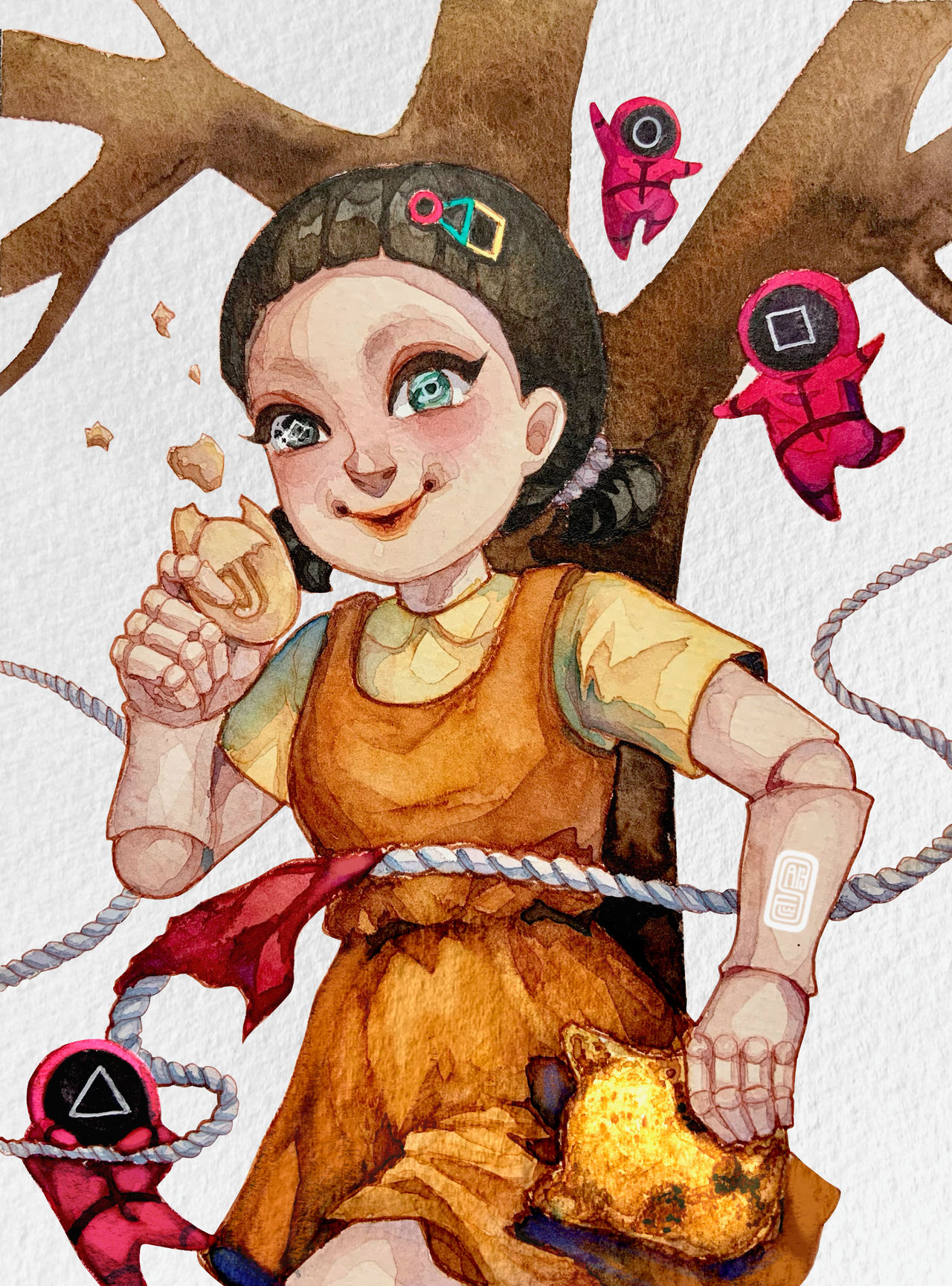
You know that feeling when a childhood memory gets completely twisted? That’s basically what happened to an entire generation of Koreans when Squid Game dropped on Netflix. The giant, pigtail-wearing robot that guns people down during a game of Red Light, Green Light isn't just a random prop dreamed up in a writer's room. She has a name. It's Young-hee.
If you grew up in South Korea during the 70s or 80s, Young-hee was everywhere. She was the friendly face on the cover of primary school textbooks. She was the "Jane" to a boy named Cheol-su’s "Dick" or "Tom." Seeing her turn into a motion-sensing killing machine was a specific kind of trauma for the audience.
It worked.
The doll became the face of the show's global explosion. Within weeks of the 2021 premiere, she was popping up as a 10-foot replica in shopping malls from Manila to Sydney. But there is a lot of weird, factual history behind this "character" that most casual viewers missed while they were busy watching people get eliminated.
Where the Squid Game Doll Actually Came From
Hwang Dong-hyuk, the creator of the show, didn't want a generic monster. He wanted something that felt like a corrupted piece of childhood innocence. When he was developing the script—which, let's remember, sat in a drawer for over a decade because it was "too unrealistic"—he looked back at the illustrations from his own school days.
The specific look of the Squid Game doll is based on the characters illustrated by Kim Tae-hyung. These characters, Young-hee and Cheol-su, were the gold standard for Korean educational materials for decades. They represented the "ideal" Korean child: neat, obedient, and simple.
The Museum Piece
Here is a detail that sounds like an urban legend but is actually true: the doll used in the filming wasn't destroyed. After production wrapped on Season 1, the production team returned the prop to a carriage museum called Macha Land in Jincheon County, North Chungcheong Province. It’s a few hours south of Seoul.
If you visited shortly after the show aired, you would have seen her standing by the entrance. Kinda eerie, right? However, there was a bit of a blunder. The museum put her on display without one of her hands. It had reportedly gone missing during transport or storage. Eventually, the museum wrapped her up in plastic and moved her into storage because the sudden influx of "Squid Game" tourists was a bit much for the quiet rural location.
That Haunting Song Explained
Everyone knows the tune. It's catchy. It’s also a death sentence. In English, we call the game Red Light, Green Light. In Korea, it’s Mugunghwa kkochi pieotseumnida.
The translation isn't "Red light, green light." It actually means: "The Hibiscus syriacus has blossomed."
The Mugunghwa is the national flower of South Korea. It’s a symbol of resilience. It’s on the national emblem. It’s everywhere. The song itself is rhythmic and slow, but the doll in the show speeds it up randomly to trip people up. In the actual children's game, the person who is "it" (the seeker) stands against a tree or wall and says the phrase as fast or slow as they want. If you’re caught moving when they turn around, you’re out. Usually, that just means you have to hold the seeker's pinky finger. In the show, "out" means a sniper bullet.
The contrast is the point. Using a national symbol of beauty and perseverance to trigger a massacre is some high-level dark irony.
Technical Specs of a Nightmare
The actual prop was massive. We're talking about a ten-foot-tall structure. While some of the movements in the show were enhanced with CGI, the physical doll was a real, rotating mechanical build.
- The Eyes: The production team specifically focused on the eyes. They needed to look soulless but high-tech. In the show’s lore, those eyes are equipped with motion-tracking sensors. In reality, it was a mix of practical camera work and post-production effects to give that scanning "grid" look.
- The Head Turn: The 180-degree snap of the neck was designed to mimic a broken toy. It’s meant to be jarring.
- The Voice: The voice isn't a computer-generated synth. It’s a processed recording of a child’s voice, pitched to sound slightly "off" and metallic.
Why Young-hee Became a Global Icon
It’s about the "Uncanny Valley." That’s the psychological state where something looks almost human but not quite right, causing a feeling of revulsion. The Squid Game doll sits right in the middle of that.
She wears a bright orange dress and a yellow shirt. Her hair is in perfect pigtails with purple bows. She looks like she should be selling cookies or teaching you the alphabet. That visual dissonance is why she’s more terrifying than a xenomorph or a slasher villain. You don't expect a schoolgirl to be a cold-blooded executioner.
Netflix leaned hard into this for marketing. They set up a functional version of the doll at a crosswalk in the Philippines. If you tried to cross the street when the light was red, the doll would turn its head and its eyes would glow red. It was a brilliant, if slightly heart-attack-inducing, way to bring the show into the real world.
The Mystery of the Second Doll
With Season 2 finally arriving, the mythos of the doll is expanding. Hwang Dong-hyuk has already teased the introduction of "Cheol-su."
If Young-hee was the female archetype of the Korean textbooks, Cheol-su was her male counterpart. Usually, he’s depicted with short, neat hair and a similar school uniform. The creator hinted that we’d be "introduced to Young-hee's boyfriend, Cheol-su."
Whether this means a second giant robot or just another corrupted childhood game remains to be seen, but the pattern is clear. The show is mining the collective childhood of South Korea to create a universal language of fear.
The Impact on Pop Culture and Gaming
You can't talk about this doll without talking about the "Squid Game" effect on the internet. Within days of the release, Roblox was flooded with thousands of user-generated Red Light, Green Light games. Every single one featured a blocky, low-res version of the doll.
It became a meme. It became a TikTok sound. It even showed up in parodies on Saturday Night Live.
But for the actors on set, it wasn't a meme. Jung Ho-yeon (who played Sae-byeok) mentioned in interviews that being in the presence of the doll was genuinely intimidating. Even when it wasn't "on," the sheer scale of the prop made the stakes feel heavy. The players weren't just acting against a green screen; they were standing in a dirt field looking up at a three-meter-tall judge and jury.
Real-World Lessons from the Doll’s Design
If you’re a creator or a marketer, there’s a lot to learn from why this worked. It wasn't just luck.
- Contextual Perversion: Take something safe and make it dangerous. Horror movies have done this with clowns and dolls for years (Chucky, Annabelle), but Squid Game did it with a specific cultural icon of education.
- Color Theory: Notice the colors. The doll is bright. The guards are pink/red. The players are teal. The environment is a bright, sunny playground. The violence happens in broad daylight. This subverts the "dark and gritty" trope of most death-game movies like Saw.
- Auditory Triggers: The song is a "brain worm." It’s repetitive and simple. It stays in your head long after the episode ends.
Final Insights for the Squid Game Fan
If you're looking to dive deeper into the lore or even visit the real-world locations, keep a few things in mind. The "real" doll from the filming is technically private property and often tucked away in storage at Macha Land, so don't expect a grand monument if you make the trip to Jincheon. Most of the "dolls" you see in public now are replicas made for promotion.
Also, if you're watching the show for the first time or re-watching before the new season, pay attention to the doll's movements in the background of other scenes. There’s a lot of foreshadowing in the murals on the walls of the players' dormitory. The doll isn't just a robot; she's a symbol of a system that watches everything and waits for the slightest stumble.
To understand the Squid Game doll is to understand the show's core message: the transition from the playfulness of childhood to the brutal, rule-bound reality of adulthood is often sudden and unforgiving.
Next Steps for Fans:
- Watch the Season 2 Teasers: Look specifically for the "Cheol-su" references to see how the design language has evolved.
- Check the National Museum of Korean Contemporary History: They occasionally have exhibits on the 1970s "Cheol-su and Young-hee" textbook illustrations if you want to see the original, non-murdery inspiration.
- Listen to the Original Folk Song: Find a recording of a Korean child singing Mugunghwa kkochi pieotseumnida without the electronic distortion. It’s surprisingly peaceful, which makes the show’s version even more effective.