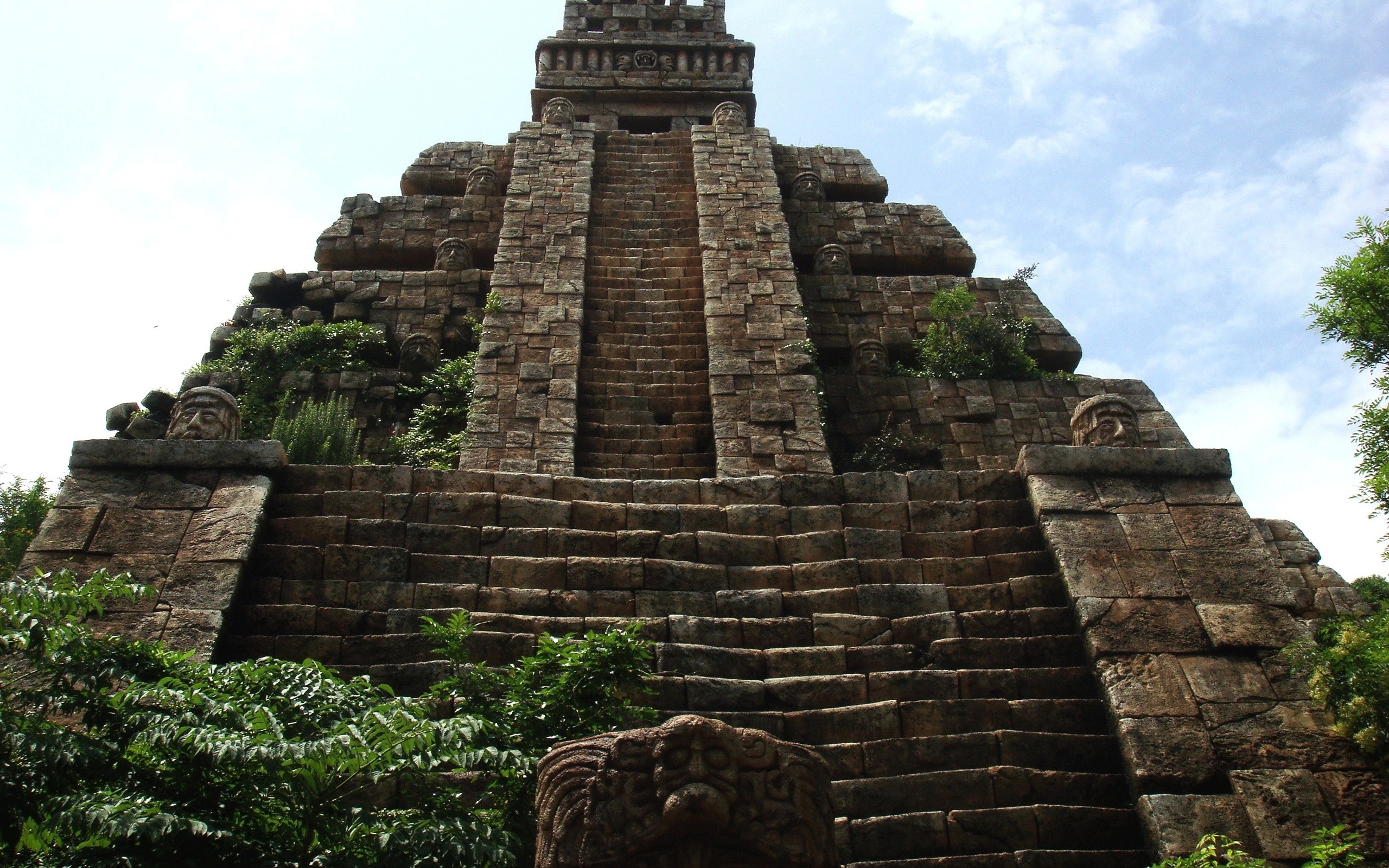
Imagine standing in the middle of a global megacity, surrounded by the roar of traffic and the smell of street tacos, only to realize you are standing on top of a literal mountain of blood and gold. That’s the reality of the Templo Mayor, the primary Aztec temple in Mexico City. It sits right in the Zócalo, the city's main square.
Most people walk right past it. They see the colonial cathedral—which is admittedly massive—and they don't realize that the stones used to build that church were literally ripped off the pyramid next door. It’s a bit surreal. You’ve got this 14th-century sacred site essentially bleeding into a 21st-century metropolis.
The Aztec Temple Mexico City Forgot—Then Found Again
For centuries, nobody actually knew where the Templo Mayor was. I mean, people had a general idea, but the Spanish did such a thorough job of leveling Tenochtitlan that the exact footprint was lost to history.
It wasn't until 1978 that electric company workers were digging a trench and hit a massive stone disk. This wasn't just any rock. It was a 20-ton carving of Coyolxauhqui, the moon goddess. She was depicted as dismembered, which, in Aztec mythology, is a pretty specific and gruesome story involving her brother Huitzilopochtli. That discovery changed everything. It forced the government to actually tear down colonial buildings to see what else was underneath.
What they found was a "Matryoshka doll" of architecture. The Aztecs didn't just build one temple; they built seven of them, each one encased inside the next. Every time a new ruler took over or they wanted to celebrate a 52-year calendar cycle, they’d just build a bigger pyramid over the old one. It’s why when you visit the site today, it looks like a jagged, messy heap of stone walls and staircases. You're looking at layers of time stacked on top of each other.
The Two Gods of the Great Temple
If you look at the top of the ruins, you’ll notice two distinct sets of stairs. This is crucial for understanding how the Aztecs saw the world. They weren't just about war.
On one side, you had the shrine to Huitzilopochtli. He was the god of war and the sun. This is where the heavy-duty sacrificial stuff happened. On the other side was Tlaloc, the god of rain and agriculture. To the Aztecs, life was a balance between these two forces: the fire of war and the water of the harvest. If you didn't keep both happy, the world ended. Simple as that.
Why This Site is Different From Teotihuacan
A lot of tourists get confused. They go to the massive pyramids of Teotihuacan—about an hour outside the city—and assume that's the "Aztec temple."
It's not.
Teotihuacan was already an ancient, abandoned ruin by the time the Aztecs showed up. They basically found it and thought, "Wow, gods must have built this," and then moved on to build their own capital, Tenochtitlan, in the middle of a lake. The Aztec temple in Mexico City is the "real" Aztec heart. It’s more intimate, more violent in its history, and frankly, more impressive when you consider it was built on swampy island ground using sophisticated piling systems.
The engineering is honestly wild. Because the ground was so soft, the temples started sinking almost immediately. You can still see the tilt in some of the stone floors today. They used cedar stakes driven into the mud to create a foundation. It’s the same problem the modern city has today—Mexico City is literally sinking several inches a year, and the Templo Mayor is the original victim of that geography.
The Tzompantli: A Wall of Skulls
If you have a weak stomach, the recent discoveries might be a bit much. In 2015, archaeologists from the National Institute of Anthropology and History (INAH) found the Huey Tzompantli.
It’s a massive rack of human skulls.
But it wasn't just a pile of bones. These skulls were mortared together with lime to form a tower. For a long time, historians thought the Spanish were exaggerating the scale of Aztec sacrifice to make themselves look like the "civilized" saviors. The discovery of the Tzompantli proved the Spanish were actually telling the truth about the scale. We’re talking thousands of individuals.
What’s interesting, though, is that it wasn't just male warriors. Analysis of the teeth and DNA showed women and children were part of this structure too. It changes the narrative from "war trophies" to something much more complex and, honestly, more chilling. It was a cosmic necessity for them. They believed the sun literally wouldn't rise if they didn't provide "precious water"—their word for blood.
The Offerings Under the Floorboards
Beyond the gore, the Templo Mayor is a treasure chest. Because Tenochtitlan was the hub of a massive empire, the Aztecs collected "tribute" from all over Mesoamerica.
Archaeologists like Leonardo López Luján have spent decades uncovering "offering boxes" tucked away in the stone fill. Inside, they find stuff that shouldn't be in Mexico City. Sea shells from the Gulf, jade from Guatemala, turquoise from the American Southwest, and even the remains of wolves and jaguars.
One of the coolest things ever found was a sacrificial wolf dressed in gold ornaments. It was buried facing west, representing the sun's journey into the underworld. These aren't just random piles of junk; they are carefully curated maps of the Aztec universe.
Visiting the Templo Mayor Today: What You Need to Know
If you're going to visit, don't just look at the rocks from the street. You have to go inside the museum. It’s one of the best-designed museums in the world, honestly.
It’s organized by the two gods. One side of the museum is all about war, sacrifice, and tribute (Huitzilopochtli). The other side is about shells, water, fertility, and life (Tlaloc).
- Location: Just northeast of the Zócalo (Main Square).
- The Best Time: Go early, around 9:00 AM. The sun hits the stone carvings just right, and the heat hasn't bounced off the concrete yet.
- The "Secret" View: If you don't want to pay the entry fee just to see the scale, go to the rooftop restaurant at the Librería Porrúa nearby. You can look down into the excavation pits while eating a mole poblano. It’s the best perspective on how the temple relates to the colonial city.
Myths and Misconceptions
People think the temple was just a pyramid. It wasn't. It was a sacred precinct. There were schools (Calmecac), smaller temples for other gods, and even a court for the ritual ball game, ullamaliztli.
Another big myth? That the Aztecs were "primitive." You don't build a city of 200,000 people on a lake with an artificial island temple system if you're primitive. They had a more advanced waste management system than London or Paris did at the same time. The Aztec temple in Mexico City was the spiritual grounding for a society that was remarkably organized.
Practical Steps for Your Trip
To really "get" the Templo Mayor, you have to do more than just stare at the ruins.
Start at the National Museum of Anthropology in Chapultepec Park first. See the "Sun Stone" (the Aztec Calendar) there. Then, take the metro to the Zócalo station. When you walk out of the station and see the cathedral, turn your back to it. Walk toward the ruins.
Look at the ground. You’ll see glass floor panels in the sidewalk. Those aren't for decoration. They are windows into the original Aztec street level.
Once you are in the Templo Mayor site, look for the "House of the Eagles." It’s a partially covered area where you can still see the original red and white paint on the benches. It feels like the priests just stepped out for a second. That's the closest you'll get to feeling the "living" history of the site.
The excavation is still happening. Only about 10% to 20% of the original precinct has been uncovered. Most of it is still trapped under the colonial buildings and the cathedral. Every time a new sewer line is put in or a basement is renovated in the Centro Histórico, there’s a chance they’ll find another god or another tower of skulls. It’s a living, breathing archaeological site, not a dead monument.
Key takeaway for your visit: Look for the stone serpents at the base of the stairs. They are still there, guarding the ascent. Even after 500 years of being buried, they look like they’re ready to strike. It’s a reminder that while the empire fell, the culture never really left Mexico City.
Essential Gear for the Site
Wear comfortable shoes. The walkways are metal grates and uneven stones. Also, wear a hat. There is zero shade while you are walking through the actual ruins.
If you want to understand the deeper context, look for Eduardo Matos Moctezuma’s books. He’s the guy who led the original 1978 excavation. His writing is academic but accessible, and it explains why they chose to leave certain parts of the colonial city standing while tearing others down to reach the Aztec layers.
The site is closed on Mondays. Don't be that person who shows up and stares through the fence. Tuesday through Sunday is your window. Admission is usually around 90-100 pesos, which is a steal for what you're seeing.
Final thought: When you stand at the edge of the pit looking at the layers of the temple, remember that the ground you are on was once a network of canals. The Aztecs didn't just build a temple; they built a world. And it’s still right there, just a few feet under your boots.
Next Steps:
- Check the official INAH website for current entry fees and special exhibition schedules.
- Download an offline map of the Centro Histórico as GPS can be spotty between the tall colonial buildings.
- Book a licensed guide at the entrance if you want the deep-cut stories about the specific sacrificial stones that aren't clearly labeled.