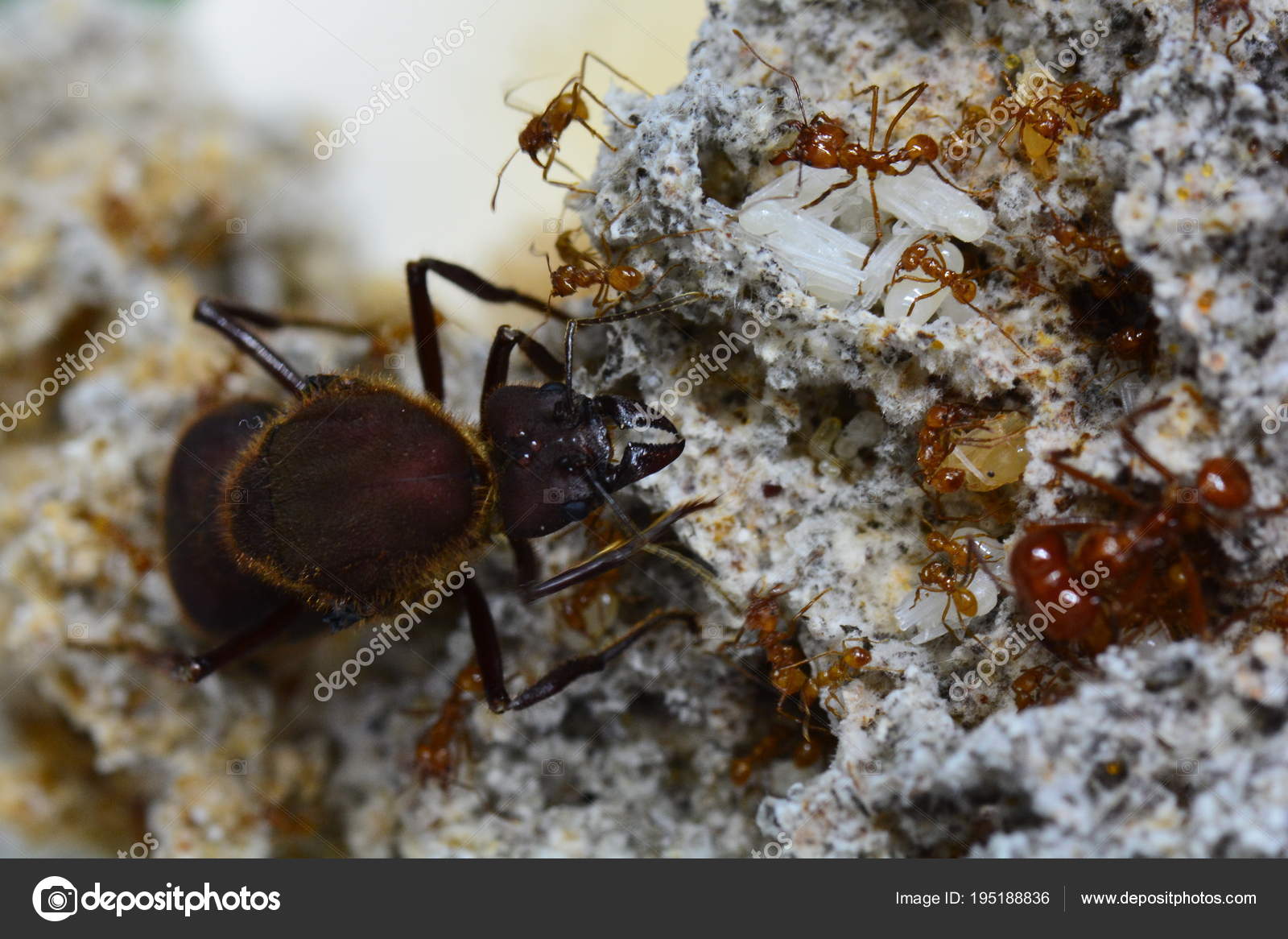
She is basically a biological tank. If you’ve ever seen a queen leaf cutter ant (specifically from the Atta or Acromyrmex genera), you know they don't look like your average kitchen pest. They are massive. Think the size of a small grape, but armor-plated and driven by a singular, obsessive purpose that borders on sci-fi.
Most people look at a line of ants carrying bits of leaves and think, "Oh, they're eating the greenery."
Nope.
They can't digest leaves. Not at all. Instead, the queen is the founder of a complex underground pharmacy and brewery that survives on a very specific type of fungus (Leucoagaricus gongylophorus). She is the literal Mother of Agriculture. Honestly, she was farming millions of years before humans even figured out how to sharpen a stick.
The Suicide Mission of the Nuptial Flight
Life starts with a chaotic, high-stakes event called the "nuptial flight." On a humid day, usually after a heavy rain, thousands of virgin queens and winged males take to the sky. It is a buffet for birds. Most of them die. It's brutal.
The survivors? They mate with multiple males—sometimes up to ten or twenty—to gather a lifetime supply of sperm. She will never mate again. She stores those hundreds of millions of sperm cells in a specialized organ called a spermatheca. She’ll use them to fertilize eggs for the next 15 to 20 years.
Once she hits the ground, she does something radical: she rips her own wings off. She doesn't need them anymore. She digs a hole, crawls inside, and seals herself in a dark, lonely chamber. She is now a prisoner by choice.
The Secret Stash in Her Throat
Before she left her mother's nest, she did something incredibly cool. She tucked a tiny "starter culture" of the colony’s fungus into a small pouch in her mouth called the infrabuccal pocket. This is her dowry.
Without this fungus, she is dead.
While she’s alone in that first chamber, she doesn't eat. Her body literally digests her own wing muscles to provide energy. She feeds the growing fungus garden with her own fecal droplets. It sounds gross, but it's the most efficient recycling system in nature. She lays a few eggs. She waits. If the fungus dies, she dies. If the first generation of workers doesn't hatch in time to take over the gardening, she dies. The stakes are basically "everything or nothing."
Managing the Underground Megacity
Once the first workers (minims) hatch, the queen leaf cutter ant shifts her role. She stops being a gardener and becomes a full-time egg-laying machine. In a mature Atta texana or Atta cephalotes colony, she might produce 150 to 200 million offspring over her lifetime.
The nest she presides over isn't just a hole. It's a subterranean city. We are talking about mounds that can span 600 square feet and go 20 feet deep into the earth. These colonies have sophisticated ventilation shafts to manage CO2 levels and temperature. They have "refuse chambers" (basically trash heaps) where they dump dead ants and spent fungus to prevent disease.
Why the Fungus Matters
The relationship between the queen and her fungus is what scientists call "obligate mutualism." The fungus can't live without the ants cleaning it and feeding it leaves. The ants can't live without the fungus because it's their only food source.
The queen is the genetic anchor for this entire system.
If you look at the research by experts like Ted Schultz at the Smithsonian, you realize this isn't just "bugs in dirt." This is a highly evolved symbiosis that has remained stable for roughly 50 to 60 million years. Humans have only been farming for about 12,000 years. We are the amateurs here.
The Chemistry of a Queen
She isn't just "the boss" because she's big. She controls the colony through a complex cocktail of pheromones. These chemical signals tell the workers when to forage, when to defend the nest, and—crucially—when to start raising new queens.
Normally, the queen suppresses the "royalty" genes in her larvae. As long as she is healthy and producing her signature scent, the workers only raise more workers. But when she gets old or the colony gets too big, that chemical grip slips. That's when the colony starts producing new "alates" (winged royals) to repeat the cycle.
Dealing with the "Escovopsis" Threat
The biggest threat to a queen leaf cutter ant isn't a predator; it's a parasite. A specialized mold called Escovopsis can wipe out the fungus garden in days.
To fight this, the queen and her workers carry a specific type of bacteria on their bodies (specifically Pseudonocardia and Streptomyces). These bacteria produce antibiotics. Yes, the ants were using "penicillin" millions of years before Alexander Fleming. They literally grow medicine on their chests to keep their farm clean.
Myths People Believe About the Queen
One big misconception is that the queen "rules" the colony like a human monarch. She doesn't. She's more like a central heartbeat. If she dies, the colony doesn't immediately vanish, but it is doomed. No one is left to lay fertilized eggs. The workers will keep working, the fungus will keep growing for a while, but eventually, the population thins out and the garden dies.
Another weird myth? That you can just "dig up" a queen.
Good luck. In a mature nest, she is buried deep in a specialized "royal chamber" that is protected by thousands of soldier ants with mandibles sharp enough to slice through human skin. These soldiers are the heavy infantry, and they will literally die in piles to keep you away from her.
How to Actually Spot One
If you are in Central or South America (or parts of the southern US like Texas or Louisiana), you can find them. Look for the "highways."
Leaf cutters create cleared paths through the jungle that look like miniature bike trails. If you follow those trails back to the mound, you're looking at the top of her empire. You won't see her, though. She stays in the dark.
The only time you’ll see a queen leaf cutter ant out in the open is during that nuptial flight. If you see a massive, winged ant that looks like it belongs in a Godzilla movie, that’s her. She’s looking for a place to start her 20-year reign.
Actionable Steps for Enthusiasts
If you're fascinated by these insects and want to learn more or observe them safely, here is what you actually do:
- Visit a Live Exhibit: Places like the American Museum of Natural History or the Cincinnati Zoo have world-class leaf cutter colonies with glass viewing panes. Seeing the fungus garden in person is the only way to grasp the scale.
- Study the Myrmecology Basics: Read The Ants by Bert Hölldobler and E.O. Wilson. It’s the "bible" of ant science and covers the Atta genus in incredible detail.
- Check iNaturalist: Use the iNaturalist app to find local sightings of Atta or Acromyrmex in your area. This is the best way to track when nuptial flights are happening near you.
- Look for "Refuse Piles": If you find a nest in the wild, look for the areas where they dump their waste. It's usually a distinct pile of brownish-grey material near the edge of the mound. It’s a great way to see what the "spent" fungus looks like without disturbing the colony.
- Avoid Chemical Pesticides: If they are in your yard, realize they are major soil aerators. If you must manage them, use physical barriers or baits designed specifically for leaf cutters; general ant bait usually doesn't work because they don't eat sugar or protein—they only eat their fungus.
The queen leaf cutter ant is a master of endurance. She turns leaves into mushrooms and dirt into a fortress. Respect the hustle.