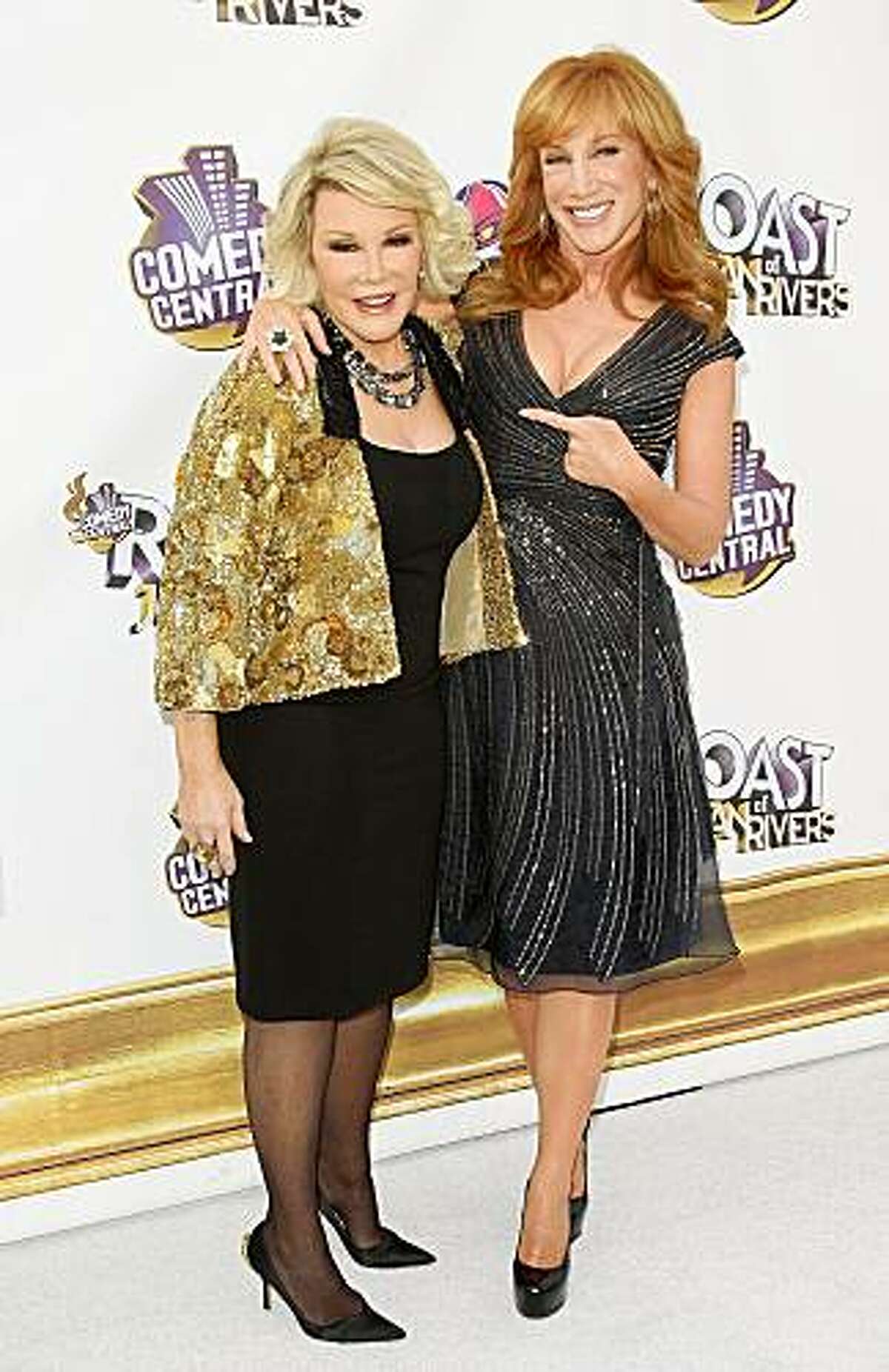
Comedy is different now. It’s safer, maybe a bit more polite, or at least more terrified of a PR nightmare. But back in 2009, when the Roast of Joan Rivers aired on Comedy Central, the rules of engagement were basically nonexistent. Joan wanted it that way. She didn't just walk into the line of fire; she built the bonfire herself and handed out the matches. Honestly, if you watch it today, some of those jokes feel like they’d result in immediate de-platforming, yet it remains arguably the most "honest" hour of television the network ever produced.
It wasn't just about the mean-spirited jabs. It was about survival. Joan had been through the wringer—the Johnny Carson ban, her husband Edgar’s suicide, the professional exile—and she used that dais to prove she was still the toughest person in the room.
The Night the Gloves Came Off
The lineup was a weird, chaotic mix of legendary icons and "who is that?" comedians. You had Kathy Griffin acting as the Roastmaster, which was a stroke of genius given their complicated, mentor-protege dynamic. Then you had the heavy hitters: Jeffrey Ross, Greg Giraldo (rest in peace), and Gilbert Gottfried. They weren't there to be nice. They were there to dismantle a woman who had spent five decades dismantling everyone else.
Giraldo, in particular, was on another level that night. He had this way of being incredibly smart and incredibly cruel at the same time. He looked at Joan—who was 76 at the time—and treated her like a peer, not a fragile grandmother. That’s what people often get wrong about roasts. The meanest jokes are actually a form of deep respect. If you pull your punches, you’re saying the person can’t handle it. Nobody pulled a single punch with Joan.
That Infamous Plastic Surgery Theme
If you took a shot every time someone made a joke about Joan’s face looking like a "melted candle" or "tupperware left on a stove," you wouldn't have made it to the first commercial break. It’s the easy joke, sure. But the way Joan leaned into it was the real story. She was the one who pioneered the idea of beating the critics to the punch.
"I’ve had so much plastic surgery," she used to say, "that when I die, they’re going to donate my body to Tupperware."
By the time Whitney Cummings or Brad Garrett got a crack at her, the material was almost meta. They were roasting a woman for the very thing she had already roasted herself for. It was a hall of mirrors. You’ve got to wonder if modern audiences would even find it funny or if they’d just find it sad. At the time? It was electric. It felt like watching a masterclass in thick skin.
Why This Specific Roast Changed the Format
Before Joan, roasts were often a bit... dusty. Think of the old Dean Martin roasts where everyone was half-drunk and the jokes were mostly about how much people drank. The Roast of Joan Rivers helped usher in the era of the "vicious roast." This was the transition point where the jokes stopped being "teasing" and started being "incinerating."
The sheer density of the comedy was staggering.
- Greg Giraldo compared her to a "white Walker" before Game of Thrones was even a thing.
- Jeffrey Ross showed up in a tuxedo that looked like it had been through a war zone.
- Mario Cantone was basically a vibrating nerve of high-pitched insults.
The pace was relentless. There was no "it's important to note" moment of sincerity until the very, very end. It was just an hour of pure, unadulterated vitriol, and Joan sat there cackling at every single line. She was the best "laugher" in roast history. She didn't do that fake, polite smile. She threw her head back and screamed with joy when someone called her an old hag.
The Edgar Jokes and the "Too Soon" Factor
The most controversial part of the night involved jokes about her late husband, Edgar Rosenberg. For most people, that’s a "no-go" zone. It’s dark. It’s painful. But Joan had told the writers beforehand that nothing was off-limits. Nothing.
When a comedian makes a joke about a tragedy in your life, they are acknowledging that you survived it. It’s a weird kind of therapy. By laughing at the darkest parts of her history, Joan was taking the power back from those events. She was saying, "You can't hurt me with this, because I've already turned it into a punchline."
The Art of the Rebuttal
The best part of any roast is the end, when the guest of honor gets to stand up and destroy everyone who just spent an hour mocking them. Joan didn't just do a rebuttal; she did a scorched-earth campaign. She went after Kathy Griffin's career, Jeffrey Ross's looks, and the very concept of aging.
She proved, at 76, that she was faster than people half her age. Her timing was impeccable. She knew exactly when to pause for the laugh and when to step on the next joke to keep the momentum going. It was a reminder that while her face might have been "reconstructed," her brain was still the sharpest tool in the shed.
Honestly, it’s hard to find that kind of courage in entertainment today. Everyone is so worried about how a joke will look when it's clipped out of context on TikTok. Joan didn't care about context. She cared about the laugh.
Lessons from the Queen of Mean
If you’re a creator, a comedian, or just someone trying to navigate a world where everyone seems to be offended by everything, there are some genuine takeaways from the way Joan handled her roast.
Own your flaws before someone else can use them against you. Joan’s entire career was built on self-deprecation. If you’re the first one to point out your mistakes, the sting of someone else pointing them out is gone. It's a power move.
Resilience is a choice. She had every reason to be bitter and retired by 2009. Instead, she chose to be relevant. She chose to be in the middle of the conversation, even if that conversation was people calling her a dinosaur.
Know your audience, but don't pander to them. Joan knew the roast audience wanted blood. She gave it to them. She didn't try to be "likable" in the traditional sense. She tried to be funny. In the end, being funny is what made her likable.
How to Watch and Learn
To really understand the mechanics of what made this work, you have to look past the insults. Watch the Roast of Joan Rivers and pay attention to the "beats."
- Observe the reaction shots. See how Joan prepares for a joke. She leans in. She engages. She never looks away. This is how you handle criticism in any field—face it head-on.
- Study the structure of the "set-up and pull." Many of the jokes that night started with a compliment and ended with a gut punch. It’s the foundational element of surprise.
- Notice the camaraderie. Despite the insults, there is an underlying sense of "we are all in the same circus."
Joan Rivers left a void in comedy that hasn't really been filled. No one else has that specific combination of high-society glamour and gutter-mouthed grit. Re-watching her roast isn't just a trip down memory lane; it’s a masterclass in how to live life without an apology. She lived her life like a permanent roast, and we were all just lucky enough to be in the audience.
If you want to apply the "Joan Method" to your own life or career, start by identifying the one thing you’re most afraid of people saying about you. Write it down. Then, find a way to make it funny. Once you can laugh at it, nobody can ever use it to stop you again. It’s the ultimate shield. It’s the reason Joan Rivers is, and will always be, the GOAT.