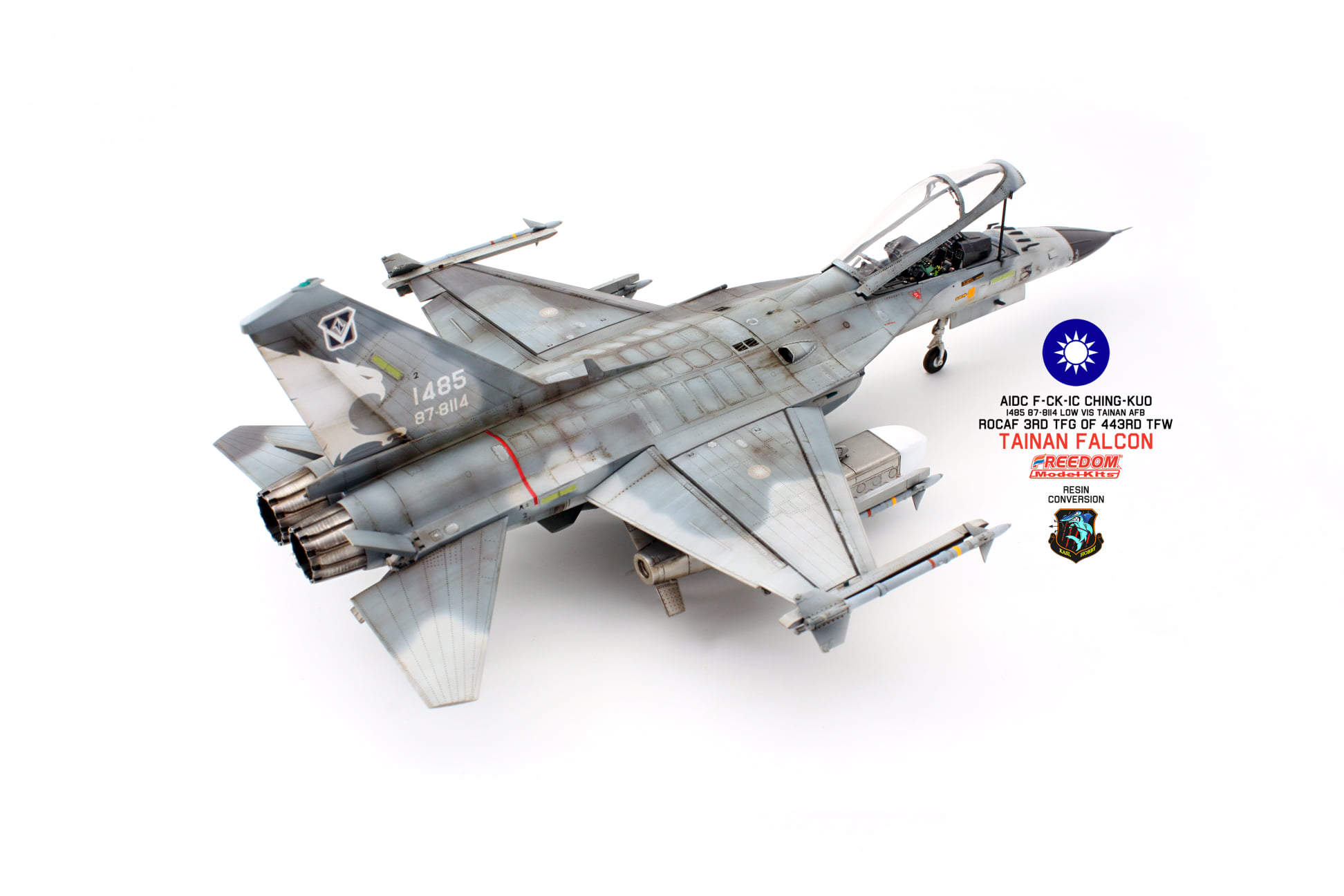
It started as a desperate gamble. In the early 1980s, Taiwan was basically stuck. They wanted the F-16 or the F-20 Tigershark from the United States, but the political climate was shifting. The 1982 Joint Communiqué between the U.S. and China effectively put a cap on the quality of weapons being sold to the island. Washington said no. So, the Republic of China (ROC) did the only thing it could: it decided to build its own. That’s how the AIDC F-CK-1 Ching-kuo—better known as the Indigenous Defense Fighter (IDF)—was born.
Honestly, a lot of people outside the aviation world look at the F-CK-1 and think it's just a "diet F-16." That’s a mistake.
While it shares some DNA with General Dynamics' designs, the IDF is a unique beast born from specific constraints. It had to be light. It had to be fast. And most importantly, it had to be powered by engines that didn't violate international export restrictions. It’s a scrappy, highly maneuverable fighter that actually paved the way for Taiwan's modern aerospace industry. Without the AIDC F-CK-1 Ching-kuo, there would be no advanced trainer programs or domestic missile integration today. It was the "proof of concept" that actually worked.
The Engine Problem That Defined a Fighter
The biggest hurdle for the Aerospace Industrial Development Corporation (AIDC) wasn't the airframe. It was the thrust. Because the U.S. government wouldn't allow the sale of high-output engines like the General Electric F110, Taiwan had to look elsewhere. They landed on a partnership with Garrett (now part of Honeywell).
They took a civilian engine, the TFE731, and basically beefed it up to create the TFE1042-70 (military designation F125).
The result? Two engines instead of one.
The AIDC F-CK-1 Ching-kuo is a twin-engine fighter not because it wanted to be, but because it had to be. These engines are relatively small. Critics often point out that the IDF is "underpowered" compared to a late-block F-16. While true in a raw drag race, this setup actually gives the IDF a very high degree of reliability and a distinct profile. The total thrust with afterburner sits around 19,000 pounds. It’s enough to get the job done for point defense, which is exactly what the plane was designed for. It wasn't meant to invade; it was meant to scramble.
Why the AIDC F-CK-1 Ching-kuo Design Works
The airframe is a blend. You see F-16 in the nose and the cockpit. You see F-18 in the twin tails and the leading-edge root extensions (LERX). You even see a bit of the French Mirage in its sleekness.
AIDC worked closely with General Dynamics on the airframe design, which is why it looks so familiar. The "cranked-arrow" wing shape provides excellent lift at high angles of attack. This makes the AIDC F-CK-1 Ching-kuo a nightmare in a dogfight. In the tight airspace of the Taiwan Strait, where engagement distances are short, maneuverability matters more than long-range fuel tanks.
The cockpit was surprisingly advanced for its time. It used a side-stick controller, just like the F-16, and featured a digital fly-by-wire system. This was a massive jump for Taiwan's air force (ROCAF), which was transitioning from older F-5s and F-104 Starfighters—planes that were basically "flying pencils" with engines. The IDF brought them into the modern era of relaxed static stability.
The Weapons Suite
Taiwan couldn't just buy AIM-120 AMRAAMs back then, so they built their own. The IDF is tightly integrated with indigenous weaponry:
- Sky Sword I (TC-1): An infrared-guided short-range missile.
- Sky Sword II (TC-2): A radar-guided medium-range missile.
- Wan Chien: A massive, GPS-guided cluster bomb cruise missile for hitting airfields.
The ability to carry four TC-2s under the fuselage makes the AIDC F-CK-1 Ching-kuo a serious interceptor. It can pop up, fire, and turn home before the enemy even knows what hit them.
The Wan An and Hsiung Ying Upgrades
By the early 2000s, the IDF was showing its age. Electronics move fast. The original Golden Dragon CD-53 radar was okay, but it needed more legs.
AIDC launched the "Wan An" (Great Peace) upgrade program, which eventually led to the F-CK-1 C/D versions. They improved the avionics, added better electronic warfare (EW) suites, and strengthened the landing gear. They also increased the internal fuel capacity. If you see an IDF today, it’s likely one of these upgraded versions. They are much more capable of handling the modern electronic environment over the Strait.
Is it as good as an F-16V? No. But it doesn't have to be. It fills the "low" end of a high-low mix, freeing up the F-16s and Mirage 2000s for more specialized roles.
What People Get Wrong About the IDF
There is a persistent myth that the "CK" in F-CK-1 stands for something... well, let's just say people have made a lot of jokes about the name. In reality, it stands for Ching-kuo, named after Chiang Ching-kuo, the late president of Taiwan who greenlit the project.
Another misconception is that the plane is just a "kit bash" of American parts. While the U.S. provided technical assistance, the integration was handled by Taiwanese engineers. Integrating a foreign engine with a domestic radar and domestic missiles is an engineering nightmare. The fact that the AIDC F-CK-1 Ching-kuo flies as well as it does is a testament to Taiwan's technical maturity. They had to invent their own flight control laws. That’s not something you just buy off a shelf.
Real-World Performance
The IDF has a very high sortie rate. Because it's a domestic product, the supply chain is right there in Taichung. When an F-16 needs a specific part, it might have to come from the States. When an IDF needs a part, they can often get it from the factory down the road. This high availability is crucial during periods of increased tension.
The plane's landing gear is also notably wide. This was a specific design choice to allow it to land on highways and makeshift strips if the main airbases are cratered. It’s a survivalist’s airplane.
The Legacy: From IDF to T-5 Brave Eagle
The story of the AIDC F-CK-1 Ching-kuo isn't over. It has evolved into the T-5 Brave Eagle, Taiwan’s new advanced jet trainer. The T-5 is essentially a modified IDF with more composite materials, no internal cannon, and a non-afterburning version of the same engine.
This shows the longevity of the design. By using the F-CK-1 as a baseline for their new trainers, Taiwan has ensured that their pilots are familiar with the handling characteristics of their frontline fighters from day one. It also keeps the production lines warm.
If you're looking at the future of Taiwan’s defense, you have to look at how they manage their fleet. The IDF is the backbone. It’s the plane that’s always ready to scramble when a "gray zone" incursion happens. It's fast to start, fast to climb, and cheap to operate compared to the heavier fighters.
Actionable Insights for Aviation Enthusiasts and Analysts
If you are tracking the development of East Asian air power, keep these points in mind regarding the AIDC F-CK-1 Ching-kuo:
- Watch the T-5 Brave Eagle rollout. The success of this trainer is directly tied to the IDF airframe. As more T-5s enter service, the maintenance cost for the remaining F-CK-1 fleet will actually drop due to parts commonality.
- Monitor missile integration. The IDF is often the first platform to test new Taiwanese missiles like the extended-range Sky Sword II. These upgrades keep the plane relevant against 4.5-generation threats.
- Understand the "Scramble" role. The IDF is Taiwan's primary "quick reaction" interceptor. Its twin-engine reliability and local supply chain make it the most active airframe in the ROCAF's daily operations.
- Look at the engines. The F125 engine (TFE1042) is one of the most successful small-ducted turbofans ever made. Its performance in the IDF is the primary reason it was later considered for other international light fighter projects.
The AIDC F-CK-1 Ching-kuo proved that a small nation could build a world-class fighter under extreme political pressure. It isn't just a plane; it's a symbol of self-reliance. While it might not have the "cool factor" of a Stealth fighter, it remains the most practical tool in Taiwan's shed. Check the flight lines at Tainan or Taichung air bases—the IDF is still the one doing the heavy lifting every single day.