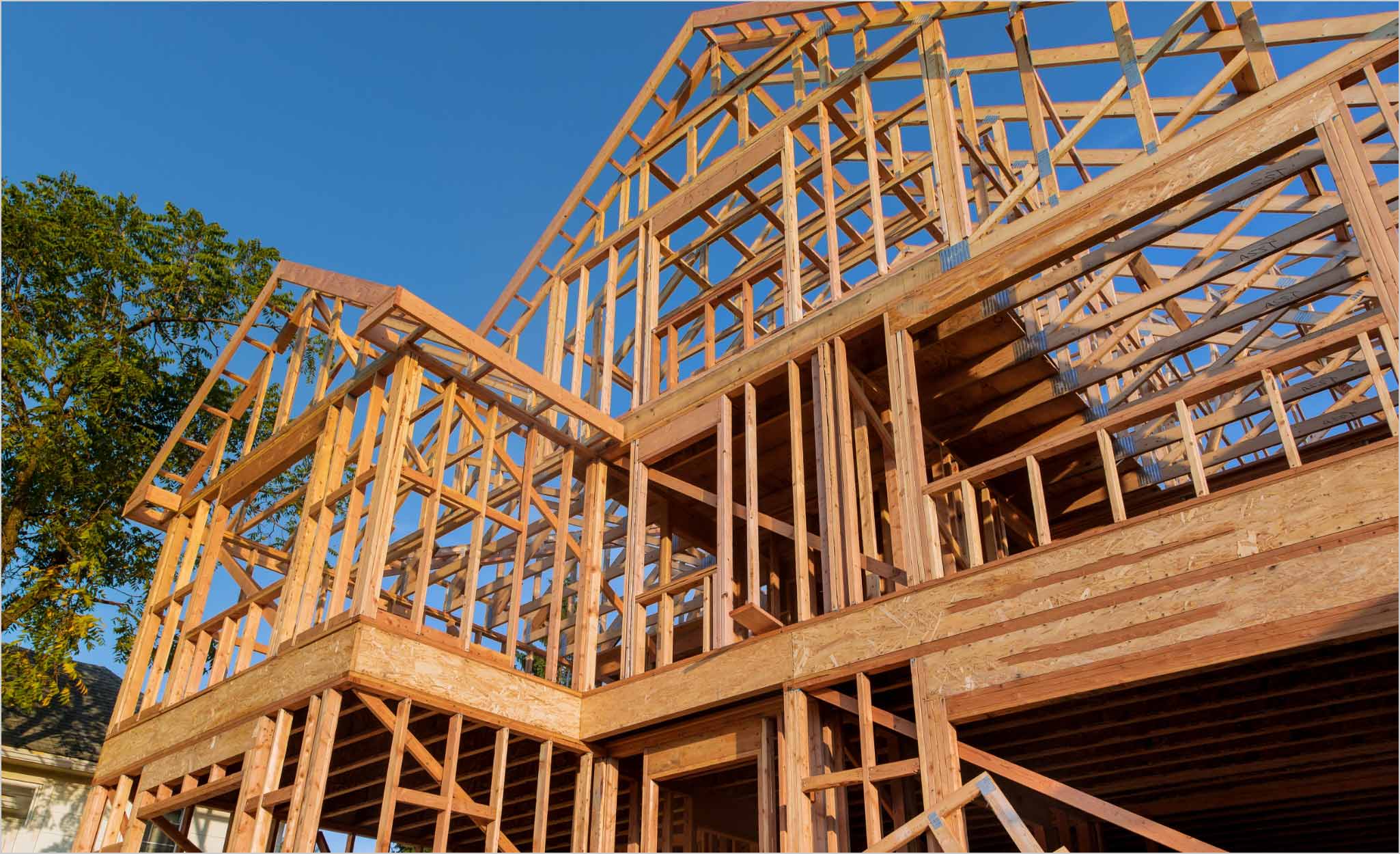
Walk down any suburban street in the United States and you’re looking at it. Most people don't think about what's behind their drywall until they try to hang a heavy TV or a kitchen cabinet and hit something solid with a drill. That "something" is almost certainly a 2x4 or 2x6 piece of kiln-dried lumber. Frame home construction is basically the DNA of the American dream, for better or worse. It’s been that way since the mid-1800s when builders realized they didn't need massive, heavy timbers to keep a roof over someone's head.
It’s fast. It’s relatively cheap. And honestly, it’s remarkably flexible.
But there’s a lot of noise out there right now about whether we should still be building this way. You’ve probably seen the videos of "matchstick" houses going up in massive developments and wondered if they’re actually sturdy. Or maybe you're looking at skyrocketing lumber prices and wondering if steel or concrete is the smarter play for a custom build. The reality is that wood framing—specifically light-frame construction—is a sophisticated engineering feat that we often take for granted because it’s so common.
The Shift From Heavy Timber to Light Frame Home Construction
Before the 1830s, if you wanted a house, you were looking at heavy timber framing. We're talking massive beams joined with mortise and tenon joints. It took a village to raise a house. Literally. Then came the "balloon frame." Legend has it that Augustine Taylor used this method to build St. Mary’s Church in Chicago in 1833. Critics thought these thin strips of wood would blow away like a balloon in the wind. They didn't.
Instead, they changed everything.
This was the birth of modern frame home construction. By using standardized lumber and factory-made nails, two guys could suddenly build a house in a fraction of the time it used to take a whole crew. We eventually moved from balloon framing—where studs ran continuously from the foundation to the roof—to "platform framing." This is what you see today. You build the first floor, put a platform on top of it, and then build the second floor on that platform. It’s safer because it creates natural fire breaks between floors.
Most people don't realize that timber is one of the few truly renewable building materials we have. When sourced from certified forests, like those monitored by the Sustainable Forestry Initiative (SFI), it has a significantly lower carbon footprint than steel or concrete. Steel requires massive amounts of energy to produce. Concrete releases huge amounts of $CO_2$ during the calcination process. Wood? It just sits there holding carbon.
Why We Can't Quit Wood (And Probably Shouldn't)
Cost is the obvious driver, but it’s not just the price of the wood itself. It’s the labor. Every general contractor in North America knows how to work with wood. If you decide to move a window or add a closet mid-build, a carpenter can fix that with a saw and a nail gun in twenty minutes. Try doing that with a poured concrete wall or a pre-engineered steel beam. You can’t.
There's also the insulation factor. Wood is a natural insulator. It has a much lower thermal conductivity than steel. In a typical frame home construction project, the spaces between the studs are essentially "pockets" waiting to be filled with fiberglass, cellulose, or spray foam. This makes it much easier to hit the R-value requirements set by the International Energy Conservation Code (IECC).
However, it’s not all sunshine and sawdust.
Wood rots. Termites love it. It burns. These are the "Big Three" arguments against wood framing. But modern chemistry and engineering have mitigated a lot of this. We use pressure-treated lumber for any wood touching the foundation to stop rot and bugs. We use fire-rated gypsum board (drywall) to give families time to get out if there's a fire. Is it as "indestructible" as a stone castle? No. But for most families, the trade-off in cost and comfort makes sense.
The Engineering Nobody Sees
People think a house is just a box. It’s actually a series of interconnected diaphragms. When the wind hits the side of a house, that load has to go somewhere. It moves through the siding, into the sheathing (usually OSB or plywood), through the studs, and down into the foundation.
- Sheathing: This is what gives a frame house its "shear strength." Without those sheets of wood nailed to the studs, the house would fold like a cardboard box.
- Joists: These are the horizontal members. In modern builds, we’re seeing more "I-joists" which look like a wooden version of a steel I-beam. They can span longer distances without sagging.
- Trusses: Most modern roofs aren't hand-framed anymore. They’re built in a factory using metal gusset plates. They arrive on a truck, get craned up, and provide incredible strength using surprisingly little material.
The Real Risks: Moisture and Movement
The biggest enemy of frame home construction isn't actually fire. It's water. If a house isn't wrapped correctly with a weather-resistant barrier (WRB)—think brands like Tyvek or Zip System—water gets trapped. Once water gets into the wall cavity, the clock starts ticking on mold.
Wood also moves. It’s an organic material. It shrinks as it dries out and expands when the humidity spikes. This is why you get those "pops" in the middle of the night in a new house. It's also why you see small cracks in the drywall above door frames after a year or two. The house is literally settling and breathing.
Experts like Joseph Lstiburek at Building Science Corporation have spent decades teaching builders how to manage this "moisture drive." The goal is to build a house that can dry out if it does get wet. The old way was to build "leaky" houses that breathed naturally. The new way is to build "tight" houses with mechanical ventilation (like an HRV or ERV) to ensure the air stays fresh without letting the energy bills skyrocket.
Steel vs. Wood: The Great Debate
Every few years, people say steel is going to take over. It’s straighter. It’s lighter. It doesn't burn. But cold-formed steel framing has a massive "thermal bridging" problem. Steel conducts heat so well that it can actually suck the warmth right out of a room, creating cold spots on the walls where moisture can condense and grow mold. To fix this, you have to add a layer of rigid foam insulation to the outside of the building, which adds cost.
Then there’s the "feel." Most homeowners prefer the sound dampening and the "solid" feel of wood. If you've ever lived in a house with light-gauge steel studs, you know that hanging a heavy picture or a TV becomes a nightmare of specialized toggles and stripped screws.
What About Advanced Framing?
If you're looking into building a house today, you’ll hear the term "Advanced Framing" or OVE (Open Value Engineering). Basically, it’s a way to use less wood and more insulation. Instead of studs every 16 inches, you put them every 24 inches. You skip the "extra" wood in corners where it isn't needed for structural support.
It sounds sketchy to the old-school guys. "I want my house built solid!" they’ll say. But the truth is, a house built with advanced framing techniques can be just as strong while being significantly more energy-efficient. It reduces the amount of wood that acts as a thermal bridge, meaning your wall has more room for insulation and less room for heat to escape.
Common Misconceptions About Modern Framing
- "New wood is garbage compared to old-growth wood." There's some truth here. Old-growth timber was denser and more resinous. But modern kiln-dried "SPF" (Spruce-Pine-Fir) is highly engineered and predictable. We know exactly how much weight a 2x10 can hold before it fails.
- "Tornadoes always destroy frame houses." While a direct hit from an EF-5 will level almost anything, modern hurricane ties and anchor bolts make a huge difference. These small metal connectors tie the roof to the walls and the walls to the foundation. In many cases, it's the lack of these $2 connectors that leads to catastrophic failure, not the wood itself.
- "Prefab is always better." Modular or panelized frame home construction can be great, but it’s not a magic bullet. It still requires a foundation, utility hookups, and finish work that can often erase the initial savings.
Actionable Steps for Your Next Project
If you are planning a build or a major renovation involving frame home construction, don't just leave it to the contractor to pick the cheapest materials.
Demand a "Tight" Envelope
Ask your builder about their flashing and air-sealing strategy. It matters more than the granite countertops. If they aren't using high-quality tapes or sealants around windows and doors, your frame will be vulnerable to rot within a decade.
Consider Engineered Lumber
For wide-open floor plans, use LVLs (Laminated Veneer Lumber) or I-joists. They stay straighter than traditional lumber, which means fewer floor squeaks and fewer "crowned" boards that make your floor look wavy.
Check the Grade
Standard framing lumber is usually Grade #2. It’s fine for most things. But for long spans or visible rafters, you might want to spring for "Select Structural" or #1 grade. It has fewer knots and is less likely to warp.
Watch the Moisture Content
Don't let the builder "dry-in" the house (put up drywall) until the framing lumber has had a chance to dry out. If they hang drywall on wet studs, those studs will shrink as they dry, and you'll be dealing with "nail pops" and cracks for years. A simple moisture meter should show the wood is below 19%—ideally closer to 12-15%—before the insulation goes in.
Plan for the Future
Add "blocking" (extra pieces of wood) between the studs in bathrooms for future grab bars and in the living room for a TV mount. It costs almost nothing during the framing stage but saves a massive headache later.
Building a house is a chaotic, expensive, and stressful process. But there is something deeply satisfying about seeing the "skeleton" of a home go up. It’s the moment the project stops being a hole in the ground and starts being a place where people will live, sleep, and grow. Wood framing isn't perfect, but it’s a remarkably resilient system that has defined the American landscape for nearly two centuries. Understanding how it works is the first step toward building something that actually lasts.