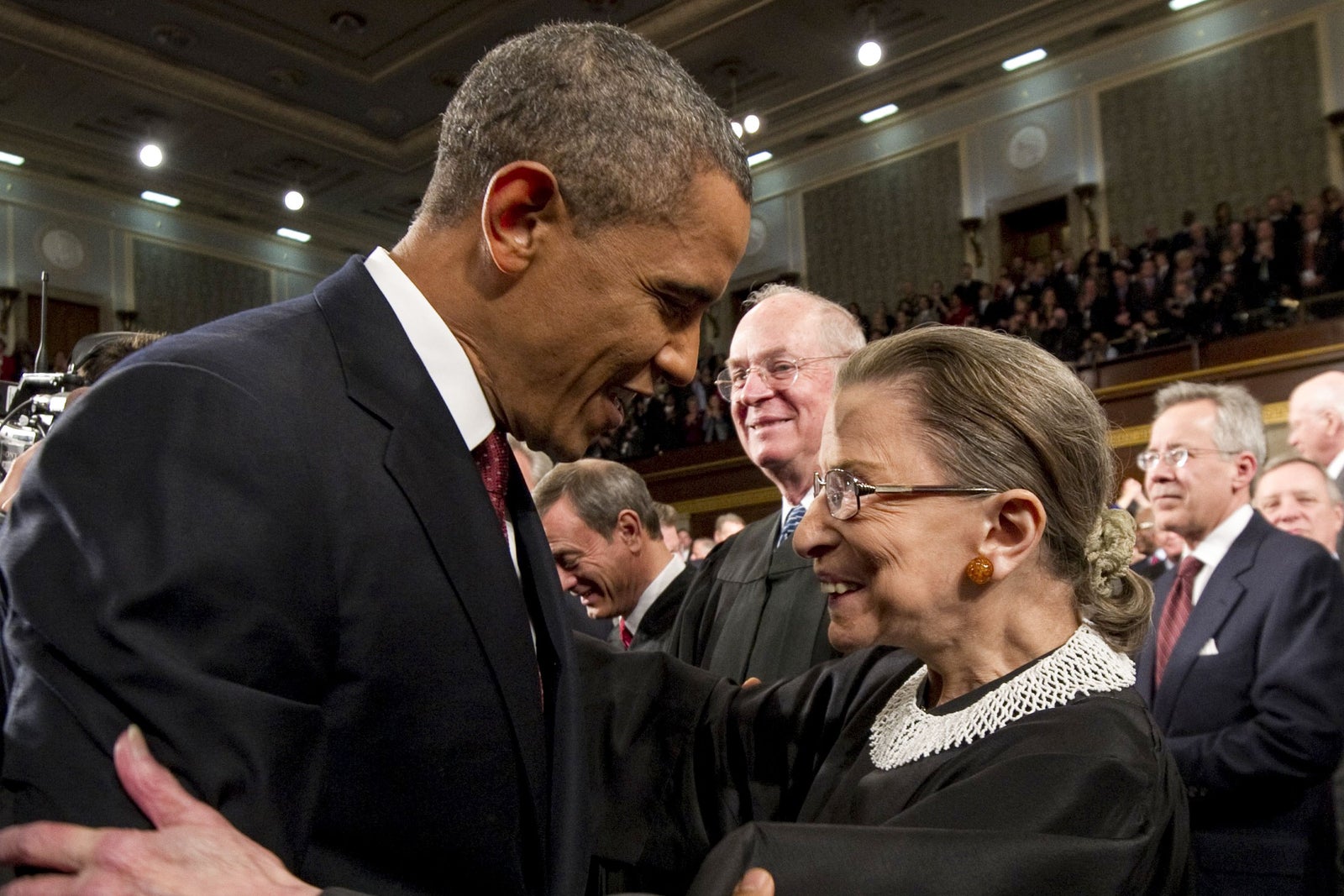
The question haunts legal circles and dinner parties alike. It’s the ultimate "what if" of modern American politics. People look at the current makeup of the Supreme Court and they point fingers. Most of those fingers point directly at Justice Ruth Bader Ginsburg. They want to know one thing: why didn't RBG retire when Barack Obama had a filibuster-proof majority or even just a friendly Senate?
It’s complicated. Honestly, it’s a mix of ego, a specific view of the court’s independence, and a series of political miscalculations that looks like a slow-motion car crash in hindsight.
You’ve probably heard the simple version. She was old, she got sick, she stayed too long. But that misses the nuance of who Ginsburg was. She wasn't just a judge; she was a strategist who had spent her whole life defying the odds. When you've beaten cancer twice and spent decades being the smartest person in every room you’ve ever walked into, you start to believe in your own invincibility. It’s human. It’s also devastatingly consequential.
The 2014 Pressure Cooker
By 2013 and 2014, the whispers for her to step down became a roar. Legal scholars like Erwin Chemerinsky were writing op-eds in the Los Angeles Times basically begging her to quit. The math was simple. Obama was in his second term. The Democrats were likely to lose the Senate in the 2014 midterms. If she stayed and the GOP took over, she’d be trapped.
She didn't care.
Ginsburg was famously stubborn. In an interview with the Associated Press in 2013, she asked, "Who do you think the president could nominate and get through the Senate that you would rather see on the court than me?" This wasn't just arrogance. It was a genuine belief that the political climate was so toxic that Obama couldn't get a "real" liberal confirmed. She saw herself as the last line of defense. She didn't want a moderate replacement. She wanted another RBG, and she didn't think Obama could deliver that.
The Lunch with Obama
There’s a specific moment people always go back to: the July 2013 lunch. President Obama invited Ginsburg to the White House. It wasn't an explicit "you need to quit" meeting—Obama is too cool for that—but the subtext was screaming. He talked about the upcoming midterms. He talked about how hard it was to get anyone through the Senate.
Ginsburg didn't take the hint.
She later told The New York Times that she didn't feel pressured. But those close to the situation knew the White House was anxious. The "Notorious RBG" phenomenon was just starting to take off. She was becoming a pop culture icon, a superhero in a lace collar. It’s hard to tell a superhero it’s time to hang up the cape. Especially when that superhero is still doing 20 pushups a day with a personal trainer at age 80.
Cancer, Resilience, and the "Notorious" Mythos
You have to remember her medical history. Colon cancer in 1999. Pancreatic cancer in 2009. These are usually death sentences. Most people would have quit after the first bout. Ginsburg? She didn't miss a day on the bench.
This resilience fueled the answer to why didn't RBG retire. She had survived things that killed everyone else. She felt she had more time. When you've spent your entire career being told "no"—no to law firm jobs because you’re a woman, no to clerkships despite being top of your class at Harvard and Columbia—you develop a thick skin. You stop listening to the experts.
The fame probably didn't help. By 2015, she was on t-shirts, mugs, and Saturday Night Live. She was the "Notorious RBG." This cult of personality created a feedback loop. Her supporters weren't telling her to retire; they were cheering for her to stay forever. It’s easy to get lost in that. It’s easy to think the rules of biology and political cycles don't apply to you.
The Miscalculation of 2016
This is the part that hurts to look back on. Like almost everyone else in the D.C. bubble, Ginsburg seemed convinced that Hillary Clinton would win the 2016 election.
If Clinton wins, Ginsburg retires in 2017 at age 84. She gets replaced by a liberal woman appointed by the first female president. It’s a perfect story. It’s the "fairytale" ending to a historic career. She was holding out for that moment. She wanted to hand her seat to someone who shared her specific vision of gender equality, and she wanted to do it under a woman’s presidency.
She gambled. She lost.
The Institutionalist Argument
Ginsburg also had a very "old school" view of the Supreme Court. She hated the idea that justices should time their retirements based on who was in the White House. She thought it made the court look like a political tool.
"I think my work is still good," she would say. To her, as long as she could do the job, she should stay. It was a matter of principle. But in a world where the Senate had already started weaponizing judicial appointments, that principle started to look a lot like naivety. The world had changed around her, but her view of the court remained static.
Why the "Obama Couldn't Get Anyone Confirmed" Argument Fails
Some defenders say that even if she had retired in 2014, Harry Reid and the Democrats couldn't have gotten a replacement through. That’s not quite right.
In 2013, the Democrats still held the majority. They had already used the "nuclear option" to get lower court judges through with a simple 51-vote majority. If Ginsburg had stepped down in early 2014, Obama almost certainly would have seated a successor. Would it have been a fiery liberal? Maybe not. But it would have been someone in their 50s who would be on the bench for thirty years.
Instead, her seat eventually went to Amy Coney Barrett.
The Aftermath and the Legacy
When she finally passed in September 2020, just weeks before the election, the fallout was immediate. The "why" didn't matter as much as the "what now." The vacancy allowed a total shift in the court’s ideological balance.
If you're looking for a single reason, you won't find it. It was a cocktail of:
- A deep-seated belief that she was the only one who could do the job "right."
- A misunderstanding of how much the GOP’s strategy had shifted under Mitch McConnell.
- The seductive nature of late-life fame.
- A misplaced faith in the 2016 polling data.
It’s a tragedy in the classical sense. Her greatest strength—her indomitable will—became the very thing that undermined her legacy's protection.
How to Evaluate Judicial Legacies Moving Forward
Understanding the RBG era teaches us a few harsh lessons about power and timing. If you are following modern legal developments or interested in the future of the court, keep these factors in mind:
1. Watch the Midterms, Not the Presidencies
The most critical window for a judicial retirement isn't just "during a friendly presidency." It is during the first two years of a presidency when the executive and legislative branches are aligned. Once the midterms hit, the "lame duck" risk becomes massive.
2. The Age 75 Rule of Thumb
Legal analysts now widely suggest that any justice who stays past 75 is taking a massive institutional risk. While Ginsburg was sharp until the end, the physical risk of sudden vacancy outweighs the benefit of seniority.
3. Actuarial Realities vs. Personal Will
No matter how many pushups a justice can do, the actuarial tables for an 80-year-old are unforgiving. When tracking current justices like Sonia Sotomayor or Clarence Thomas, observers now look at their health and age through the lens of the RBG "cautionary tale."
4. Diversify Your Information Sources
To get a full picture of Supreme Court strategy, don't just read the major news sites. Look at academic journals like the Harvard Law Review or specialized legal blogs like SCOTUSblog. They often discuss the "strategic retirement" theory long before it hits the mainstream media.
The RBG story isn't just about one woman. It's about how hard it is to let go of power, even when you know the stakes. It’s a reminder that in politics, as in life, timing is everything.