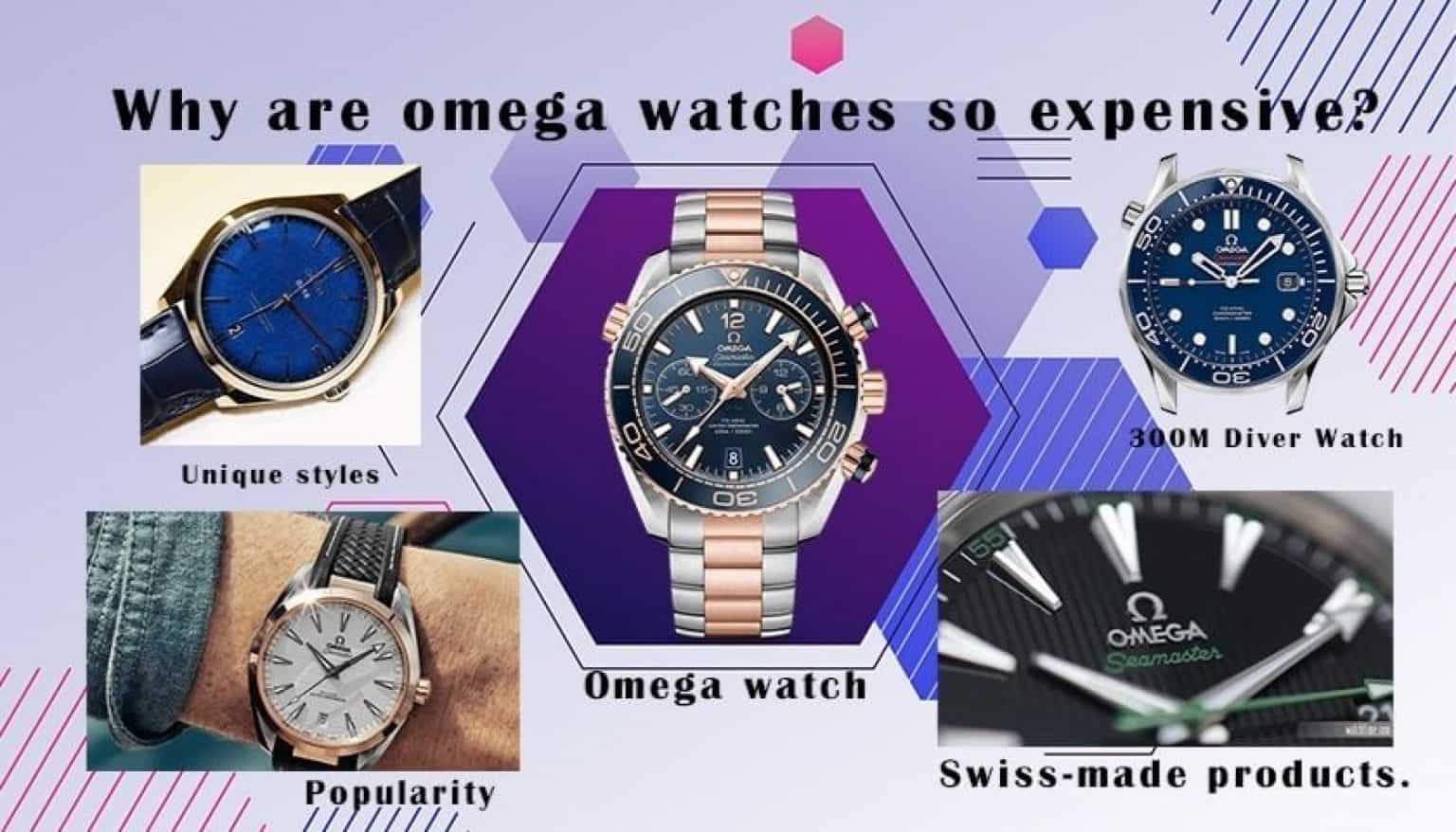
You’re standing at a glass counter, looking at a piece of steel that costs more than a decent used car. It’s a Seamaster. Or maybe a Speedmaster. You see the price tag—$6,000, $9,000, maybe $50,000 for a gold Moonwatch—and that voice in your head starts chirping. It just tells time, right? My phone does that for free. Honestly, it’s a fair question. If you’re looking at it purely as a tool to not be late for a Zoom call, the math never adds up. But when you start digging into why are Omega watches so expensive, you realize you aren't really paying for a clock. You’re paying for a weirdly obsessive level of engineering, a massive marketing machine, and a history that literally involves leaving the planet.
Omega isn't just a "luxury brand" in the way some fashion labels are. They don't just slap a logo on a generic movement. They are vertical. They are technical. And they are currently in a high-stakes arms race with Rolex for the soul of the Swiss watch industry.
The Co-Axial Escapement: Why the Guts Matter
Most people don't care about the tiny ticking wheels inside a watch until they realize that’s where all the money goes. In the late 90s, Omega did something pretty ballsy. They adopted the Co-Axial escapement, an invention by the late, legendary watchmaker George Daniels. Before this, almost every mechanical watch used a "Swiss Lever" escapement, which involves a lot of sliding friction. Friction is the enemy. It wears down oil, it slows things down, and eventually, it kills the watch.
Daniels' design changed the way energy is transmitted, reducing friction and, theoretically, making the watch more accurate for longer periods. It’s basically the horological equivalent of moving from a standard piston engine to something far more exotic. But here’s the kicker: Omega didn't just buy the patent; they spent years industrializing it. It’s hard to mass-produce something that delicate. When you buy an Omega today, you’re paying for that specific mechanical pedigree that you simply cannot find in a $500 Tissot or a $1,000 Hamilton.
They also introduced the Master Chronometer certification. It’s not enough to be accurate. Omega sends their watches to METAS (the Swiss Federal Institute of Metrology). They subject these things to 15,000 gauss of magnetism. That’s enough to ruin most watches. If you walk past an MRI machine or even just rest your wrist on a laptop's magnetic clasp, a normal mechanical watch might start gaining minutes a day. An Omega won't. That "Master Chronometer" text on the dial? That’s a receipt for a battery of tests that most brands simply can't pass.
The Moon, Bond, and the Price of Cool
Let's be real for a second. A huge chunk of the price tag is the story.
Omega spends a fortune making sure you associate their brand with the coolest humans to ever live. Since 1995’s GoldenEye, James Bond has worn an Omega. Before that, 007 wore Rolex or Seiko. Omega didn't get that spot by accident; they secured it through aggressive (and expensive) marketing partnerships. Every time you see Daniel Craig or Cillian Murphy at an awards show with a vintage-looking Seamaster peeking out from a tuxedo cuff, that’s a calculated move.
Then there's the Moonwatch. The Speedmaster Professional is arguably the most famous chronograph on Earth. It was the only watch flight-qualified by NASA for the Apollo missions. It was on Buzz Aldrin’s wrist when he stepped onto the lunar surface. Omega leans into this hard. People often ask if the modern Speedmaster is the same one the astronauts wore. Mostly, yes. But keeping that legacy alive while modernizing the movement (like the recent 3861 caliber) costs millions in R&D. You’re paying for the right to say your watch is space-ready, even if the most "extreme" environment it sees is a humid boardroom.
Materials That Sound Like Science Fiction
If you look at the "Dark Side of the Moon" series, you aren't looking at painted steel. You’re looking at a solid block of zirconium oxide ceramic. It’s incredibly difficult to machine. It requires diamond-tipped tools and immense heat. But the result is a watch that is virtually scratch-proof. You can wear it for a decade, and it will still look like you took it out of the box yesterday.
They also have their own gold alloys.
- Sedna Gold: Their version of rose gold that doesn't fade over time.
- Canopus Gold: A white gold alloy that’s brighter and more durable.
- Moonshine Gold: A paler, more "lunar" yellow gold.
Creating these proprietary metals requires an in-house metallurgy department. Most "affordable" brands just buy gold or steel from a third-party supplier. Omega makes the ingredients. When you're manufacturing your own metals to ensure a specific shade of "shimmer," the price is going to reflect that level of pedantry.
The Resale Value and the "Rolex Effect"
For a long time, the knock on Omega was that they didn't hold their value like Rolex did. You’d buy a Seamaster, walk out of the store, and it would immediately lose 30% of its value. That’s changing.
The luxury market has shifted. As Rolexes became impossible to buy at retail stores, collectors started looking closer at Omega. They realized that, objectively, the Omega movement was often technically superior to the Rolex equivalent. Prices started creeping up. Today, the Speedmaster "Snoopy" editions or the limited "Ed White" models trade for double or triple their original retail price on the secondary market.
Omega has also been raising their retail prices aggressively over the last three years. Some of this is inflation, sure. But a lot of it is "brand positioning." If you want to be seen as a peer to Rolex and Cartier, you can't be "the cheap alternative." You have to price your products like a luxury good. It’s a psychological game. People want what is expensive because the price itself is a signal of quality and status.
The Hidden Costs of Service
When you buy a luxury watch, you’re entering a long-term relationship. A mechanical Omega is a tiny machine with hundreds of parts. It needs a "tune-up" every 5 to 8 years. A full service at an official Omega service center usually starts around $700–$900.
Why? Because they don't just oil it. They take the entire thing apart. They replace worn gears. They refinish the case using the same lathes and polishing wheels used in the original factory. They pressure test it to ensure it’s still water-resistant to 300 meters. The infrastructure required to maintain these watches globally is massive. When you ask why are Omega watches so expensive, you have to factor in that the brand is promising to be able to fix that watch 50 years from now. That’s a promise a microbrand or a fashion watch company can’t make.
Is It Actually Worth It?
This is where it gets subjective. Honestly, no watch is "worth" $10,000 if your only metric is functionality. But value isn't just about utility.
Take the Seamaster Diver 300M. It’s got a ceramic bezel, a helium escape valve, and a movement that can survive a magnet that would wipe your hard drive. It’s over-engineered for 99% of its owners. But that over-engineering is the point. It’s the same reason people buy Ferraris even though the speed limit is 65 mph. It’s about the capability.
Omega sits in that "sweet spot" of luxury. It’s more expensive than Longines or Oris, but usually more attainable than Patek Philippe or Audemars Piguet. It’s the choice of the person who wants the highest possible level of Swiss watchmaking without necessarily waiting three years on a list or paying $100,000 for a "holy trinity" piece.
How to Navigate an Omega Purchase
If you're looking to pull the trigger but the price still stings, there are ways to be smart about it.
- Look at the "Grey Market" or Pre-owned: Sites like Chrono24 or Bob’s Watches often have "new old stock" or lightly used models for 15-20% less than the boutique price. Just make sure the warranty card is stamped.
- Focus on the Movement: If you want the best tech for your money, look for the "Master Chronometer" designation. It ensures you’re getting the METAS-certified anti-magnetic tech.
- Skip the Gold: If the price seems insane, it’s usually because of the metal. Omega’s 316L stainless steel is world-class and significantly more durable for daily wear than their Moonshine gold.
- The "One Watch" Strategy: Most collectors recommend the Speedmaster Professional (the Hesalite version) as the first "big" purchase. It’s the most iconic thing they make, and it holds its value better than almost anything else in their catalog.
The reality is that Omega watches are expensive because they are one of the few brands that actually backs up their marketing with genuine, industry-leading technical innovation. You aren't just buying a name; you're buying a piece of machinery that is designed to outlive you. Whether that’s worth five figures is up to your bank account, but the quality isn't a myth.
To get the most out of your investment, always verify the serial number on the lug of the watch against the Pictogram card provided in the box. This ensures the movement inside matches the case and that the watch hasn't been "frankensteined" with aftermarket parts. If you're buying new, try to build a relationship with a local authorized dealer rather than a corporate boutique; they often have more flexibility to include an extra strap or a small discount for a first-time buyer.