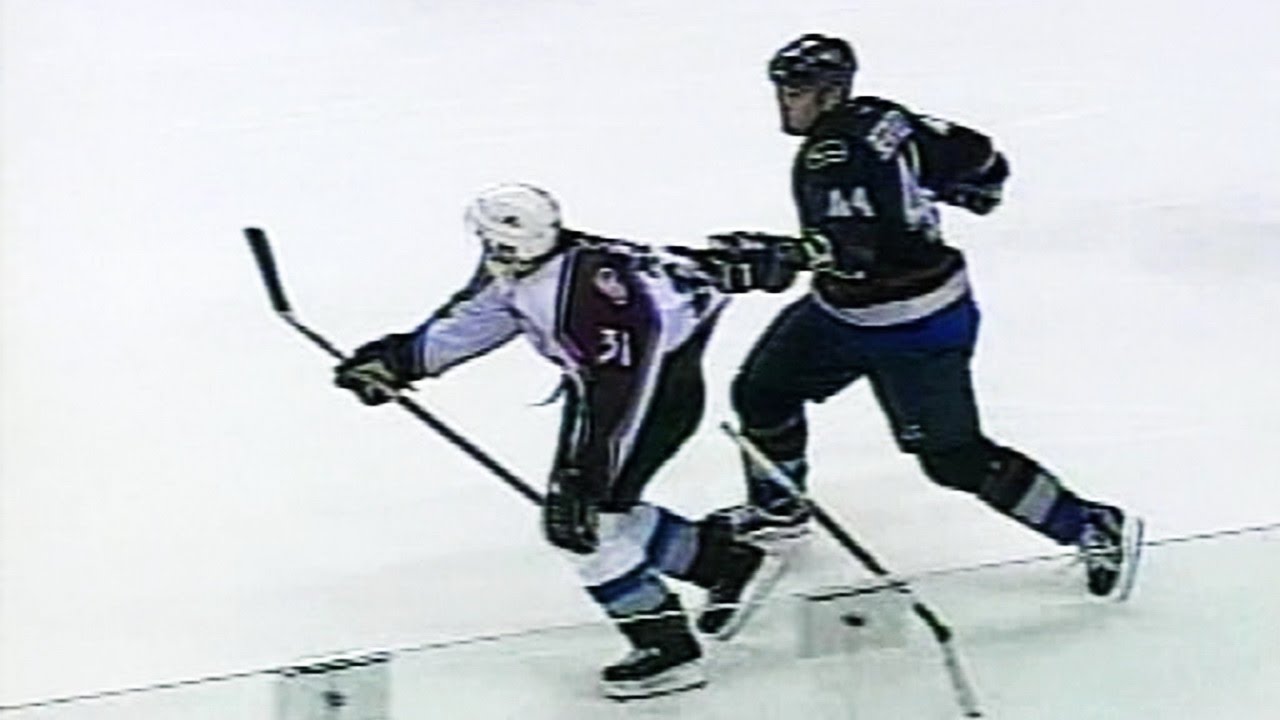
March 8, 2004. If you were watching hockey that night, you remember the silence. It wasn’t just a quiet arena; it was that heavy, sickening hush that happens when everyone knows they just saw something that shouldn’t belong in a game. Todd Bertuzzi, a powerhouse forward for the Vancouver Canucks, grabbed Colorado Avalanche rookie Steve Moore from behind, punched him in the jaw, and drove him face-first into the ice.
It was over in seconds. But for Todd Bertuzzi and Steve Moore, those seconds became a decade-long legal nightmare and a permanent stain on the sport.
Some call it the "Code" gone wrong. Others call it a criminal assault that was masquerading as a hockey play. Honestly, it was probably both. But to understand why people are still talking about this twenty years later, you have to look past the punch and into the "bounty" talk, the broken neck, and a lawsuit that almost pulled the NHL’s most guarded secrets into a public courtroom.
The Hit That Started a War
It didn’t start with Bertuzzi. It started three weeks earlier on February 16. Steve Moore, a Harvard grad trying to find his footing in the big leagues, caught Canucks captain Markus Naslund with an open-ice hit. Naslund was the league’s leading scorer. He was the heart of Vancouver. When Moore’s shoulder caught Naslund’s head, the captain went down with a concussion.
The refs? They didn’t call a thing. The league? They reviewed it and said it was a legal hit.
Vancouver didn’t see it that way. In the locker rooms and the local papers, the message was clear: Moore had a target on his back. Brad May, a Canucks veteran, famously talked about a "bounty" on Moore’s head. When the teams met again on March 8, the air was thick. Moore even fought Matt Cooke in the first period, seemingly "paying his dues" according to hockey's unwritten rules. But the Canucks weren't satisfied.
Colorado was up 8–2 late in the third. The game was over. Yet, Todd Bertuzzi was stalking Moore. He was chirping, tugging at him, trying to get him to drop the gloves. Moore wouldn't go. He just kept skating. That's when Bertuzzi snapped.
The Physical Toll: What Actually Happened to Steve Moore?
The medical report from that night reads like something from a car crash. When Bertuzzi landed on top of Moore, the combined weight—plus the impact of other players piling on in the ensuing brawl—crushed Moore's cervical vertebrae.
- Three fractured neck vertebrae (C3 and C4).
- A grade-three concussion.
- Vertebral ligament damage.
- Facial lacerations and nerve damage.
Moore lay on the ice for ten minutes. He never played another game of professional hockey. Think about that for a second. A 25-year-old kid who worked his way through the Ivy League to make it to the NHL had his entire livelihood erased because of a "retribution" play in a blowout game.
Bertuzzi, for his part, was devastated in the immediate aftermath. He gave a tearful apology two days later. He looked like a man who realized he’d gone too far in a culture that encouraged him to go right up to the line. But the "I'm sorry" didn't stop the police from showing up.
The Legal Saga: From the Ice to the Courtroom
This is where the Todd Bertuzzi and Steve Moore story gets really messy. Usually, what happens on the ice stays on the ice. Not this time. The Attorney General of British Columbia charged Bertuzzi with assault causing bodily harm.
He eventually pleaded guilty. The sentence? A conditional discharge, a year of probation, and 80 hours of community service. Because he completed the probation, he technically doesn't have a criminal record today, but the civil side of things was a different beast entirely.
Moore filed a lawsuit seeking $68 million in damages. That is a massive number, even for pro sports. He wasn't just suing Bertuzzi; he went after the Vancouver Canucks and their parent company, Orca Bay. Moore’s legal team, led by Tim Danson, argued "vicarious liability." Basically, they claimed the team was responsible because the coaches and management created an environment where this kind of violence was expected.
The "Pay the Price" Allegations
During the discovery phase of the lawsuit, things got ugly within the Canucks organization. Bertuzzi actually testified that his coach, Marc Crawford, told him Moore had to "pay the price."
Crawford denied it. He claimed he told Bertuzzi to get off the ice before the incident happened. Suddenly, it wasn't just Moore vs. Bertuzzi; it was Bertuzzi vs. his own former coach. This was the NHL’s worst nightmare. A public trial would have forced Commissioner Gary Bettman and other top executives to testify under oath about the "culture of violence."
They managed to dodge that bullet. In September 2014—ten years after the punch—the parties reached a confidential settlement. We will likely never know the exact dollar amount, but considering Moore was seeking nearly $70 million, it’s safe to say it was significant.
Why the NHL Changed Forever
You can draw a straight line from that night in Vancouver to the way the NHL handles player safety today. Before 2004, the "Department of Player Safety" didn't really exist in its current form. Discipline was often arbitrary.
- The End of the "Blindside" Era: The league realized they couldn't just let players police themselves through headhunting.
- The 17-Month Suspension: Bertuzzi’s ban was one of the longest in history. He missed the final 13 games of the 2004 season, the playoffs, and then the entire 2004-05 lockout season because the IIHF honored the suspension.
- Coaching Accountability: The lawsuit made teams terrified of being held liable for what their players did. You don't hear coaches talking about "bounties" or "headhunting" in press conferences anymore.
The Human Element
It's easy to look at this as a series of stats and legal filings. But it's about two lives that were fundamentally altered.
Todd Bertuzzi did return to the NHL. He played for several more years, even becoming a productive member of the Detroit Red Wings. But he was never "Big Bert" again. The swagger was gone. He was the guy who did that thing. Every road arena reminded him. Every interview brought it up.
Steve Moore’s life became about recovery and litigation. He started the Steve Moore Foundation to help people with concussions and head injuries. He didn't get the career he spent his life working for, but he became a reluctant symbol for player safety.
Moving Forward: Lessons for the Modern Game
If you're a coach, a player, or even a fan, the Todd Bertuzzi and Steve Moore incident is a case study in where "passion" meets "criminality."
- Understand the "Code": Retaliation is part of hockey, but it has to be face-to-face. Blindsiding someone isn't "the code"; it's a lack of respect.
- Concussion Awareness: We know so much more now than we did in 2004. A "bell-rung" moment is a traumatic brain injury. Treat it as such.
- Legal Reality: The ice is not a vacuum. If you commit an act that falls outside the "normal risks" of the sport, you can and will be sued or charged.
The best way to honor the fallout of this tragedy is to keep the intensity of the game while stripping away the "eye for an eye" mentality that ended a career and changed the league's soul. Check out the work being done at concussion research centers or follow the current NHL Department of Player Safety updates to see how these rules are actually enforced in today's much faster game.