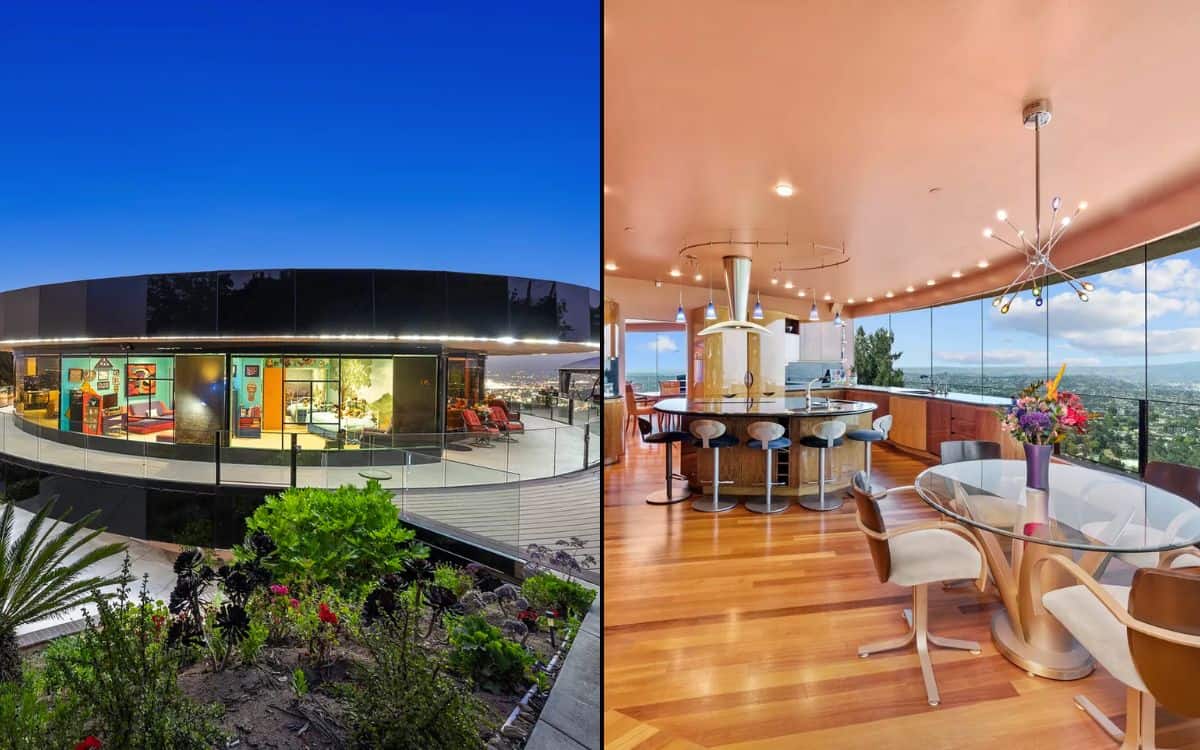
You’re driving up the steep, winding roads of Mt. Helix in La Mesa, thinking about where to grab dinner, when you see it. It looks like a giant, sleek mushroom or maybe a high-tech space station that decided to settle down in a quiet Southern California suburb. Then, you blink. Was that window there a minute ago? You keep driving, come back ten minutes later, and the entire front door has migrated to the other side of the lot. You aren't losing your mind. The San Diego rotating house—officially known as the Rotating Home—is a feat of engineering that actually spins 360 degrees to catch the sunset, the breeze, or just a change of scenery.
Most people assume this is some billionaire’s eccentric weekend project or a high-concept art installation. It’s not. It’s a functional, lived-in residence designed by Al and Janet Johnstone. They didn't just want a view; they wanted every view. All the time.
Why the San Diego Rotating House Isn't Just a Gimmick
Al Johnstone isn't a world-renowned architect with a fleet of interns. He’s a guy who likes to solve problems. When he and Janet bought the lot on Mt. Helix, they realized the view of the Pacific Ocean, the Coronado Bridge, and the Cuyamaca Mountains was scattered across different angles. Instead of picking one favorite side, Al decided the house should move.
The engineering is surprisingly robust. The house sits on a massive center pivot. Think of it like a giant record player, but instead of vinyl, it’s carrying a two-story, 5,100-square-foot luxury home. The rotation is powered by a relatively small electric motor—about 1.5 horsepower. That’s less power than some high-end lawnmowers. Because the balance is so precise, it doesn't take much juice to get the momentum going.
It moves slowly. You won't get motion sickness. In fact, if you’re sitting on the sofa, you probably won't even notice you’re moving unless you look at a fixed point outside, like a specific tree or the neighbor's roofline. It can complete a full rotation in anywhere from 30 minutes to 24 hours, depending on how Al sets the speed.
The Plumbing Nightmare (That Isn't)
The first question everyone asks is: "What happens to the toilets?"
Seriously. How do you have a moving house without twisting the copper pipes into a metal pretzel or snapping the sewer line? Al solved this with a proprietary "central utility column." All the water, electricity, gas, and waste lines run through the very center of the house—the axis of rotation. He used specialized rotating joints and slip rings. These are similar to the technology used in tank turrets or massive industrial cranes.
- The water comes in through a swivel joint.
- The electricity uses brushes and rings to maintain a constant connection.
- The sewage drops down a central vertical pipe that doesn't need to bend.
It’s elegant. It’s also incredibly rare. While there are a handful of rotating structures around the globe—like the Suite Vollard in Brazil or the Heliotrope in Germany—the Johnstone's home is one of the few that functions as a private, high-spec residence in a standard American neighborhood.
Living in a House That Spins
Imagine waking up with the sun hitting your face. By noon, you’ve rotated the house so the bedroom is in the shade for a nap. By 6:00 PM, you’ve swung the kitchen around so you can watch the sun dip into the Pacific while you’re boiling pasta. This isn't just about the "cool factor." It’s about thermal efficiency.
By rotating the house, the Johnstones can naturally regulate the temperature. In the summer, they can turn the windows away from the direct, harsh afternoon sun to keep the interior cool. In the winter, they chase the heat. It’s a low-tech way to use high-tech movement for energy savings.
The house itself is a massive 5,100 square feet. It’s got four bedrooms and a basement that, notably, does not rotate. The garage and the ground-level entry stay put. You take an elevator or stairs from the stationary base up into the rotating portion of the home.
Does it ever get stuck?
Technically, anything with a motor can fail. But the San Diego rotating house was over-engineered for safety. It’s built to withstand major earthquakes—which is a necessity in Southern California. The steel structure is incredibly rigid. Because the weight is distributed so evenly across the circular track, there’s very little strain on the motor itself.
Honestly, the biggest "risk" isn't the house breaking; it's the neighbors getting distracted. People frequently pull over on the side of the road to gawk. It’s become a local landmark, even though it’s a private residence. The Johnstones have been remarkably open over the years, occasionally hosting tours for architecture students or local news crews, but at the end of the day, it's just their home.
Real-World Stats of the Mt. Helix House
To understand the scale, you have to look at the numbers.
The diameter of the rotating floor is roughly 80 feet. The entire moving mass weighs about 600,000 pounds. Despite that massive weight, the friction is so low that you could theoretically push the house by hand if the motor was disengaged (though I wouldn't recommend trying it). The drive system uses heavy-duty wheels that run on a circular steel rail, much like a train track.
The interior is surprisingly normal. You won't find curved furniture everywhere just to fit the walls. Because the house is so large, the "curve" of the exterior walls is gradual. From the inside, it feels like a standard, albeit very round, luxury home.
The Logistics of Maintenance
Maintaining a house like this isn't as simple as calling a local handyman. You can't just find "rotating house repair" in the Yellow Pages. Al Johnstone has had to be his own chief engineer.
- Track Lubrication: The steel rails need to stay clean and lubricated to prevent grinding or noise.
- Motor Inspections: The 1.5hp motor is the heart of the movement; if it burns out, the house becomes a very expensive, stationary circle.
- Seal Integrity: Because the house moves against a stationary base, the weather stripping and seals at the "seam" have to be top-notch to keep out rain and pests.
Most of the components are industrial grade. Al intentionally used parts that are found in heavy machinery because they are built to last decades, not years. This isn't "consumer-grade" tech; it’s industrial-strength living.
What People Get Wrong About the Rotating Home
There’s a common myth that the house spins fast. Some people think it’s like a carnival ride. It’s not. If it spun fast, your furniture would slide to the outer walls and your dinner would fly off the table. Centrifugal force is not your friend in architecture.
Another misconception is that it’s incredibly expensive to operate. Because the balance is so perfect, the electrical cost to rotate the house is roughly equivalent to running a few light bulbs. The "expensive" part was the initial engineering and construction, which cost significantly more than a standard custom build of the same size.
Lastly, people think it’s just a "San Diego thing." While the San Diego rotating house is the most famous in the US, the concept of rotating architecture is actually a global niche. However, Al's design is unique because he developed a system that allows for an infinite number of rotations in either direction without ever tangling the wires or pipes. Most other "moving" houses can only turn a certain number of degrees before they have to "unwind."
The Legacy of the Moveable Home
In an era where "smart homes" usually just means you can turn your lights off with your phone, the Johnstone house is a reminder of what "smart" used to mean: clever mechanical engineering. It addresses the fundamental relationship between a building and its environment.
It’s a bit of a tragedy that more houses aren't built this way. As land becomes more expensive and "perfect" lots with 360-degree views become non-existent, the ability to move a house to face the best available light or view is actually a very practical solution.
If you’re ever in the La Mesa area, keep your eyes peeled toward Mt. Helix. You might catch a glimpse of the silver-clad structure. Just don't expect it to be in the same place twice.
How to Apply These Concepts to Your Own Home
You probably aren't going to put your current house on a giant turntable next weekend. However, the principles Al Johnstone used can be applied to any home improvement project.
- Prioritize the "Site Lines": Before you build an extension or even just place a new window, spend a full day in the space. Watch how the light moves. Don't just settle for a "standard" layout if the best view is at a 45-degree angle.
- Think About Utility Access: The "central column" idea is great for renovations. Keeping your wet walls (bathrooms, laundry, kitchen) clustered together saves a fortune in plumbing and makes maintenance easier.
- Thermal Shifting: Use landscaping or moveable exterior shutters to mimic the "rotation" effect. If you can block the sun in the summer and invite it in during the winter, you’ll see the same energy benefits the Johnstones enjoy.
- Don't Fear Custom Engineering: Sometimes the "off-the-shelf" solution isn't the best one. If you have a unique problem with your property, look toward industrial solutions rather than just residential ones.
The San Diego rotating house stands as a testament to the idea that "because it’s always been done this way" is a terrible reason to keep doing it. Whether it's rotating a 300-ton house or just rethinking your kitchen layout, the goal is the same: make the house work for you, not the other way around.