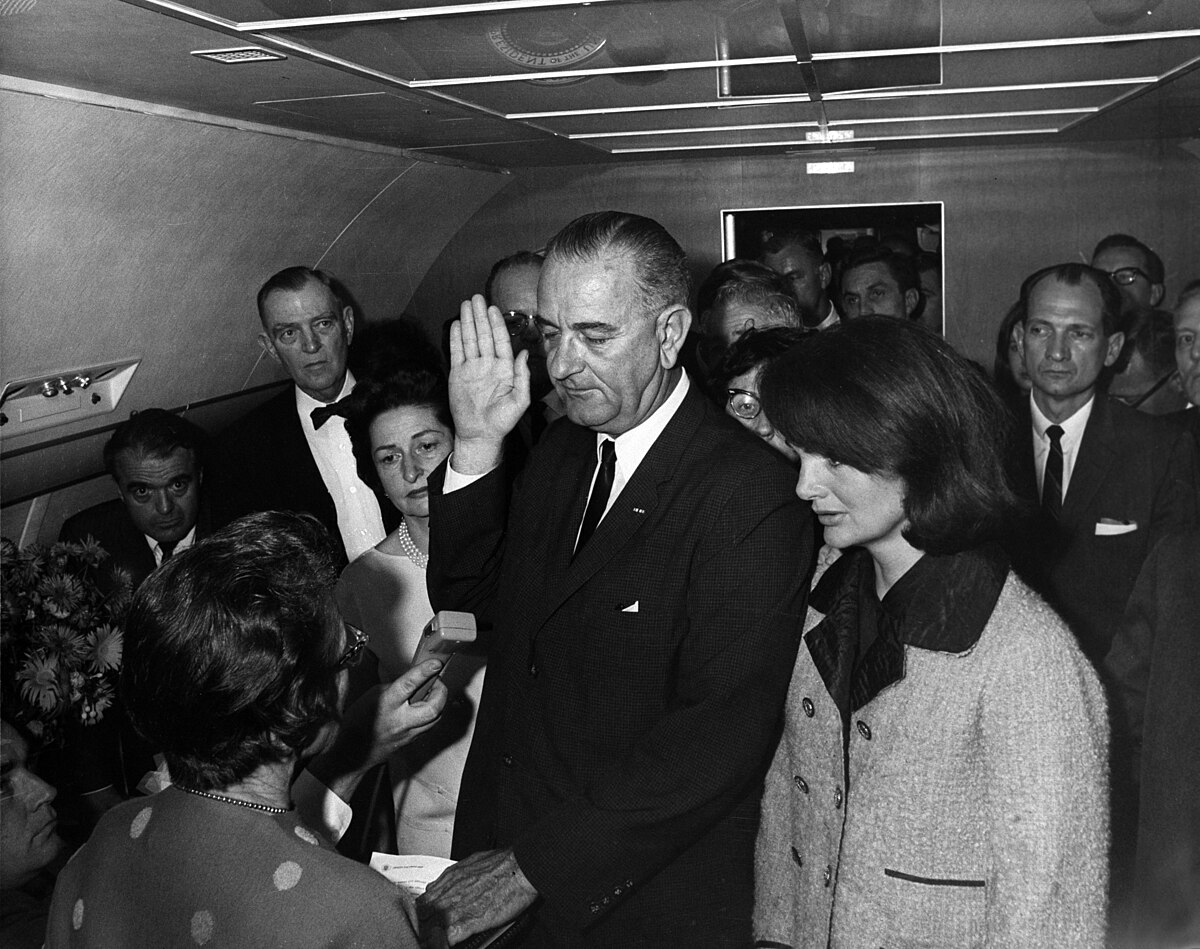
When most people picture an LBJ swearing-in, they think of the tragedy. They see that grainy, claustrophobic photo aboard Air Force One in 1963—Jackie Kennedy in her blood-stained pink suit, the grim set of Johnson’s jaw, and the literal weight of a fallen presidency hanging in the humid cabin air. But that wasn't his "real" celebration. The inauguration of Lyndon B. Johnson on January 20, 1965, was something else entirely. It was a massive, loud, and deeply complex validation of a man who had spent his whole life trying to step out of a predecessor's shadow.
It was a cold Wednesday in D.C.
Johnson had just crushed Barry Goldwater in a landslide victory. He didn't just win; he obliterated the opposition, carrying 44 states. So, the 1965 ceremony wasn't just a formality. It was a mandate. If you look at the archives from the LBJ Presidential Library, you see a man who was finally, for the first time, breathing easy. Sorta. Because with LBJ, nothing was ever truly easy.
A New Kind of Security for a New Era
The vibe in Washington was tense. It had only been fourteen months since Dallas. Because of that, the inauguration of Lyndon B. Johnson featured security measures that people back then thought were borderline paranoid. Today, we’re used to the "bubble," but in '65, the sight of a bulletproof limousine was a jarring reminder of what had been lost.
The Secret Service wasn't taking chances. They used a specially built limousine with a transparent, bullet-resistant bubble top. You’ve probably seen the photos. It looked futuristic and a bit isolating. LBJ, being the quintessential "people person" (or at least a person who needed to be seen by the people), hated the distance. He famously kept wanting to get out and press the flesh.
The Ceremony and That Famous Texas Style
The oath was administered by Chief Justice Earl Warren. It’s funny, looking back at the footage, how much Johnson seemed to loom over everyone else. He was a big man, 6'3", and he used that height to dominate rooms. On the inaugural stand at the East Front of the Capitol, he looked like a titan.
👉 See also: Why the 2013 Moore Oklahoma Tornado Changed Everything We Knew About Survival
His speech? It wasn't the Camelot poetry of JFK. It was pure Great Society. He talked about the "American Covenant." He used the word "change" a lot. He was basically telling the world that the New Deal was getting an upgrade. He wanted to end poverty. He wanted to end racial injustice. It was a big swing.
"In a land of great wealth, families must not live in hopeless poverty. In a land rich in harvest, children must not go hungry. In a land of healing miracles, neighbors must not suffer and die untended."
That’s a direct quote from the address. It sounds hopeful, right? But the shadow of Vietnam was already creeping into the corners of the Great Society. Even as he spoke about a "Great Society," the number of advisors in Southeast Asia was ticking up. It’s a weird contrast that historians like Robert Caro have spent decades deconstructing.
The Lady Bird Factor
We can't talk about this day without Lady Bird Johnson. She was the first First Lady to actually hold the Bible for the swearing-in. Before 1965, the Bible usually just sat on a table or was held by a clerk. It was a small gesture, but it signaled a shift in how the First Lady was perceived—less of a hostess and more of a partner. She chose a family Bible, and the image of her holding it while Earl Warren spoke the words remains one of the most iconic shots of the day.
The Party Washington Never Forgot
The 1965 inaugural balls were legendary for their sheer scale. There were five of them. Five! They were held at the Mayflower Hotel, the Statler Hilton, the National Guard Armory, the Sheraton Park, and the Washington Hilton.
✨ Don't miss: Ethics in the News: What Most People Get Wrong
If you think modern galas are chaotic, imagine 1960s D.C. with thousands of Texans descending on the city in cowboy boots and tuxedos. It was a collision of cultures. The "Texas style" was in full swing. There was a lot of barbecue, a lot of loud laughter, and a lot of expensive bourbon.
One thing that often gets missed in the history books is how much LBJ actually enjoyed the party. After the 1963 swearing-in, which felt like a funeral, he felt he deserved this. He danced. He moved through the crowds like a whirlwind. Honestly, the man had an engine that didn't quit until he hit the pillow.
Why 1965 Matters More Than You Think
Usually, inaugurations are just pomp and circumstance. But the inauguration of Lyndon B. Johnson was the starting gun for some of the most transformative legislation in U.S. history.
Within months of this ceremony, he would sign the Voting Rights Act of 1965. He would push through Medicare and Medicaid. He was a legislative steamroller. The inauguration gave him the social capital to do things that other presidents would have been terrified to try. He used the momentum of that day to bully, cajole, and charm Congress into reshaping the American social contract.
But there was a cost.
🔗 Read more: When is the Next Hurricane Coming 2024: What Most People Get Wrong
The Vietnam War began to swallow the budget and the political will he needed for his domestic dreams. If you look at the photos of LBJ at the beginning of the day versus the end of his term, the physical toll is staggering. The 1965 inauguration was the peak. It was the moment where everything seemed possible.
Quick Facts About the 1965 Inauguration
- Date: January 20, 1965
- Location: East Front, U.S. Capitol
- Weather: Overcast and chilly, about 38 degrees.
- Bible: The Johnson family Bible.
- Key Guest: Vice President Hubert Humphrey, who was finally back in the executive branch after a long stint in the Senate.
The Secret Turmoil Behind the Scenes
Despite the landslide and the cheers, Johnson was chronically insecure. He was obsessed with how the media compared him to Kennedy. Even on his big day, he was checking the wire services. He wanted to know if people liked his speech. He wanted to know if the crowds were bigger than they were in 1961.
He also had a bit of a wardrobe crisis. Johnson was notoriously picky about his suits. He wanted them to fit a certain way—loose enough to move in but sharp enough to look presidential. He famously gave very "detailed" instructions to his tailors about where he needed more room. On inauguration day, he wanted to look the part of the statesman, moving away from the "Texas rancher" image that some of the East Coast elite mocked.
What You Should Do Next
If you’re a history buff or just someone interested in how power works, you shouldn't just read about the 1965 inauguration. You should see it.
- Check out the LBJ Library archives online. They have digitized thousands of photos and, more importantly, the telephone tapes. Listening to LBJ talk on the phone is a masterclass in political maneuvering.
- Visit the Smithsonian National Museum of American History. They often have Lady Bird’s inaugural gown on display. It’s a yellow silk crepe dress designed by John Moore, and it’s surprisingly simple for such a massive event.
- Read "The Years of Lyndon Johnson" by Robert Caro. Specifically, look at how he describes the transition from the accidental presidency of '63 to the earned presidency of '65. It’ll change how you view the office.
- Watch the footage of the 1965 address. Pay attention to his cadence. He was a man of the Senate, and he spoke like he was trying to convince a committee, not just a crowd.
The 1965 inauguration wasn't just a party; it was the birth of the modern American state as we know it today. Whether you love his policies or hate them, that day in January changed the trajectory of the country forever. It was loud, it was expensive, and it was uniquely, undeniably Johnson.