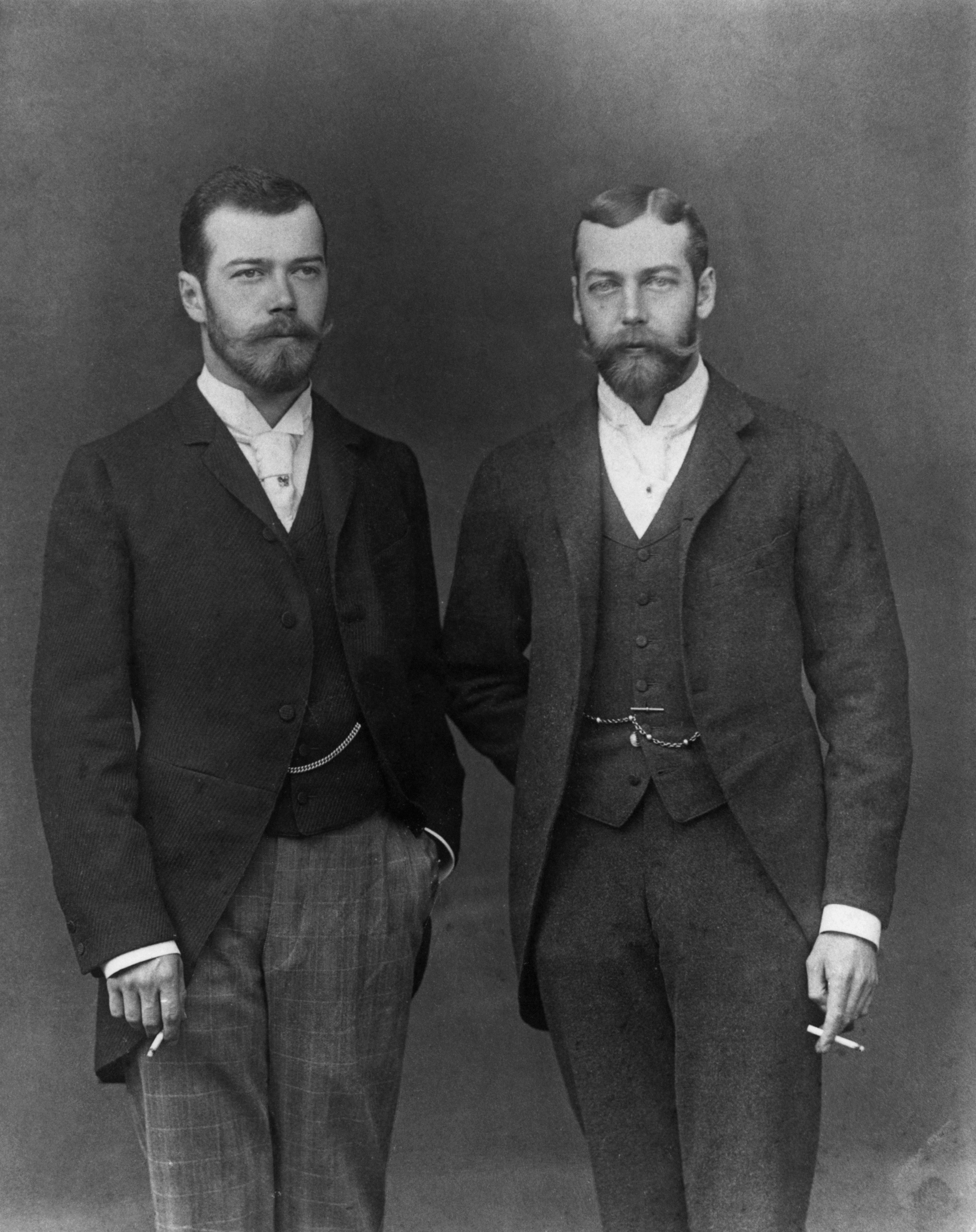
They looked like the same person. Honestly, if you put King George V and Tsar Nicholas II in the same room—which happened often—you’d have a hard time telling who was who. They had the same trimmed beards, the same piercing blue eyes, and that specific regal posture that only comes from being at the top of a world-spanning empire.
They weren't just lookalikes. They were first cousins. Their mothers, Alexandra and Dagmar, were Danish sisters who married into the most powerful families on the planet. Naturally, the boys grew up calling each other "Georgie" and "Nicky" in their private letters.
But history isn't a fairy tale. While they shared a face, their fates couldn't have been more different. One became the father of the modern House of Windsor. The other ended up in a blood-splattered basement in Siberia.
The Twin Cousins of Europe
People used to get them confused at parties all the time. At the wedding of Princess Victoria Louise in 1913, they even swapped uniforms for a laugh. It was a prank that only emperors could pull off.
George V was the King of the United Kingdom and Emperor of India. Nicholas II was the Tsar of All the Russias. Together, they represented an incredible amount of global power. But despite their identical appearances, their internal lives were worlds apart. George was a man of routine, obsessed with his stamp collection and the naval traditions of Britain. Nicholas was a man out of time, an absolute autocrat who believed God had personally handed him the keys to Russia.
A Bond of Letters and Leisure
Their relationship was genuinely warm. You've probably seen the photos of them sitting together, looking like twins. Those weren't just for show.
- Casual Correspondence: They wrote to each other constantly, often in English.
- Family Holidays: They spent summers together at the Danish court, escaping the pressures of their respective thrones.
- Mutual Respect: George admired Nicholas's devotion to his family, while Nicholas looked to the British crown as a symbol of stability.
But by 1917, the world was on fire. The Great War was grinding Europe into the dirt, and in Russia, the people had reached a breaking point.
Why George V Didn't Save the Romanovs
This is the big one. The question that still haunts historians and royal enthusiasts alike. Why did "Georgie" let "Nicky" die?
For years, people blamed the British government. The story went that Prime Minister David Lloyd George was the one who blocked the rescue. But real history is messier. Declassified documents, including letters from George V's private secretary, Lord Stamfordham, tell a different story.
It was actually King George V who got cold feet.
The Fear of Revolution
Britain in 1917 wasn't exactly a stable paradise. The war was dragging on, and the working class was watching the Russian Revolution with a lot of interest. There were strikes. There was talk of republicanism.
George V was terrified that bringing the "Bloody Tsar" to England would light a fire under his own throne. Nicholas wasn't popular in the UK. He was seen as a tyrant who had ordered the shooting of peaceful protesters on "Bloody Sunday" in 1905.
Then there was the problem of the Tsarina, Alexandra. She was German. During World War I, being German in Britain was a social death sentence. The King was so worried about his German roots that he literally changed the family name from Saxe-Coburg-Gotha to Windsor that same year.
Bringing a German-born Empress and a disgraced autocrat into the country? It was political suicide.
The Tragic End at Ekaterinburg
The window for rescue closed fast. While the British debated and George V worried about his image, the Provisional Government in Russia was replaced by the Bolsheviks.
Nicholas, Alexandra, and their five children were moved from palace to palace, eventually ending up in the Ipatiev House in Ekaterinburg. By then, any hope of a British ship waiting in the Baltic was a fantasy.
In July 1918, the family was woken up in the middle of the night. They were told they were being moved for their safety. Instead, they were led into a small basement room.
The execution was chaotic. It was brutal. Because the girls had sewn jewels into their corsets for safekeeping, the diamonds acted as makeshift armor, causing the bullets to ricochet. It took far longer than the executioners intended.
When the news reached London, George V was devastated. He wrote in his diary about the "terrible murder" of his cousin. But deep down, he knew his own hesitation had played a part.
Lessons From the Throne
The story of George V and Nicholas II is basically a masterclass in the cold reality of power. Personal loyalty often stops exactly where political survival begins.
If you want to understand this era better, don't just look at the big battles. Look at the personal letters.
What you can do next:
Check out the National Archives (UK) online resources on the Russian Revolution. They have digitized several key letters from Lord Stamfordham that prove the King’s involvement in the asylum denial. It changes the way you look at the "Twin Cousins" forever.
To see the visual proof of their bond, look up the 1913 Berlin wedding photos. It’s haunting to see them smiling in those identical uniforms, completely unaware that in five years, one would be dead and the other would be fighting to keep his crown.
Real history doesn't always have a hero. Sometimes it just has people making impossible choices in a world that’s falling apart.
Actionable Insight: If you're researching this for a project or just curiosity, focus on the 1917 telegrams between the British Foreign Office and the Ambassador to Russia. They reveal the exact moment the British "invitation" for asylum was quietly withdrawn. This specific paper trail is the "smoking gun" of the Romanov tragedy.