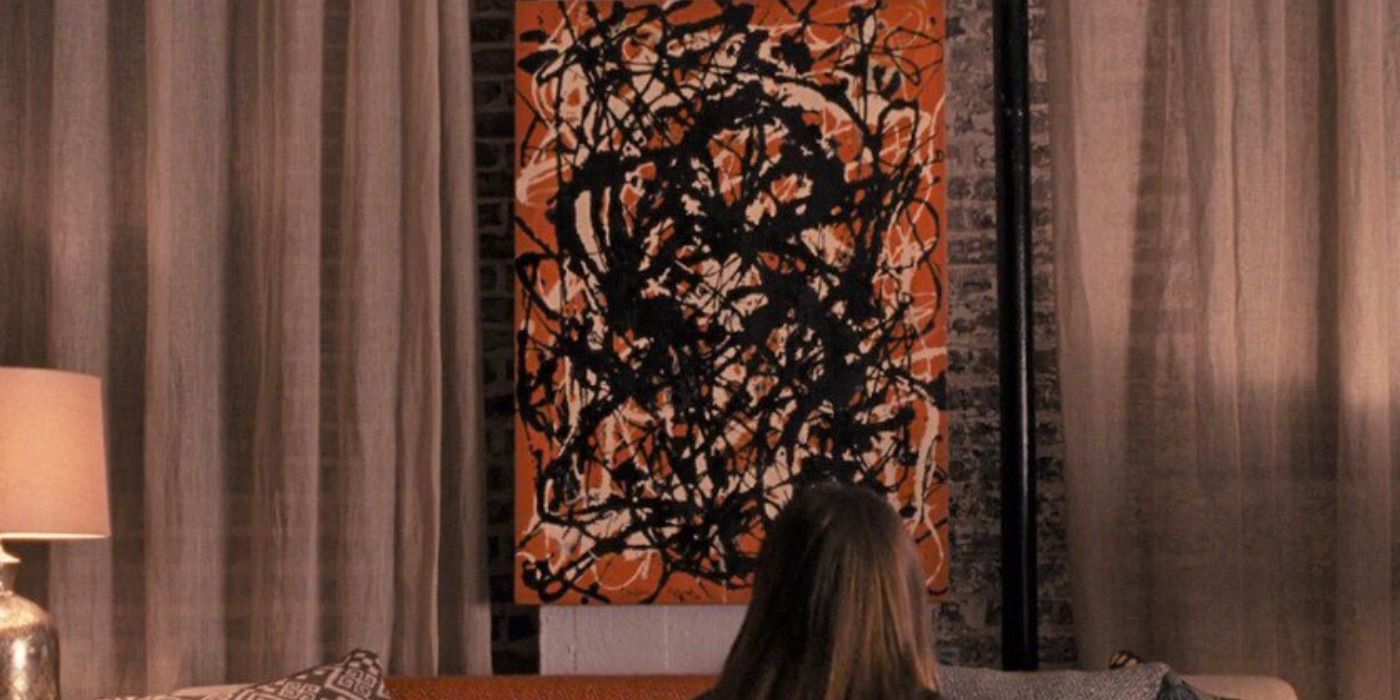
Art and math don't usually sit at the same table. One is messy, all about feelings and "splatter," while the other is rigid, cold, and binary. But in the 2016 thriller The Accountant, these two worlds collide inside a silver Airstream trailer. If you've seen the movie, you know the scene: Ben Affleck’s character, Christian Wolff, is lying on his bed, staring up at a chaotic tangle of black, white, and red lines.
It’s a Jackson Pollock. Specifically, it's a 1946 piece called Free Form.
Most people just see it as a "rich guy trophy." A way to show that this math savant has millions of dollars hidden away. But honestly, the choice of this specific Jackson Pollock painting in The Accountant isn't random. It’s actually a pretty brilliant piece of storytelling that mirrors exactly what’s going on inside Christian’s head.
What is the Pollock Painting in The Accountant?
The painting shown in the film is an oil-on-canvas work titled Free Form. Pollock painted it in 1946, right at the dawn of his most famous "drip" period. It’s not a massive mural like some of his later works; the real thing is actually quite small—only about 19 by 14 inches.
In the movie, Christian has it mounted on the ceiling of his trailer.
Think about that for a second. Pollock usually painted with the canvas on the floor. He’d "dance" around it, dripping paint from above. By putting it on the ceiling, Christian is literally reversing the perspective of the creator. It’s a forensic accountant’s way of looking at the world: upside down, deconstructed, and looking for the hidden logic in the mess.
The Real History of Free Form
You won't find this painting in a private bunker in real life. It currently lives at the Museum of Modern Art (MoMA) in New York. It was a gift from the Sidney and Harriet Janis Collection.
Is it worth the "hundreds of millions" implied in the film?
- Auction Reality: While Free Form itself hasn't been sold lately, other Pollocks have cleared $140 million to $200 million easily.
- The MoMA Connection: Because it’s in a museum collection, it’s basically "priceless." It’s not for sale.
- The 1946 Significance: This was likely one of Pollock’s first-ever drip paintings. It represents the exact moment he broke away from traditional art and started his "action painting" style.
Why Does a Math Genius Love Drip Art?
It seems like a contradiction. Christian Wolff is a man of extreme order. He lines up his silverware. He finishes every task he starts. He can't handle a puzzle with a missing piece. So why would he want to stare at a "mess" like a Pollock?
Basically, it's about the math of chaos.
Back in the late 90s, a physicist named Richard Taylor discovered that Pollock’s paintings actually follow the rules of fractal geometry. Fractals are patterns that repeat at different scales—think of the way a snowflake or a coastline looks. They appear chaotic to the naked eye, but they have a deep, underlying mathematical structure.
For a guy like Christian, the Jackson Pollock painting in The Accountant isn't a mess. It’s a complex equation. He isn't looking at "splatters"; he’s likely seeing the fluid dynamics and the recurring patterns that most of us are too "normal" to notice. It calms him because it represents a type of order that exists beyond the surface of things.
The Secret Gift at the End
The movie ends with a bit of a "gotcha" moment involving the art. Christian gives a gift to Dana (Anna Kendrick). It’s a framed copy of Dogs Playing Poker by Cassius Marcellus Coolidge.
Kinda funny, right? It’s the ultimate "low-brow" art.
But then she notices the corner peeling. Underneath the kitschy dogs is the original Free Form. It’s a massive gesture. He’s giving her the most valuable, most personal thing he owns. In his world, that painting was his anchor. By giving it away, he’s showing he’s finally "letting go" or at least opening up his rigid world to another person.
Art vs. Accuracy in the Film
We have to be real here—some of the art stuff in the movie is pure Hollywood.
- The Size: The movie version looks a bit larger than the real 19x14 inch canvas at MoMA.
- The Portability: You probably shouldn't mount a $150 million masterpiece to the ceiling of a vibrating trailer if you want it to stay in "museum condition."
- The Storage: Keeping a Renoir and a Pollock behind a fake wall in an Airstream is an insurance agent's literal nightmare.
How to Value a Pollock Today
If you ever find yourself in a thrift store—like Teri Horton did in the famous documentary Who the #$&% is Jackson Pollock?—and you see something that looks like the Jackson Pollock painting in The Accountant, don't get your hopes up too fast.
Authentication is a brutal process. The "Pollock-Krasner Foundation" stopped authenticating works years ago because the lawsuits from disgruntled owners were too much to handle. Today, experts look for "provenance" (the paper trail of who owned it) and forensic evidence.
Forensic art experts like Peter Paul Biro (who was mentioned in real-life Pollock disputes) use things like:
- Fingerprint matching: Finding a print in the wet paint that matches Pollock’s studio.
- Paint Analysis: Checking if the pigments were actually available in the 1940s.
- Fractal Analysis: Using computer algorithms to see if the "drip" matches the artist’s physical rhythm.
Actionable Insights for Art Lovers
If the movie made you curious about Abstract Expressionism, don't just stare at a screen. You can actually see the "vibe" of Christian Wolff's collection in person.
- Visit MoMA: If you're in NYC, go see the real Free Form. It’s smaller than you think, but the texture is incredible in person.
- Look for the Fractals: Next time you see a drip painting, try to stop looking for "shapes." Instead, look for the density of the lines. See if you can spot the repeating patterns.
- Check the Edges: True Pollocks often have paint that goes right to the edge because he painted on unstretched canvas. It’s a tell-tale sign of his process.
The Jackson Pollock painting in The Accountant isn't just a prop. It's a bridge between the character's autism and the "chaotic" world outside. It’s the one place where he finds a logic that matches his own.
If you want to dive deeper into how art is used in film, start by looking at Ex Machina—it uses a different Pollock painting (Number 17A) to explain the exact same concept of "deliberate vs. random" intelligence. It’s a recurring theme for a reason: because some things can only be explained through a splatter of paint.