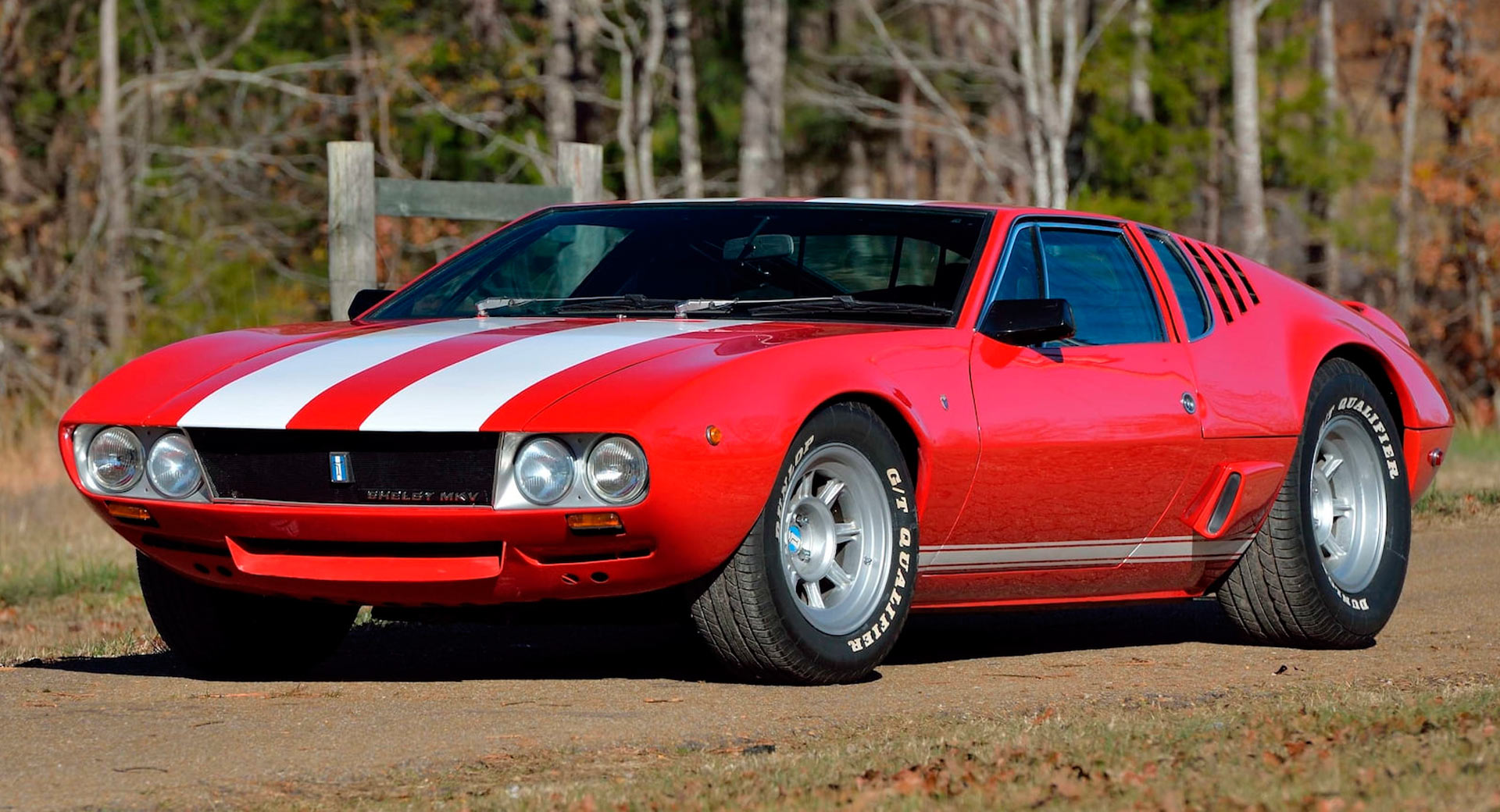
Italian curves meet American muscle. It sounds like a cliché, right? But back in 1967, the De Tomaso Mangusta wasn't a cliché; it was a middle finger. Alejandro de Tomaso, a charming and notoriously difficult Argentinian racing driver turned constructor, wanted to eat Carroll Shelby’s lunch. He literally named the car "Mangusta"—the Italian word for Mongoose—because those are the only animals that can kill a Cobra.
It worked. Sort of.
If you look at one today, your jaw just drops. It’s impossibly low. It’s wider than it has any right to be. Giorgetto Giugiaro, working for Ghia at the time, penned a silhouette that makes modern supercars look like they were designed by a committee of accountants. But here’s the thing about the Mangusta: it is a beautiful disaster. It’s a car that wants to kill you, and it’ll look stunning while doing it. Honestly, it’s probably the most misunderstood vehicle of the 1960s.
Why the De Tomaso Mangusta Design Still Wins
The doors are the first thing everyone notices. Not the ones you climb into, though those are cool too. I’m talking about the rear engine covers. They are "gullwing" style, hinged down the center spine of the car. When you open them, the entire rear of the chassis is exposed like a mechanical heart transplant. It’s theatrical. It’s excessive. It’s exactly what a supercar should be.
Underneath that glass and steel sat a Ford V8. Specifically, the 289 cubic-inch (4.7L) engine for European models and the 302 (5.0L) for the U.S. market. It produced about 220 to 306 horsepower depending on who you asked and which day of the week it was. You’ve got this delicate, high-fashion Italian body wrapped around a cast-iron lump of Detroit iron. It’s basically a supermodel in work boots.
But why did Giugiaro make it so low? The roofline sits just 43 inches off the ground. If you’re over six feet tall, you aren’t driving this car; you’re wearing it. The cabin is cramped, the pedals are offset to the right because of the wheel arch, and the air conditioning—if it works—mostly just moves hot air around.
The Handling Nightmare Nobody Admits
Let's talk about the "widowmaker" reputation.
The De Tomaso Mangusta has a weight distribution that defies logic. About 68% of the weight sits over the rear wheels. For context, a modern rear-engine Porsche 911 usually hovers around 60%. When you have that much mass swinging around behind the rear axle, physics becomes a very stern teacher.
Most owners will tell you that the chassis flex is real. The car used a backbone chassis, which was great for keeping things light but less great for keeping things rigid under cornering loads. If you hit a bump mid-corner at high speed, the car sort of... recalculates its trajectory. Not always in the direction you intended.
- The suspension was independent all around.
- Disc brakes were standard at all four corners.
- The ZF five-speed transaxle was the same unit used in the Ford GT40.
It was a beast. But it wasn't a refined beast. Unlike the later Pantera, which benefited from Ford’s massive engineering resources and better weight balance, the Mangusta was a boutique experiment. It was raw.
The Shelby Feud and the Mongoose Name
History is full of petty grievances, and the automotive world is no exception. Alejandro de Tomaso and Carroll Shelby were supposed to collaborate on a racing project called the P70. De Tomaso was handling the chassis; Shelby was handling the engines and the money.
The deal went south. Shelby pulled out to focus on the GT40 program for Le Mans. Alejandro was furious. He took the bones of that project, handed them to Giugiaro, and told him to build a road car that would humiliate Shelby’s Cobra.
The name wasn't a coincidence. It was a declaration of war.
Ironically, the Mangusta ended up being more of a grand tourer than a track weapon. It was too heavy and too unpredictable for serious racing, but as a piece of rolling sculpture on the streets of Modena or Los Angeles, it had no equal. Only about 400 were ever built between 1967 and 1971. Today, finding one that hasn't been modified or crashed is like finding a unicorn that pays its taxes.
What It’s Actually Like to Own One Today
Buying a De Tomaso Mangusta in 2026 isn't just a financial decision; it’s a lifestyle choice. You need to be okay with people staring. You also need to be okay with your mechanic having a permanent residence in your guest house.
The Ford engines are actually the easy part. You can get parts for a 302 V8 at any local auto parts store. The bodywork, however? That’s a different story. If you crack one of those gullwing engine covers, you aren't ordering a replacement from a catalog. You're hiring a master metal worker to spend three months hammering out a new one by hand.
Then there’s the rust. Italian steel from the late 60s wasn't exactly known for its corrosion resistance. Many Mangustas literally dissolved if they spent a weekend in a humid garage. A "survivor" car—one that hasn't been fully restored—is incredibly rare.
- The Look: Unmatched. Even a Lamborghini Miura looks a bit "soft" next to a Mangusta.
- The Sound: Pure American thunder. It doesn't scream like a Ferrari; it growls.
- The Value: Prices have skyrocketed. Ten years ago, you could snag one for $100k. Now? You’re looking at $250,000 to $400,000 depending on provenance.
Misconceptions and Reality Checks
People often confuse the Mangusta with its younger brother, the Pantera. Don't do that. The Pantera is a much better car to drive, but it’s a much less "special" car to look at. The Pantera was mass-produced (relatively speaking) and sold through Lincoln-Mercury dealerships. The Mangusta was a hand-built boutique special.
One common myth is that the car is slow because of the low horsepower numbers of the US-spec smog-choked engines. Sure, 220 horsepower sounds pathetic by today’s standards where a Honda Civic can put up those numbers. But the Mangusta is light. It weighs about 2,600 pounds. That’s roughly the weight of a Mazda Miata but with a V8 shoved in the middle. It’s fast enough to be scary.
Actually, the scariest part isn't the speed; it's the visibility. You cannot see anything behind you. The rear-view mirror is basically a decorative piece of glass. You rely on faith and the sound of other cars honking as you merge.
Why the Mangusta Matters Now
We live in an era of "perfect" cars. Everything is computer-controlled, aerodynamically optimized, and safe. The De Tomaso Mangusta is the opposite of all that. It’s an exercise in ego and aesthetics.
It reminds us that cars don't have to be good to be great. The Mangusta is a "bad" car in many objective ways. It handles poorly, it’s cramped, and it’s temperamental. Yet, it remains one of the most desirable collector cars on the planet. Why? Because it has a soul. It was built by a man who wanted to settle a score, designed by a genius at the peak of his powers, and powered by an engine that sounds like the end of the world.
Practical Steps for the Aspiring Collector
If you're actually serious about putting one of these in your garage, you need to do your homework. This isn't a car you buy on eBay after two glasses of wine.
- Verify the Chassis: Many Mangustas have "hidden" rust in the central backbone. Get a borescope. Look inside the frame. If the backbone is compromised, the car is a paperweight.
- Check the Transaxle: The ZF 5DS-25 is a legendary gearbox, but it's expensive to rebuild. Make sure it shifts smoothly. If it grinds, you’re looking at a $15,000 repair bill instantly.
- Join the Club: The Pantera Owners Club of America (POCA) actually welcomes Mangusta owners. The community knowledge there is deeper than any shop manual you’ll find.
- Don't Over-Restore: There is a trend toward "concours" restorations where the car is better than it was when it left the factory. Don't do that. A Mangusta should look a little mean, a little used, and a lot like it just finished a high-speed run down the Autostrada.
Buying a Mangusta is an admission that you value drama over comfort. It’s a commitment to preserving a piece of automotive history that was never meant to be sensible. It was meant to be a Mongoose.
Next Steps for Enthusiasts:
- Research Serial Numbers: Start by cross-referencing known VINs through the De Tomaso Registry to ensure any car you're looking at isn't a "bitsa" (bits of this, bits of that).
- Locate a Specialist: Before purchasing, identify a shop in your region that understands the ZF transaxle and Ford small-block tuning. You'll need them for the post-purchase "sorting" phase.
- Study the Prototypes: Look into the "Spyder" versions of the Mangusta. Only one was officially built by the factory, but several conversions exist. Knowing the difference is key to understanding the market value.