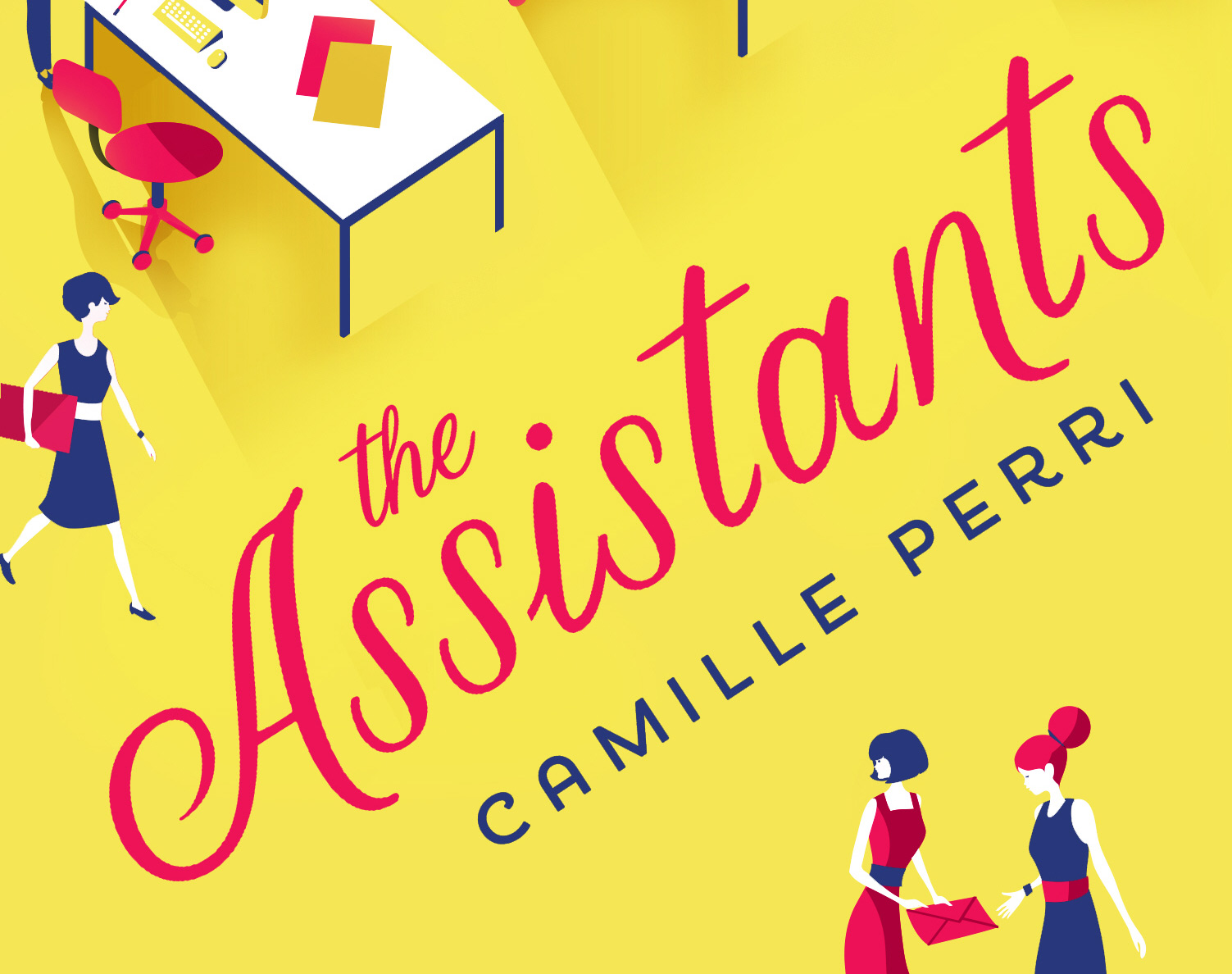
You know that feeling when you're staring at your bank account and it’s just... sad? Like, "I worked forty hours this week and I still can't afford a decent sandwich" sad. That is the gut-punch reality at the heart of The Assistants by Camille Perri. It’s a book that gets labeled as "chick lit" or a "beach read," but honestly? It’s basically a manifesto for anyone who has ever felt like a ghost in a glass office building.
The story follows Tina Fontana. She’s thirty, she’s sharp, and she’s the executive assistant to Robert Barlow, the billionaire CEO of a massive media conglomerate called Titan Corp. Tina is the person who knows his favorite scotch and handles his private jet bookings. She is also the person who can barely pay her rent in a damp New York apartment while her student loans loom over her like a vengeful shadow.
The "Accidental" Heist
The whole plot kicks off because of a boring technicality. A clerical error results in a reimbursement check for $19,147 landing on Tina’s desk. For Robert, that’s literal pocket change—the kind of money he’d spend on a decorative tree for his garden without blinking. For Tina, it’s her entire debt. It’s her freedom.
She cashes it.
She doesn't set out to be a criminal mastermind. She just wants to stop drowning. But here’s the thing about "just one time"—people notice. Specifically, Emily Johnson, an assistant in the accounting department, sniffs out the discrepancy. Instead of narc-ing, Emily wants in. Then another assistant wants in. Suddenly, Tina is the reluctant leader of an underground embezzlement ring that is basically a Robin Hood scheme for the overeducated and underpaid.
Why This Book Still Matters in 2026
You might think a book from 2016 wouldn't feel fresh today, but the "assistant class" struggle has only gotten weirder. Perri wrote this while she was actually working as an assistant at Esquire. She saw the two worlds side-by-side: the expense reports for five-figure dinners and the assistants eating ramen in the breakroom.
Most people get this book wrong by thinking it’s just a lighthearted caper. It’s actually a pretty biting critique of how we value labor. Tina is "beloved" by her boss, yet her salary doesn't reflect that value. The book asks a messy question: If the system is rigged, is it really "stealing" to take back what you need to survive?
The Characters Who Make It Work
- Tina Fontana: Our narrator. She’s relatable because she’s not a rebel; she’s a "good girl" who finally breaks.
- Emily Johnson: The foil to Tina. She’s a bit of a "money-chasing brat" (as some reviewers put it), but she represents the raw ambition that Tina lacks.
- Robert Barlow: He isn't a cartoon villain. He’s actually somewhat charming, which makes the betrayal feel more complex.
- Wendi: The IT expert who brings the technical muscle to the scheme. She’s the one who turns a few checks into a full-blown movement.
Realism vs. Fantasy
Let’s be real—the chances of cashing a nearly $20,000 corporate check in 2026 without an immediate fraud alert from a bank algorithm are... slim. The book definitely leans into the "fable" side of things. Some readers find the middle section a bit repetitive as Tina cycles through her guilt, but the final third picks up the pace significantly. It shifts from a quiet office drama into a high-stakes scramble that feels like Ocean’s Eleven if the cast wore sensible flats and carried Starbucks cups.
Where is the Movie?
There’s been talk about a film adaptation for years. Back in 2016, Cold Iron Pictures acquired the rights, and Perri was even set to adapt the screenplay herself. While things in Hollywood move at a glacial pace, the themes are so relevant to the "quiet quitting" and "labor rights" era that it's a story that refuses to die. Interestingly, Camille Perri’s other hit, When Katie Met Cassidy, also saw development interest from HBO Max.
The Actionable Takeaway
If you’re stuck in a cycle of "overeducated and underpaid," The Assistants is a cathartic read. It won't give you a legal way to embezzle your student loan payments—please don't try that—but it does offer some genuine perspective:
Audit your own value. If you are the "brain" behind a high-powered executive, you have more leverage than you think. You don't need to commit a felony to start demanding a seat at the table.
Find your "Wendi." Tina couldn't have scaled her "non-profit" without a team. In the real world, this means networking with other assistants. Information sharing (like salary transparency) is the legal version of Tina’s scheme.
Don't wait for the error. The most heartbreaking part of the book is how long Tina waited for "permission" to be successful. The system isn't designed to hand you a windfall; usually, you have to go out and negotiate for it.
Read it for the dry wit. Read it for the New York vibes. Just don't expect it to be a simple "happily ever after"—it's much more complicated than that.
Next Steps for Readers
- Check out Camille Perri’s follow-up, When Katie Met Cassidy, if you want a shift into queer rom-com territory with the same sharp observations on power dynamics.
- Look into the "Pay Up" movement or similar labor advocacy groups if the themes of income inequality in the book hit a little too close to home.
- Compare the book to The Devil Wears Prada—while Andy Sachs wanted to leave the industry, Tina Fontana and her crew want to stay and actually afford to live in it.