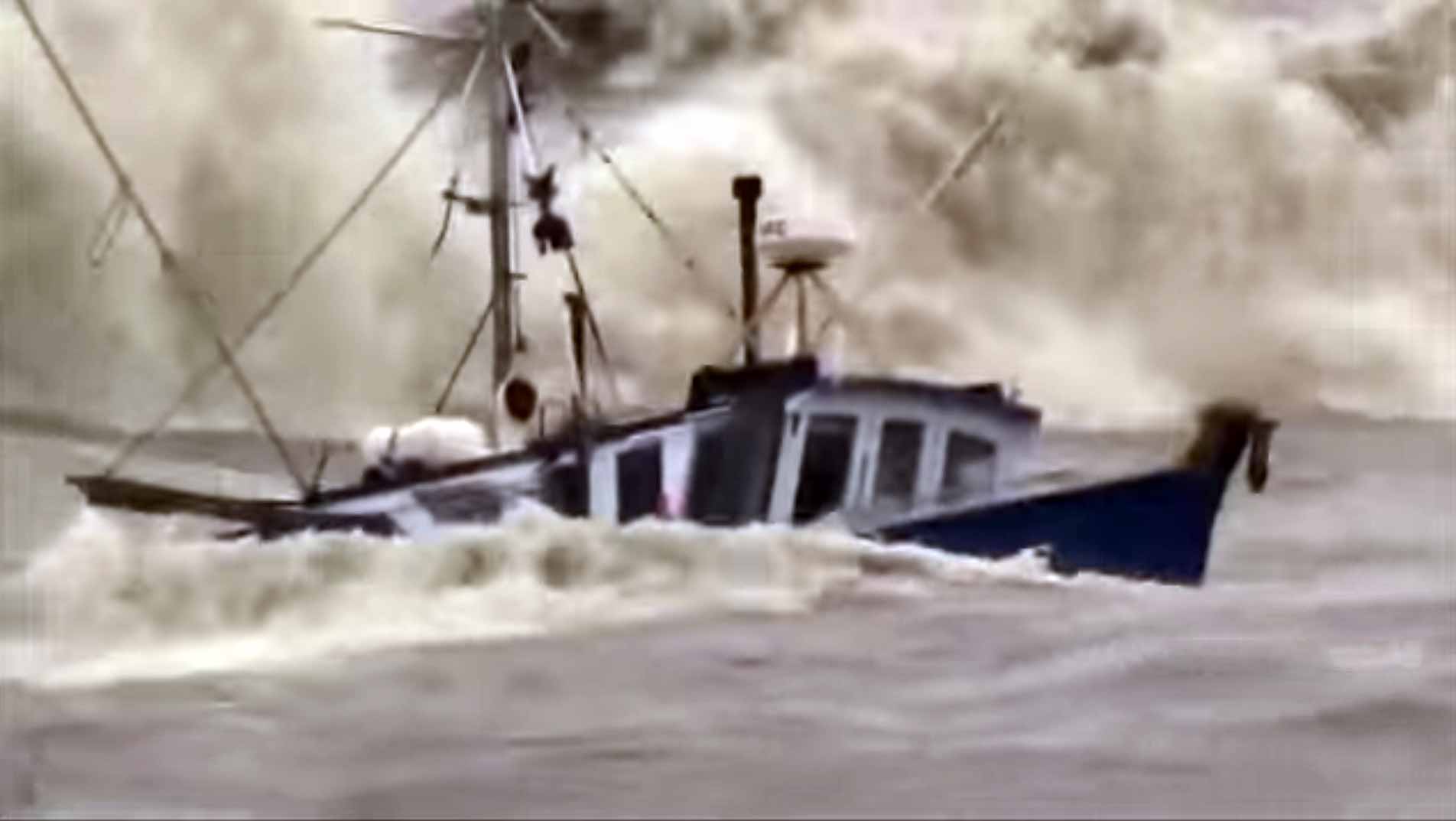
Ever watched a video of a massive container ship disappearing into a gray wall of water and wondered how the heck it comes back up? It’s terrifying. Honestly, the physics of ships in rough seas is less about "fighting" the ocean and more about being a very sophisticated, very heavy toy that knows how to wobble correctly. Most people assume a ship stays upright because it’s heavy. That's actually wrong. If it were just heavy, it would sink like a stone the second a wave hit the deck.
The secret is buoyancy and a little thing called the metacenter.
When a ship tilts—what sailors call "heeling"—the center of buoyancy shifts. In a well-designed vessel, that center moves in a way that pushes the ship back to the middle. It’s a constant, violent dance between gravity pulling down and the ocean shoving up. But when you’re in the middle of the North Atlantic during a "bomb cyclone," it doesn't feel like physics. It feels like being inside a washing machine filled with steel.
The Reality of Surviving Ships in Rough Seas
Modern naval architecture is insane. Take the Emma Maersk, for instance. It’s over 1,300 feet long. When a ship that size encounters ships in rough seas conditions, the hull actually flexes. It bends. If the steel were perfectly rigid, the ship would literally snap in half like a dry twig when it gets caught between two wave crests. This is called "hogging" and "sagging." Imagine the ship balanced on a single wave in the middle; the ends hang down (hogging). Now imagine the ends supported by two waves while the middle hangs over a trough (sagging). The ship is basically a giant, slow-motion spring.
The ocean doesn't care about your schedule.
In 2015, the El Faro sank because it lost propulsion in the middle of Hurricane Joaquin. That's the nightmare scenario. Once a ship loses its engines, it can't keep its bow pointed into the waves. It turns "beam-to," meaning the waves hit the side. That’s usually game over. Without the ability to steer, the ship loses its "righting arm."
Why Weight Distribution is Everything
You can't just throw containers on a deck and hope for the best. Stability is a math problem.
Chief officers use "loading computers" to make sure the Metacentric Height (GM) is just right. If the GM is too high, the ship is "stiff." It snaps back upright so fast it can break equipment or throw crew members across the room. If the GM is too low, the ship is "tender." It rolls slowly and takes a long time to recover. If it’s too low? It just keeps rolling. Capsized.
- Free Surface Effect: This is a silent killer. If you have a half-full tank of water or fuel, that liquid sloshes to the low side during a roll. It adds weight to the tilt, making it harder to come back up.
- Green Water: This isn't just spray. This is solid ocean landing on the deck. A cubic meter of seawater weighs about a metric ton. If a ship takes 500 tons of water on its forward deck, the nose stays down, and the next wave just buries it further.
Rogue Waves: The Stuff of Nightmares
For decades, scientists thought "rogue waves" were just tall tales told by drunk sailors. They weren't. In 1995, the Draupner platform in the North Sea recorded a single wave that was 84 feet high. This wasn't a tsunami caused by an earthquake. It was just the ocean being mean.
When ships in rough seas encounter a rogue wave, the math changes. These waves are often twice the size of the surrounding sea state and come from a different direction. They can smash bridge windows that are 60 or 70 feet above the waterline. The Queen Elizabeth 2 hit one in 1995 that the captain described as a "great wall of water." It was estimated at 95 feet. The ship survived because it was built like a tank, but it’s a reminder that we’re guests out there.
How Technology Tries to Cheat the Ocean
We have better tools now than the old "look at the horizon and pray" method.
- Stabilizer Fins: These are basically underwater wings. They stick out from the side of the hull and use lift to counteract rolling. They work great on cruise ships because passengers hate vomiting. But in a true survival storm, they usually get retracted so they don't get ripped off.
- Weather Routing: Companies like FleetWeather or StormGeo provide real-time data to help captains go around the worst of it. It’s better to arrive two days late than not at all.
- AIS and Satellite Monitoring: We can track exactly how a ship is moving, its pitch, and its roll from space.
It’s easy to forget that despite all our tech, the ocean is still the same ocean that sank the Vikings.
The North Atlantic in winter is particularly brutal. You have the "Perfect Storm" conditions where warm air from the Gulf Stream hits cold Arctic air. This creates low-pressure systems that turn the sea into a graveyard. Mariners talk about "The Wall," a specific area where the current and wind oppose each other, creating steep, vertical waves that have no back to them. You don't sail over these waves; you fall off them.
The Human Element in the Storm
What’s it like for the crew? It’s exhausting. You can’t sleep because you’re being tossed out of your bunk. You can’t eat because the galley is a disaster zone. Everything has to be "lashed." If you don't tie down a chair, it becomes a projectile.
The psychological toll of ships in rough seas is massive. You’re listening to the ship groan. Steel isn't supposed to make those noises. There's a specific "thrum" when the propeller (the screw) comes out of the water because the ship is pitching so hard. The whole vessel vibrates violently as the engine suddenly has no resistance, then wham—the screw bites back into the water. It feels like the ship is being hit by a train.
Misconceptions About Sinking
Most people think ships sink because they get a hole in the bottom. While that happens (looking at you, Titanic), most modern ships in storms sink because of "loss of stability."
Maybe a cargo hold hatch fails. Maybe the "heavy fuel oil" gets contaminated with seawater. Maybe the cargo shifts. If you're carrying grain and it all slides to the port side, the ship stays tilted. This is "static heel." Once you're tilted, you're a sitting duck for the next wave.
Reflect on the Cougar Ace, a car carrier that tilted 60 degrees. It didn't sink immediately, but it was totally incapacitated. Recovering a ship in that state is a feat of engineering that costs millions.
Navigating the Future of Maritime Safety
We are getting better at this. New "X-Bow" designs by companies like Ulstein make ships pierce through waves rather than slamming on top of them. It’s a weird-looking inverted bow that looks like a whale’s nose. It reduces the "slamming" effect and makes the ride much smoother for the crew and better for the fuel tank.
But even with the best tech, the ocean remains unpredictable.
If you’re interested in the technical side of how we keep ships in rough seas from falling apart, you have to look at the International Maritime Organization (IMO) standards. They dictate everything from how many lifeboats you need to the exact thickness of the hull plates. It’s a boring list of rules written in the blood of sailors who didn't have them.
Actionable Steps for Understanding Maritime Safety
If you're looking to dive deeper into how vessels handle extreme conditions or if you're planning a career at sea:
- Study the "Stability Booklet": Every ship has one. If you’re a student or enthusiast, learning to read a GZ curve will tell you more about a ship’s soul than any photo.
- Monitor Real-Time Data: Use apps like MarineTraffic or VesselFinder during a major hurricane. Watch how the pros anchor or "heave to" (pointing the bow into the wind and moving just enough to maintain steerage).
- Research the "Significant Wave Height" (SWH): When you see a weather report saying 10-foot waves, remember that individual waves can be twice that height. Always plan for the maximum, not the average.
- Check the Load Line: Next time you see a ship, look for the "Plimsoll Mark" on the side. It’s a series of lines that tell you exactly how deep the ship can sit in different types of water (fresh, salt, tropical, winter North Atlantic). It’s the law of the sea in a single circle.
The ocean hasn't changed in four billion years. Our ships just got bigger. But as any old salt will tell you, the bigger they are, the more surface area there is for the wind to grab. Stay safe, stay dry, and respect the heave.