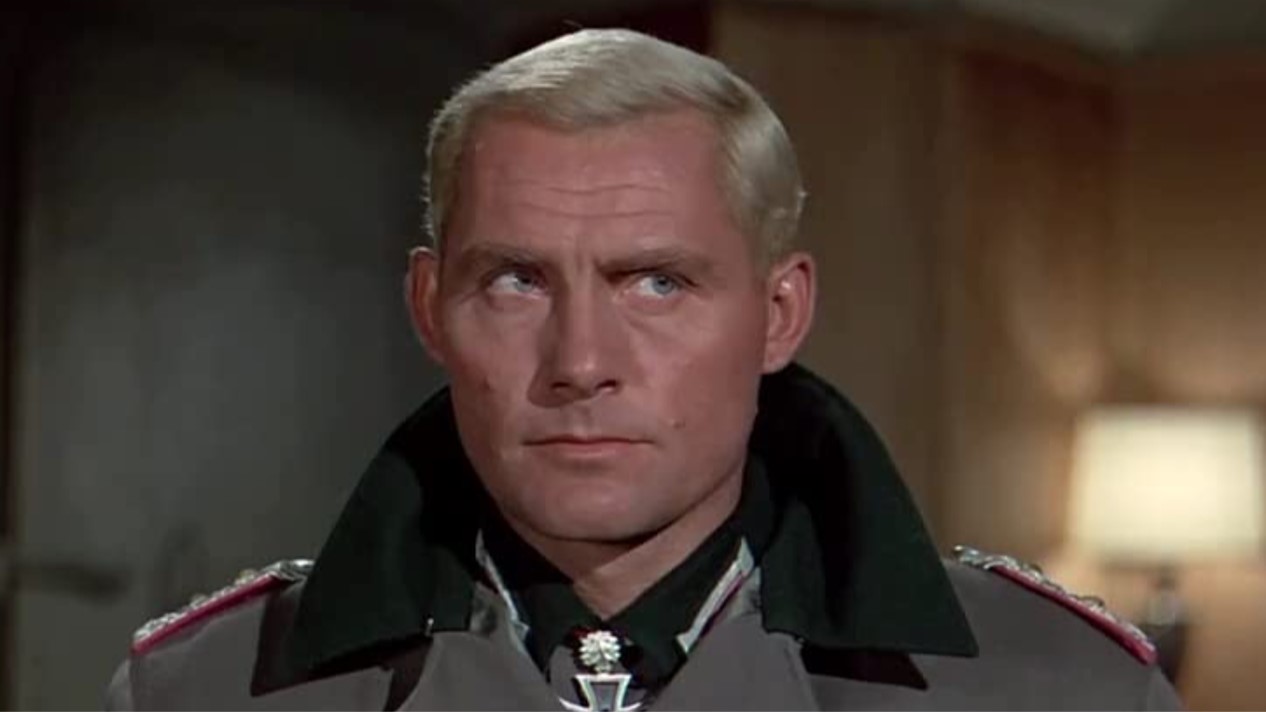
Robert Shaw was a force of nature. If you’ve seen him as the grizzled shark hunter Quint in Jaws, you know the vibe. He had this way of dominating the screen without even trying. But ten years before he was hunting Bruce the Shark, he was stomping around in a black Panzer uniform in the 1965 epic Battle of the Bulge.
Honestly, the movie is a bit of a mess. It’s loud, it’s long, and it’s about as historically accurate as a superhero flick. But Shaw? He’s the reason people still talk about it.
Robert Shaw: Battle of the Bulge and the "Ur-Nazi"
In the film, Shaw plays Colonel Martin Hessler. He’s the tip of the spear for the German offensive. The character is basically a thinly veiled version of the real-life SS commander Joachim Peiper. Shaw didn’t just play a villain; he played a man who seemed to breathe diesel fumes and icy conviction.
You’ve probably seen the "Panzerlied" scene. If not, look it up. It’s Hessler meeting his young, inexperienced tank crews. They start stomping their boots and singing a German tank anthem. Shaw just stands there, his face shifting from skepticism to this terrifying, grim satisfaction. It’s a chilling piece of acting. He made Hessler more charismatic than almost any of the "good guys."
That was actually part of the problem.
Why Ike Hated This Movie
Former President Dwight D. Eisenhower didn't just dislike the film. He hated it. He actually came out of retirement to hold a press conference specifically to denounce it. Imagine a former U.S. President today calling a press conference just to trash a Hollywood blockbuster. That’s how much of a "historical tragedy" he thought it was.
Why the anger? Well, for starters:
- The movie was filmed in the sunny hills of Spain. The real Battle of the Bulge happened in the freezing, snow-clogged Ardennes forest.
- The tanks were all wrong. The "German Tigers" were actually post-war American M47 Pattons painted gray.
- It completely ignored the British contribution.
- It simplified a month-long meat grinder into a couple of sunny afternoons.
But through all that inaccuracy, Robert Shaw's Battle of the Bulge performance remains the one thing critics and historians can't quite dismiss. He brought a "human dimension" to a character that could have been a cardboard cutout.
The Reality vs. The Robert Shaw Version
The real Joachim Peiper was a war criminal. He was responsible for the Malmedy Massacre, where American POWs were gunned down in a field. The movie touches on this but changes the names and details. Hessler is portrayed as a professional soldier who is "fed up" with the politics of the war but still wants to win at any cost.
Shaw played him with a sharp, clipped British accent that somehow felt more German than a real one. He had this "map of England" face, as some critics said, but he wore that peroxide-blonde hair and the black uniform like he was born in it.
The movie ends with a massive tank battle that basically never happened. The Germans run out of gas—which did happen—but the way it’s shown is pure Hollywood. Yet, when you watch Shaw’s face as he realizes his glorious offensive is literally sputtering to a halt, you feel the weight of it. That’s the power he had.
Is It Worth Watching Today?
If you're looking for a history lesson, stay away. Go watch Band of Brothers instead. But if you want to see a masterclass in screen presence, this is it. Shaw was just starting his run of "tough guy" roles that would lead to The Sting and The Taking of Pelham One Two Three.
He wasn't a "star" in the way John Wayne was. He was an actor's actor. He improvised. He challenged directors. He made the people around him—even legends like Henry Fonda—work harder.
What You Can Do Next
If you're a fan of Shaw or WWII cinema, here is how you can actually dive deeper into this specific rabbit hole:
- Watch the "Panzerlied" scene on YouTube. It’s the definitive Robert Shaw moment in the film and arguably the most famous scene in 60s war cinema.
- Compare it to "A Bridge Too Far." If you want to see how Shaw handled a more "realistic" war movie, check out his role as General Joe Vandeleur in the 1977 film. It’s a great "before and after" comparison of his style.
- Read "The Devil's Adjutant" by Michael Reynolds. If you want the real, brutal truth about Joachim Peiper (the man Hessler was based on), this is the definitive biography. It’ll show you exactly where the movie took "creative liberties."
Robert Shaw didn't need a real Tiger tank to be intimidating. He just needed a camera and a reason to look disappointed in everyone else on screen.