You’re staring at the bedroom door at 3:00 AM. Every creak in the hallway sounds like a threat. For years, the conversation around home protection was binary: you either bought a firearm or you bought a deadbolt and hoped for the best. But things have changed. A lot.
Non lethal self defense guns are no longer just clunky toys or glorified flashlights that buzz. They’ve become a massive middle ground for people who want to stop a threat without the heavy, life-altering weight of using lethal force. Honestly, the technology has leaped forward so fast that most of the "common knowledge" people have about pepper balls and CO2 launchers is just plain outdated.
It’s about layers. Safety isn't a single item; it's a series of decisions you make before the "bad thing" happens.
The Reality of Stopping Power Without a Bullet
People love to argue about "stopping power." If you spend five minutes on a self-defense forum, you’ll see guys claiming that anything less than a .45 ACP is a paperweight. They’re missing the point. The goal of non lethal self defense guns isn't necessarily to incapacitate someone for an hour—it's to create a "window of opportunity."
You need time. Time to get out the back door. Time for the police to arrive after you’ve hit the silent alarm.
Take the Byrna SD, for example. It looks like a high-tech handgun, but it fires 68-caliber projectiles. These aren't just rubber balls. When one of these hits a chest at 300 feet per second, it hurts. A lot. But the real "magic" is the chemical payload. If you’re using pepper or tear gas rounds, you’re creating a cloud of misery that shuts down a person's ability to see or breathe clearly.
It's hard to be a threat when you're involuntarily coughing and your eyes are slammed shut.
But here is the catch: wind. If you fire a chemical projectile into a stiff breeze coming at you, guess who gets seasoned? You do. Professionals like Aaron Cohen, who trains elite security teams, often emphasize that tools are only as good as the environment they're used in. You have to think about the "backstop" and the air currents in your own hallway.
Why CO2 Is Both Your Friend and Your Enemy
Most of these devices rely on compressed CO2 or Nitrogen. This is great because it means no gunpowder, no background checks in most states, and no loud "bang" that permanently ruins your hearing in a small room.
However, CO2 has a dirty little secret. It leaks.
If you leave a CO2 cartridge pierced in your launcher for six months, there’s a very high chance that when you pull the trigger in an emergency, you’ll just hear a pathetic "hiss." That’s why newer models, like those from Umarex or the higher-end Byrna units, use a "pull-to-pierce" or "fast-pierce" system. The cartridge sits there, sealed and fresh, until the exact second you pull the trigger or hit a button.
Don't buy an old-school paintball marker for home defense. Just don't. Those seals aren't meant to hold pressure for years of sitting in a nightstand. You want something specifically engineered for "on-demand" use.
The Legal Gray Area Nobody Mentions
We need to talk about the "toy" problem.
Some non lethal self defense guns are designed to look exactly like a Glock or a Smith & Wesson. From a distance, in low light, a police officer or a criminal isn't going to see the orange tip or the slightly different slide shape. They are going to see a gun.
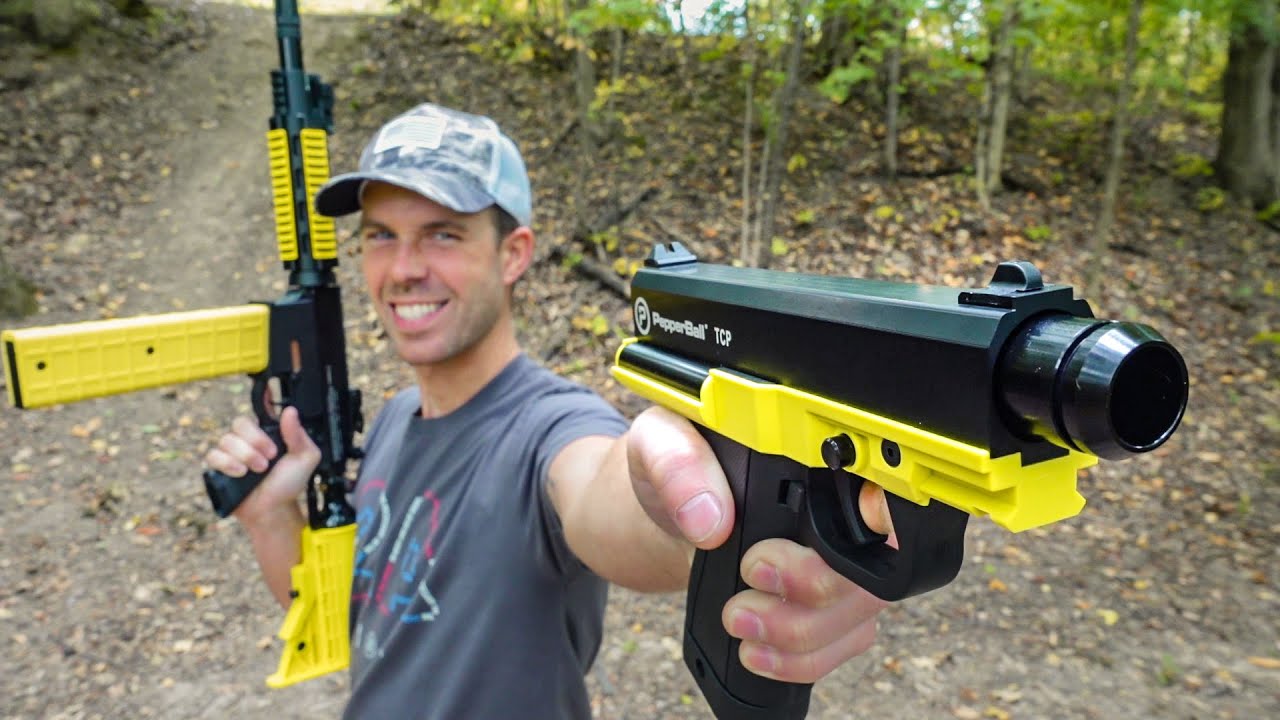
If you point a realistic-looking non-lethal device at someone who has a real firearm, the outcome is almost always tragic. This is why some manufacturers are leaning into bright colors—safety orange, desert tan, or even yellow. It signals to everyone involved that this is a different kind of encounter.
Then there’s the state-by-state headache. Even though these aren't "firearms" by federal definition (since they don't use an explosive charge), places like California, New York, and even certain cities like Chicago have specific bans on "imitation firearms" or specific types of chemical irritants.
- California: Generally allows them, but specific laws govern the "transfer" and the size of the chemical canisters.
- New York: Extremely restrictive on anything that looks like a real gun or shoots projectiles.
- Massachusetts: Requires a permit for pepper spray in some jurisdictions, which can sometimes extend to launchers.
You’ve got to do the boring work of checking your local penal code. Don't take a YouTuber's word for it. Look up your local "CCW" and "Imitation Firearm" statutes.
Projectile Types: Beyond the Rubber Ball
Most people think it's just "hurt" vs. "not hurt." In reality, the "ammo" for non lethal self defense guns is a science.
- Kinetic Rounds: These are hard plastic or rubber. They are meant for pain compliance. Think of it like a professional pitcher hitting you with a baseball. It creates a massive welt and stops forward momentum.
- Chemical Irritant (OC/CS): This is the "spicy" stuff. Oleoresin Capsicum (pepper) or CS (tear gas). These are best for multiple attackers or if you have bad aim. You don't have to hit the person directly; hitting the wall near their head creates a "hot zone."
- Inert Rounds: These are for practice. They usually have baby powder inside. Use these. Use them a lot. If you haven't fired your device at least 50 times, you aren't ready to use it when your heart is beating at 150 BPM.
There are also "grimah" or metal-weighted rounds, but be careful. The heavier the round, the more likely it is to cause permanent injury or even death if it hits a sensitive spot like the temple or throat. At that point, you've crossed back into the "lethal force" legal territory without the reliability of a real firearm. It’s a dangerous middle ground to inhabit.
The Maintenance Myth
You can't just throw a launcher in a drawer and forget it exists for five years. These are mechanical devices with O-rings and seals.
Dust is the enemy.
If you live in a dusty environment, the lubricant on the internal bolts can turn into a gritty paste. Every few months, you should be checking the seals, ensuring the projectiles haven't become "egged" (deformed) from heat, and maybe even firing one inert round to make sure the mechanical linkage still works.
It's a bit of a chore. But it's better than a "click" when you need a "pop."
Salt vs. Pepper: The Brand Wars
You've probably seen the ads for the SALT Supply gun or the PepperBall VKS. These companies are fighting for your attention with very different marketing. SALT focuses on the "home aesthetic"—white, sleek, doesn't look "scary." PepperBall focuses on the "law enforcement grade" angle.
Both are generally effective, but they serve different users. If you’re a hiker, you want something compact. If you’re defending a 3,000-square-foot house, you might actually want one of the long-gun variations that holds more rounds and has a higher velocity.
Interestingly, some of the best tech is coming out of the "Less-Lethal" divisions of companies that usually make tactical gear for SWAT teams. They are starting to realize the civilian market is huge.
Actionable Steps for Choosing and Using Your Device
Don't just go out and buy the first thing that pops up on your social media feed.
First, determine your "Why." Are you worried about a stray dog on a walk, or a home invasion? If it's a dog, a small handheld spray or a compact launcher like the Byrna EP is plenty. If it's a home intruder, you need something with a larger magazine and a higher "muzzle" velocity.
Second, buy a "training kit." Most reputable brands sell bundles that include a dozen CO2 cartridges and 50+ practice rounds. Go to a safe spot, set up some cardboard, and see how the wind affects the shot. See how the "kick" feels. It’s not much, but it’s there.
Third, establish a "staging" routine. Keep your launcher in a consistent, accessible spot. Make sure it's away from kids—even though it's "non-lethal," a pepper ball to the eye can cause permanent blindness. Treat it with the same respect you would a real firearm.
Finally, have a backup. A non-lethal gun is a tool, not a magic wand. If the device fails, do you have a high-lumen flashlight to disorient the intruder? Do you have a secondary exit?
Safety is about the system, not just the gadget. Use the launcher to buy yourself the seconds you need to win the situation by ending it—not necessarily by winning a fight. That’s the real secret to self-defense. It’s not about being the toughest person in the room; it’s about being the one who gets to go to sleep safely when the lights go out.
Check your local laws one more time. Seriously. Then, pick a system that matches your comfort level and practice until the movement is muscle memory. That’s how you actually stay safe.