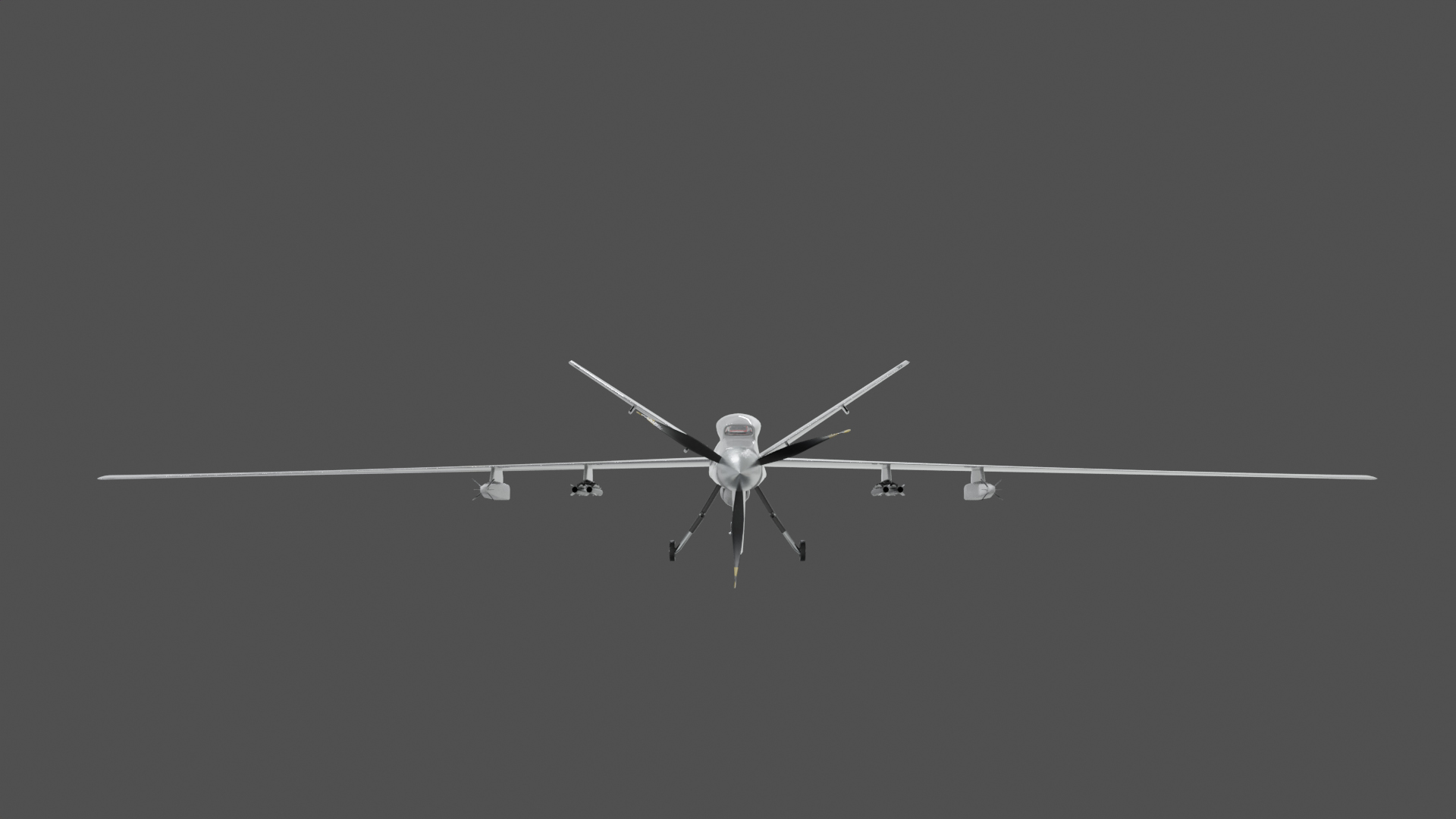
If you’ve ever scrolled through military forums or watched a grainy YouTube video of a precision strike, you’ve probably heard the number: $30 million. People toss it around like it’s the MSRP on a window sticker. But honestly? Buying a Predator B—the "Reaper"—isn't like buying a Cessna. You don't just hand over a check and fly away.
When people talk about mq 9 reaper drone cost, they usually miss the forest for the trees. The actual "flyaway" price of a single MQ-9 airframe is often quoted between $15 million and $20 million. But a bare-metal drone is just an expensive glider. It can't see, it can't talk to satellites, and it certainly can't hit a target. By the time you add the sensors, the ground control stations, and the satellite links, that number balloons.
In fact, the U.S. Air Force often cites a total system cost—which includes four aircraft, sensors, and the ground station—at roughly $56.5 million in older fiscal terms. In today's economy? You're looking at much more.
The Sticker Shock Nobody Explains
Let’s be real. If you’re a country looking to buy these, like Qatar or India recently did, you aren't paying $20 million. You're paying billions.
Why? Because the "unit cost" is a trap.
Take the Qatar deal from early 2025. The U.S. government greenlit a potential sale of eight MQ-9B SkyGuardian drones for about $1.96 billion. If you do the quick math, that’s $245 million per drone. Is General Atomics overcharging? Not necessarily. That price tag includes a massive "package":
- Spares for years of operation.
- Heavy-duty encrypted communication links.
- Training for pilots and sensor operators.
- Specialized hangars and ground equipment.
- Hellfire missiles and precision-guided bombs.
It’s the difference between buying a smartphone and buying the entire cellular network it runs on. For a military, the "drone" is the smallest part of the investment.
Flyaway vs. Program Cost
There’s a nuance here that gets lost in headlines.
- Flyaway Cost: Just the plane and its basic guts. Roughly $16M - $28M depending on the "Block" (Block 5 is the modern standard).
- Gross Weapon System Cost: The plane plus the sensors (the Multi-Spectral Targeting System) and the radar.
- Total Program Cost: Everything. Research, development, and the buildings they sit in.
General Atomics, based in Poway, California, has basically cornered this market. They don't just sell a product; they sell a capability.
Why the MQ-9B Costs Way More Than the MQ-9A
You'll hear two names a lot: SkyGuardian and SeaGuardian. These are the "B" variants. They are significantly pricier than the older "A" models the Air Force used in the early 2000s.
The MQ-9B is designed to fly in civilian airspace. That sounds simple, but it’s a nightmare of engineering. It needs lightning protection, a different type of composite material, and "Detect and Avoid" technology so it doesn't accidentally clip a Southwest flight over Ohio.
The SeaGuardian version adds specialized maritime radar and sonobuoy dispensers for hunting submarines. When India looked into buying 31 of these, the estimated cost hit $3.99 billion. That’s a lot of zeros. But when you realize one drone can patrol the Indian Ocean for 30+ hours without a pilot getting tired, the math starts to make sense for a Navy.
Hidden Costs: It’s Not Just the Purchase
Buying the drone is the down payment. Running it is the mortgage.
One of the biggest misconceptions is that drones are "cheap" to fly. Compared to an F-35? Absolutely. An F-35 costs about $35,000 to $40,000 per hour to operate. A Reaper? It’s usually pegged around **$3,500 to $5,000 per hour**.
Cheap, right? Well, sort of.
The problem is endurance. A fighter jet flies a two-hour mission and lands. A Reaper stays up for 24 hours. To keep one MQ-9 "orbit" (a single drone in the air 24/7) going, you need a massive footprint of people. We’re talking:
- 1 Pilot (in a trailer in Nevada or elsewhere).
- 1 Sensor Operator.
- A Mission Intelligence Coordinator.
- A team of maintenance techs at the launch site.
- Data analysts to watch the video feed.
Even though it’s "unmanned," it takes roughly 180 people to keep one "combat air patrol" active. That’s a massive payroll.
Attrition and the "Oops" Factor
Drones crash. A lot more than manned planes do.
In a 2021 government study, researchers found that while drones were 40% cheaper to fly per hour than a Navy P-8 Poseidon, the actual "lifecycle" savings were only about 20%. Why? Because the military expects to lose about one drone a year to mechanical failure, weather, or being shot down. You don't lose P-8s that often.
When a $30 million Reaper goes into the Black Sea or crashes in the desert, that "low cost" advantage evaporates instantly.
Is it Still a Good Deal in 2026?
The landscape is shifting. We’re seeing $500 FPV drones in Ukraine taking out tanks. So why spend $30 million on a Reaper?
Basically, it’s about the "unblinking eye." A cheap quadcopter can’t sit at 25,000 feet for two days straight with a high-definition thermal camera that can read a license plate from five miles away. The MQ-9 is a persistent surveillance platform.
However, the Air Force is moving toward "Collaborative Combat Aircraft" (CCA). These are smaller, "attritable" drones—meaning they are cheap enough that it’s okay if they get destroyed. The goal for CCA is to keep the cost under $15 million.
The Reaper is currently in an awkward middle ground. It’s too expensive to lose but too slow to survive in high-end "hot" wars against countries with advanced air defenses.
What This Means for Your Tax Dollars
If you're tracking the mq 9 reaper drone cost for a research project or just out of curiosity, keep these three things in mind:
- The $30M figure is a myth. It’s either $16M for a shell or $200M+ for a full international package.
- Maintenance is the real killer. The data links and the human crews are the majority of the budget.
- Configuration is everything. A Reaper set up for "Electronic Warfare" (jamming) costs significantly more than one set up for basic "ISR" (reconnaissance).
If you’re looking to dive deeper into military procurement, you can check the Department of War’s "Program Acquisition Cost by Weapon System" reports. They are dry, but they show exactly where the money goes—from the "Flyaway" costs to the "Support Equipment."
The next time you see a Reaper in the news, remember: you're looking at one of the most complex, expensive, and personnel-heavy systems in the sky. It’s a flying supercomputer, not a hobbyist drone.
To get a real sense of the MQ-9's financial footprint, you should compare its flight-hour cost against the RQ-4 Global Hawk or the newer "loitering munitions" being developed under the Replicator initiative. This provides the context of why the Pentagon is shifting its budget toward smaller, cheaper systems while keeping the Reaper for specific, high-end surveillance needs.