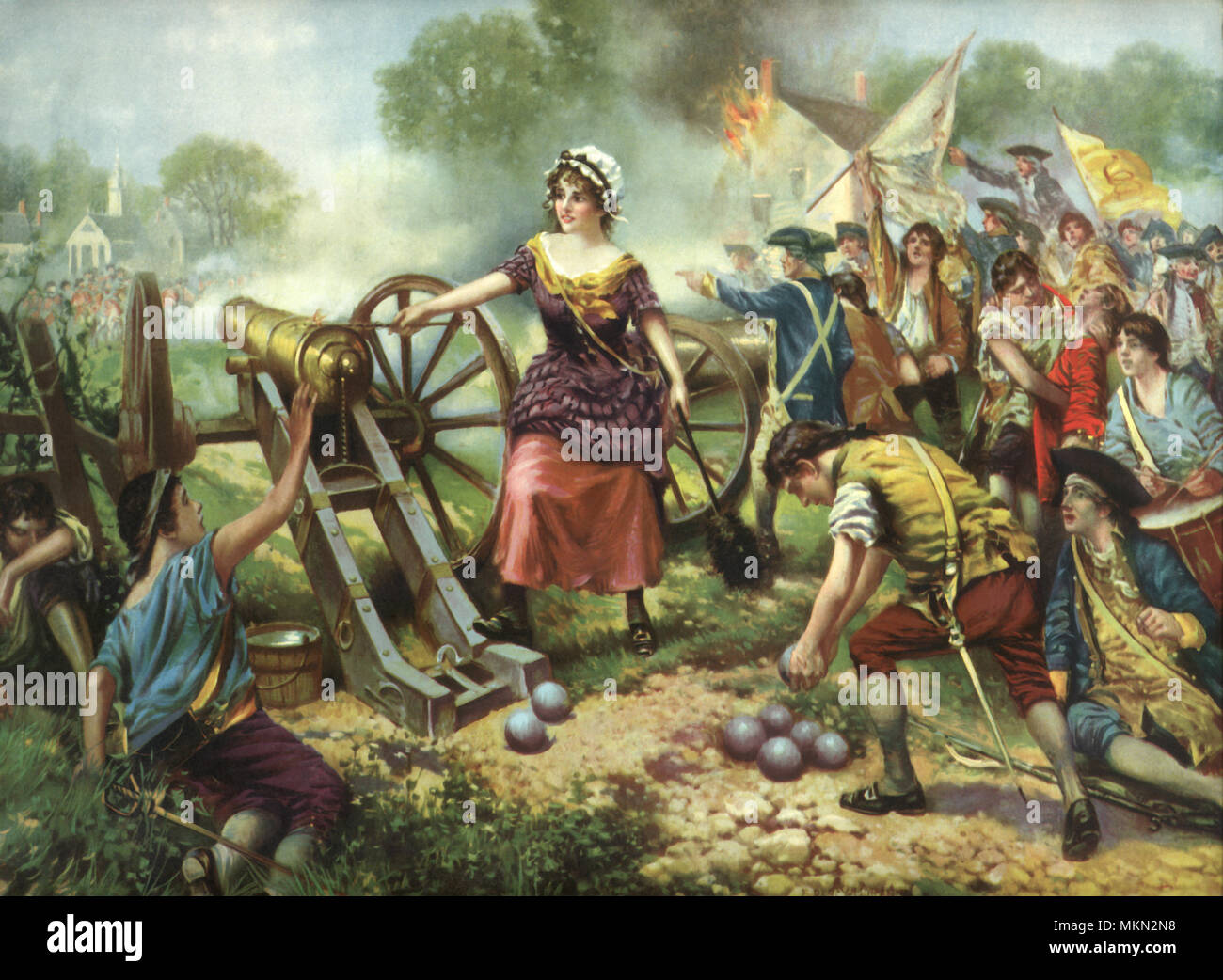
You’ve probably seen the paintings. A woman in a billowing dress, face smeared with soot, standing defiantly over a smoking cannon while men collapse around her in the heat. It’s one of those iconic American images that feels like it belongs on a postage stamp or a high school history poster. Most people call her Molly Pitcher.
But here’s the thing. History is rarely as clean as a painting.
If you dig into the archives of the Revolutionary War, you won't find a soldier named "Molly Pitcher." Instead, you find Mary Ludwig Hays, a real woman who lived, breathed, and apparently swore like a sailor in the 1700s. Honestly, the real Mary is way more interesting than the polished legend we’re taught in second grade. She wasn't some dainty lady helping out; she was a tough-as-nails camp follower who ended up in the middle of one of the nastiest battles of the war.
Who Was the Real Mary Ludwig Hays?
Mary was born around 1754, likely in New Jersey, though Pennsylvania likes to claim her too. Her family were German settlers—hardworking folks. She wasn't literate. She didn't spend her days writing flowery letters about liberty. Instead, she spent her youth working as a domestic servant for a doctor named William Irvine in Carlisle, Pennsylvania.
That’s where she met William Hays, a barber. They got married in 1769.
When the war broke out, William did what most men did: he signed up. He became an artilleryman in the 4th Pennsylvania Artillery. But Mary didn't stay home and knit. She became a "camp follower." Basically, that meant she traveled with the army, doing the grueling work that kept the Continental Army from falling apart—washing clothes, cooking, and nursing the sick.
It was a rough life. No tent. No regular rations. Just constant moving and the smell of gunpowder and unwashed bodies.
The Sweltering Heat of Monmouth
Fast forward to June 28, 1778. The Battle of Monmouth.
It was miserably hot. We're talking 100 degrees Fahrenheit, with humidity so thick you could practically drink the air. Men were dropping dead from heat exhaustion before the British even fired a shot. In that chaos, Mary was doing what she always did: helping. She was running back and forth to a nearby spring, carrying a pitcher of water to the thirsty gun crews.
Every time she appeared, the soldiers would yell, "Molly! Pitcher!"
That’s how the name stuck. "Molly" was just a common nickname for Mary back then. It was basically the 18th-century equivalent of "Hey, girl with the water!"
The Moment Legend Met Reality
The story gets intense when Mary’s husband, William, collapsed. Some sources say he was wounded; others say the heat finally got him. Regardless, he was out.
Standard procedure back then was to move the cannon if the crew was too short-handed to fire it. Mary wasn't having it. She stepped up, grabbed the rammer, and started working the gun herself.
We actually have an eyewitness account for this, which is rare for the time. A soldier named Joseph Plumb Martin wrote about it in his diary. He saw a woman serving a cannon, and he recorded a crazy detail: a British cannonball flew right between her legs. It ripped off the bottom of her petticoat but didn't touch her.
According to Martin, she just looked down and said something like, "Lucky it didn't pass a little higher," and then went right back to loading the gun.
That’s not a legend. That’s just being a badass.
Why the "Molly Pitcher" Myth is Complicated
Now, we have to be honest here. Some historians argue that "Molly Pitcher" isn't just one person. They think she's a composite—a mix of Mary Ludwig Hays and another woman named Margaret Corbin.
Corbin actually did something very similar at the Battle of Fort Washington in 1776. Her husband was killed, and she took over his cannon until she was seriously wounded by grapeshot. She actually received a pension from Congress years before Mary did.
So, did Mary Ludwig Hays do all the things the stories say?
- Did she carry water? Yes.
- Did she fire a cannon at Monmouth? Almost certainly.
- Was she some mythical goddess of war? Probably not.
She was a woman doing what needed to be done to survive and support her husband. Over time, the stories of Mary and Margaret (and maybe others) started to bleed together into the "Molly Pitcher" we know today.
Life After the War: No Glory, Just Hard Work
After the war ended, Mary and William went back to Carlisle. Life wasn't easy. William died in 1786, leaving her with some land but not much else. She married again, to a guy named John McCauley, but that turned out to be a disaster. He supposedly spent her money and then vanished or died, leaving her to work as a servant and a charwoman in the local courthouse.
She didn't get famous until she was much older.
In 1822, the Pennsylvania State Legislature finally took notice. They awarded her an annual pension of $40. Interestingly, they didn't just give it to her because she was a widow. They gave it to her "for services rendered" during the war. That’s a huge distinction. It means the government acknowledged she did the work of a soldier.
How to Visit the Legacy Today
If you’re ever in Carlisle, Pennsylvania, you can actually visit her grave. It’s in the Old Graveyard. There’s a statue of her there, and she’s buried under the name Molly McCauley. Local residents kept her story alive long before history books did.
You can also visit the Monmouth Battlefield State Park in New Jersey. They have markers for the "Molly Pitcher Spring" where she supposedly gathered water. It’s a quiet place now, but it’s easy to stand there and imagine the roar of the cannons and the crushing heat of that June day.
Actionable Steps for History Buffs
If you want to dive deeper into the real story of Mary Ludwig Hays, don't just stick to the children's books. Here is how you can verify the facts yourself:
- Read the Primary Source: Find a copy of A Narrative of a Revolutionary Soldier by Joseph Plumb Martin. It’s one of the best first-hand accounts of the war and contains the specific mention of the woman at the cannon.
- Check the Pension Records: You can look up the 1822 Pennsylvania Legislative records. Seeing the "services rendered" language in the official government documents really changes how you view her contribution.
- Compare the "Mollies": Look up Margaret Corbin (Captain Molly) and compare her service record with Mary’s. Seeing how their stories differ helps you understand how the "Molly Pitcher" archetype was built.
- Visit Carlisle: The Cumberland County Historical Society has amazing resources on her life in Pennsylvania after the war, including details about her work at the courthouse.
Mary Ludwig Hays wasn't a symbol. She was a person. She smoked, she cursed, and when the world was literally on fire around her, she picked up a ramrod and kept fighting. That’s the version of history worth remembering.