You see it hovering over the Super Bowl or a random PGA Tour stop and it looks like a toy. A giant, silver-and-blue pill floating effortlessly against the clouds. But honestly, getting inside the Goodyear Blimp is less like boarding a plane and more like stepping into a high-tech, floating glass balcony. It's weird. It’s loud. And it’s nothing like what you expect.
Most people assume it’s a big balloon filled with air. Nope. It’s a semi-rigid airship, specifically the Wingfoot series (Wingfoot One, Two, and Three), which replaced the old-school GZ-20 models a few years back. The difference? These new ones have an internal frame made of carbon fiber and aluminum. They don't just "float" where the wind goes; they fly.
The Gondola: Not Your Average Cabin
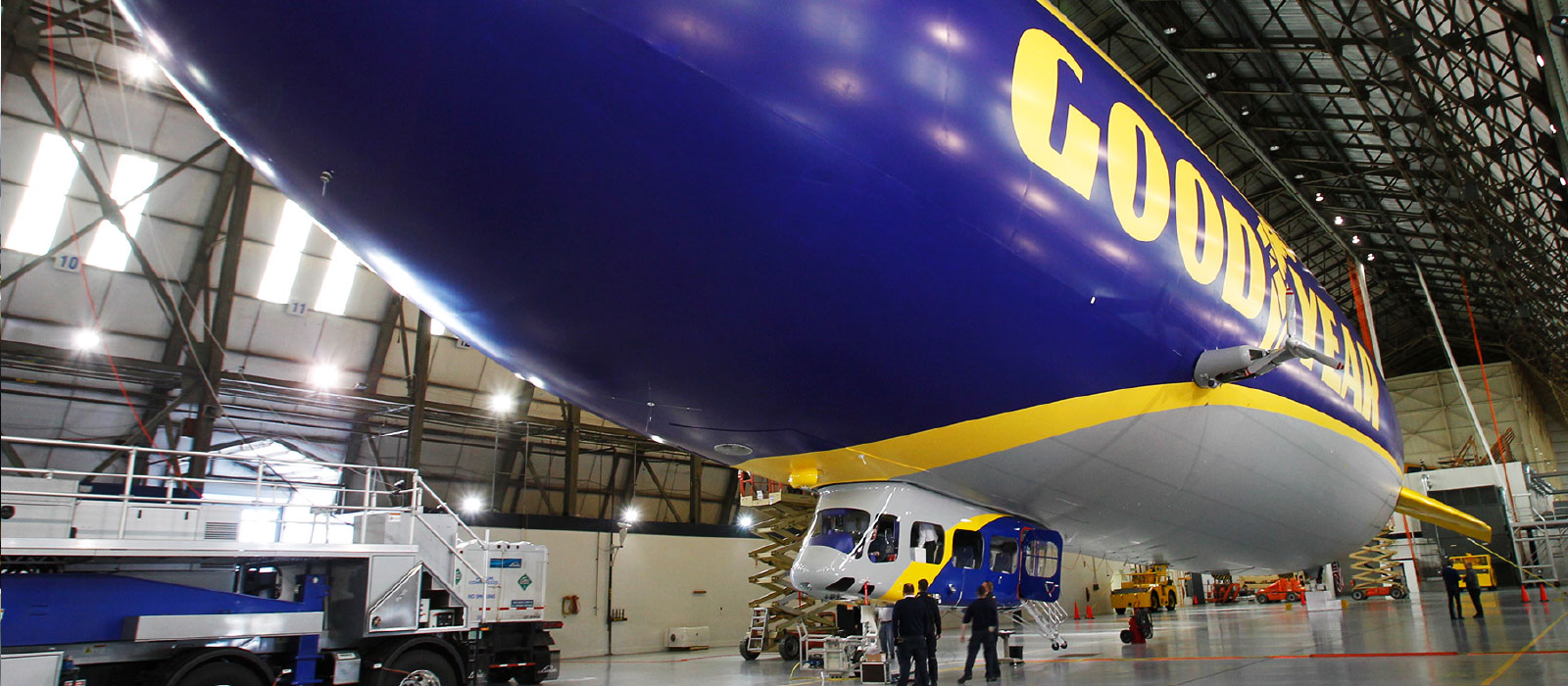
When you walk up to the blimp, the first thing you notice is that the gondola—the part people actually sit in—is tiny compared to the massive envelope above it. It’s like a minivan hitched to a skyscraper. Once you’re inside the Goodyear Blimp, the space is surprisingly tight but incredibly open. There are usually seats for about 12 people, depending on the specific model and crew requirements.
The windows are the real stars here. They’re massive. Unlike a Boeing 737 where you’re squinting through a double-paned porthole, the blimp features floor-to-ceiling wraps of glass. You can literally look straight down at your feet and see the grass of the airfield or the tops of trees. It's exhilarating. It's also a bit terrifying if you aren't a fan of heights, because the sensation of movement is so slow that your brain has plenty of time to process exactly how high up you are.
The Cockpit and Those Thumping Engines
Looking toward the front, you’ll see the pilot. In the old days, flying a blimp was a physical workout involving huge wooden wheels and cables. Now, it’s mostly joysticks and glass cockpits. It looks more like a modern helicopter setup than a vintage aircraft.
There are three engines on the Wingfoot models. Two on the sides and one at the tail. Because the engines are mounted on the frame rather than the gondola itself, the vibration is different. It’s a low-frequency hum. You can talk to the person next to you without screaming, but it’s definitely not "whisper quiet." The pilot can actually swivel these engines (vectoring), which allows the blimp to take off vertically or hover in place like a massive, lazy drone.
The Physics of Floating (and Why it Feels So Weird)
If you've ever been on a boat in a light swell, you know the feeling of a blimp ride. It doesn't "cut" through the air; it displaces it. You feel the thermals. If the sun hits a dark patch of woods and then a bright parking lot, the air temperature change creates a little bump. It’s a gentle, rhythmic swaying.
What most folks don't realize about being inside the Goodyear Blimp is that the "balloon" part isn't just one big bag of helium. It’s actually divided. There are internal bags called ballonets. The pilots pump regular air into these ballonets to change the weight of the ship and compensate for the helium expanding or contracting. If you hear a sudden rush of air, that’s just the ship "breathing" to maintain its shape.
- Helium: It’s non-flammable. No Hindenburg vibes here.
- The Envelope: Made of high-tech polyester with a film called Tedlar. It’s incredibly tough.
- Speed: You're looking at a cruising speed of maybe 30 to 50 miles per hour. A brisk highway pace, but you’re in the sky.
The Secret "Lounge" and the View
There isn't a bathroom.
Seriously. Most blimp flights are short—maybe 1-2 hours for guests—so you'd better go before you board. If the blimp is on a cross-country ferry flight, the crew has to plan stops very carefully. There’s no "Mile High Club" luxury here; it’s practical, functional, and focused entirely on the view.
The "Inside the Goodyear Blimp" experience is really about the perspective. Because blimps fly much lower than airplanes—usually between 1,000 and 1,500 feet—you see everything. You see people waving from their backyards. You see the individual players on a football field. You see the way traffic patterns actually work. It’s the ultimate "people watching" platform.
Who Actually Gets to Go Inside?
This is the kicker: you can’t just buy a ticket. Goodyear doesn't sell rides. Never has. Most people inside the Goodyear Blimp are either corporate guests, members of the media, or winners of very specific charity auctions. Occasionally, Goodyear employees get a seat. It is one of the most exclusive "tickets" in aviation simply because you can't throw money at it to make it happen.
The Logistics of Landing
Landing a blimp is a choreographed dance. You don't just taxi to a gate. A ground crew of about 15 to 20 people is usually waiting. They grab the nose lines (long ropes hanging from the front) and literally muscle the ship toward the mooring mast.
From the inside, this is the most active part of the flight. You feel the ship dipping forward, the engines reversing, and then the sudden "thud" of the landing gear—which is usually just one or two wheels—hitting the tarmac. Once the ship is "masted," it stays there, pivoting with the wind like a giant weather vane. If the wind shifts 180 degrees, the blimp turns with it.
Takeaways for the Aspiring Aeronaut
If you ever find yourself lucky enough to be invited inside the Goodyear Blimp, keep these practical tips in mind:
- Dress in layers. Even though the cabin is enclosed, it can get chilly or surprisingly hot depending on the sun's position and the altitude.
- Phone tether. If you’re leaning near a window that happens to be open (some of the older models had them, the newer ones less so), hold on tight. You don't want your iPhone 17 becoming a kinetic missile over a golf course.
- Watch the pilot. The way they use the vectoring thrust to hover is a masterclass in physics. It’s the closest thing to magic you’ll see in the sky.
- Forget the "Hindenburg" jokes. The crew has heard them all. They aren't funny, and they aren't accurate since this is helium, not hydrogen.
The Goodyear Blimp remains a bridge between the golden age of aviation and modern tech. It’s a slow-motion miracle in a world that’s obsessed with going faster. If you get the chance to go up, take it. Just remember to use the restroom first.
To see where the blimps are currently located, check the official Goodyear Blimp tracker. If one is headed to an airport near you, you can often watch the takeoffs and landings from the airfield perimeter, which is almost as cool as being on the flight deck itself. Keep an eye on local charity gala auctions in cities like Akron, Pompano Beach, or Carson, as these are often the only way for a regular person to secure a seat through a donation.