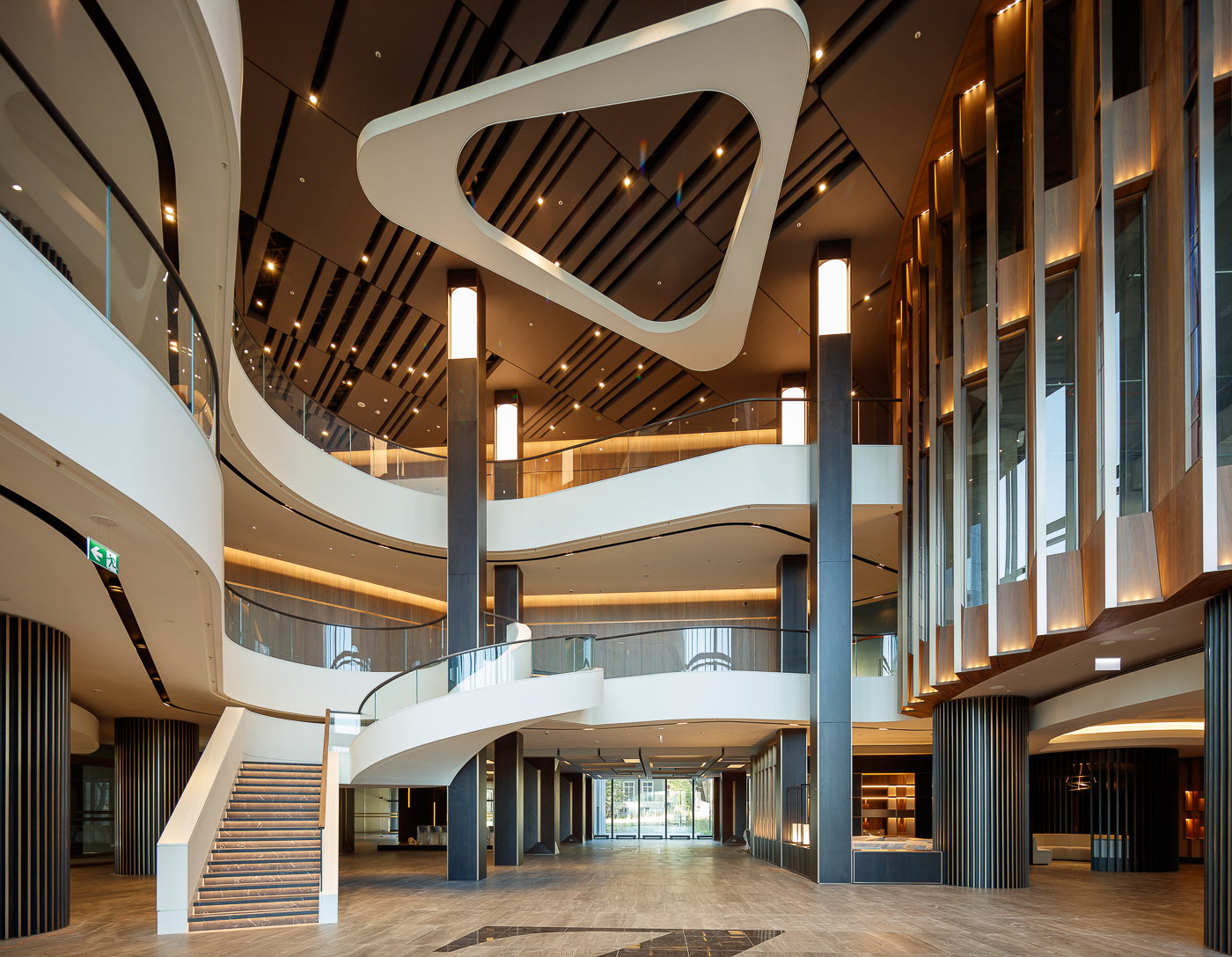
If you ever stepped into the original World Trade Center, you know that feeling. The elevator ride was a blur. You’d shoot up past 40 or 70 floors in what felt like seconds, and then the doors would slide open. Suddenly, you weren’t in a cramped hallway. You were in a massive, sun-drenched square in the clouds. This was the Twin Towers sky lobby, a concept that basically saved the skyscrapers of the 20th century from becoming giant blocks of wasted space.
Architecture is usually about what you see on the outside. But with the Twin Towers, the real genius was tucked away on the 44th and 78th floors. Without these massive transfer points, the North and South Towers probably wouldn't have been built at least not at that height.
Minoru Yamasaki, the lead architect, had a massive problem to solve in the 1960s. He wanted 110 stories. The Port Authority wanted maximum rentable square footage. But if you build a 110-story building using traditional elevator logic, the elevator shafts end up taking up half the floor space by the time you reach the bottom. It's a math nightmare. To fix it, Yamasaki looked at the New York City Subway.
Why the sky lobby was a literal game changer
Think about how an express train works. You take the A train to a major hub, then hop on a local to get to your specific street. That is exactly how the Twin Towers sky lobby functioned.
Before this, every elevator went all the way to the ground. In a building that tall, you would have needed dozens upon dozens of shafts cutting through every single floor. By creating these "sky lobbies" on the 44th and 78th floors, Yamasaki could stack elevators on top of each other. A local elevator serving floors 10 through 20 lived in the same vertical shaft as a local elevator serving floors 50 through 60.
This saved a staggering amount of space. We are talking about a 75% efficiency rate for floor space, compared to the 50% you usually saw in older skyscrapers. It made the project economically viable. Honestly, without the sky lobby, the Twin Towers would have been too "fat" or too expensive to ever get off the drawing board.
The experience of being 78 floors up
Walking into the 78th-floor sky lobby of the South Tower was an experience in scale. It wasn't just a waiting room. It was a city square. Because the towers used a "tube-frame" structural system—where the strength was in the outer walls—the interior was wide open. No massive columns blocking your view.
You’ve got to remember the 70s and 80s aesthetic here. Huge banks of elevators, often with brushed metal finishes. The windows were narrow—only 18 inches wide—because Yamasaki actually had a bit of a fear of heights. He wanted people to feel secure. But when you were in that sky lobby, the sheer number of windows made the light feel infinite.
On September 11, these lobbies became the center of the world's most intense drama. In the South Tower, the 78th floor was the main transfer point for thousands of people trying to evacuate. When the second plane hit, it struck right near that lobby. It’s a heavy thing to think about, but it’s part of why this specific architectural feature is etched into history. It wasn't just a design choice; it was where thousands of lives intersected.
The Engineering Legacy of the Twin Towers Sky Lobby
If you look at the Burj Khalifa in Dubai or the Shanghai Tower today, they all use this. They have to. You can't build 2,000 feet into the air without a sky lobby.
Otis Elevator Company had to invent brand-new tech for the WTC. They developed "high-speed" expresses that could move at 1,600 feet per minute. That was terrifyingly fast for the era. But the sky lobby made it manageable. You’d take the express to 44 or 78, then switch to a local. It felt like a commute within a commute.
Modern skyscrapers that stole the idea
- The Willis Tower (Sears Tower): Chicago took the WTC blueprint and ran with it. They used two sky lobbies to manage the massive floor plates.
- Petronas Towers: These take it a step further with a literal bridge connecting the two sky lobbies.
- One World Trade Center: The new tower still uses the transfer concept, though the security and layout are vastly different for obvious reasons.
The sky lobby wasn't just about elevators, though. It was about psychology. Yamasaki wanted these floors to be "breaks" in the vertical journey. He envisioned them as places where workers could grab a coffee, look at the view, and realize they were part of something bigger than just a 9-to-5 desk job.
What most people get wrong about the design
A lot of folks think the sky lobbies were just for the public or for tourists going to the "Top of the World" deck. That's not true. The public usually bypassed the 44th and 78th floors entirely. If you were a tourist, you took a dedicated express straight from the ground to the 107th floor.
The Twin Towers sky lobby was for the workers. It was for the bankers, the lawyers, and the shipping clerks. It was a functional piece of infrastructure.
Another misconception is that the sky lobbies were "weak points." Some early critics of the towers suggested that the large open spaces of the sky lobbies contributed to the collapse. However, the NIST (National Institute of Standards and Technology) reports later clarified that the collapse was due to the severance of support columns and the intense heat of the jet fuel weakening the floor trusses. The sky lobby design itself was incredibly robust.
A different way to see the city
If you were standing in the 44th-floor lobby, you were at the level of many other "tall" buildings in Manhattan. You could see the roof of the Woolworth Building. It gave you a sense of perspective. You weren't just "high up"; you were in a new layer of the city.
The elevators themselves were a feat. They used a "dead end" system where the shafts didn't have to go all the way down to the pit if they were serving the upper zones. This saved miles of steel cable. It's the kind of invisible engineering that we take for granted now when we book a hotel on the 60th floor of a Marriott, but in 1973, it was borderline sci-fi.
Actionable insights for architecture enthusiasts
If you're fascinated by how these "cities in the sky" function, you don't have to just look at old photos. You can see the evolution of the Twin Towers sky lobby in modern urban planning.
- Visit the 64th floor of One World Trade Center: While access is generally restricted to tenants, the building uses a similar express-to-local logic. The lobby there is a spiritual successor to the originals.
- Study the "Stacked City" model: Look up the work of Leslie Robertson, the lead structural engineer for the WTC. His notes on how the sky lobbies distributed weight and traffic are essential reading for anyone into civil engineering.
- Check out the 40th-floor sky lobby at the Chicago Willis Tower: It’s one of the best remaining examples of this era of "Big Architecture" and gives you that exact same sense of scale that the Twin Towers offered.
- Explore the 9/11 Memorial Museum: They have actual artifacts from the elevator systems, including some of the massive motors that powered the sky lobby expresses. It puts the "human" back into the "hardware."
The Twin Towers are gone, but the way we move through tall buildings is still defined by what happened on those 44th and 78th floors. We stopped building "up" and started building "in layers." That shift changed the skyline of every major city on Earth. It was about making the impossible—110 stories of office space—actually make sense for the people walking into the building every morning. It was a transition from the ground to the sky, and for a few decades, it was the most sophisticated way to travel on the planet.