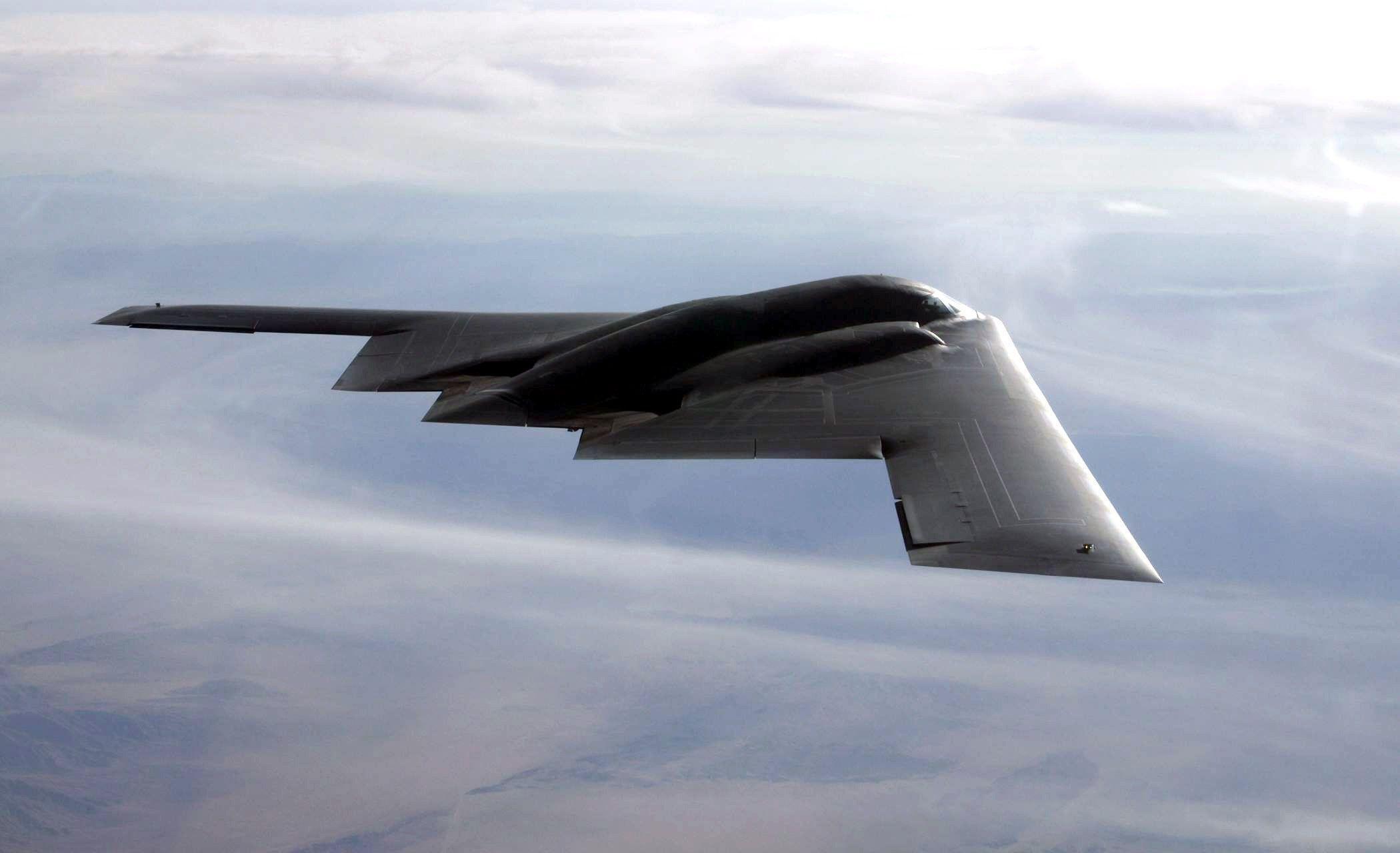
You’ve probably seen the silhouette. That black, alien-looking triangle gliding through the sky like a ghost. It’s the Northrop Grumman B-2 Spirit, and let’s be honest, it looks like it should be able to outrun a bolt of lightning. But if you’re looking for a jet that cracks the sound barrier and leaves a trail of shattered windows in its wake, you’re looking at the wrong plane.
When people ask how fast is the b2 bomber, they usually expect a number starting with Mach 2 or 3. They want to hear about hypersonic speeds. The reality is actually way more interesting, and maybe a little surprising. The B-2 isn't fast. Not in the way a fighter jet is. In fact, your average commercial airliner might give it a run for its money in a straight sprint across the Atlantic.
The Speed of a Shadow: Breaking Down the Mach 0.95 Myth
The official line from the U.S. Air Force is that the B-2 is "high subsonic." That’s a fancy military way of saying it stays below the speed of sound. While most enthusiasts and aviation experts, like those at National Security Journal, peg its top speed at approximately 627 mph (around 1,010 km/h), it rarely ever hits that.
Think about it this way:
- Speed of Sound (Mach 1): Roughly 767 mph at sea level.
- B-2 Top Speed: Roughly 627 mph (Mach 0.85 to 0.95 depending on altitude).
- Typical Cruise Speed: Closer to 560 mph.
Basically, it’s a tortoise that knows how to hide really, really well. If it went any faster, it would actually ruin the very thing that makes it special. Breaking the sound barrier creates a sonic boom. You can’t exactly be a "stealth" bomber if you’re announcing your arrival with a literal explosion in the sky.
The engines are the key here. The B-2 uses four General Electric F118-GE-100 turbofans. You won't find afterburners on this thing. Afterburners are great for speed, but they create a massive infrared signature—a giant "shoot me" sign for heat-seeking missiles. By ditching the afterburners, the B-2 stays cool, quiet, and invisible.
Why Speed Isn't the Point
In the world of strategic bombing, there’s an old-school philosophy and a new-school one. The old school was the B-1B Lancer. That plane is a beast. It has variable-sweep wings and can push past Mach 1.25. It’s built to fly low and fast to outrun the enemy.
The B-2 is the exact opposite.
It was designed during the Cold War to slip through Soviet air defenses that were getting way too good at spotting fast planes. The engineers realized that instead of trying to outrun a missile—which is getting harder and harder as tech evolves—it’s better to just never be seen by the radar in the first place.
Everything about the B-2's shape is a compromise. That "flying wing" design is incredibly efficient for long-range cruising, but it’s naturally unstable. It needs a complex "fly-by-wire" computer system just to stay level. If the computers crashed, the plane would basically tumble out of the sky. But that instability is the price you pay for a radar cross-section that is reportedly the size of a large bird.
Range Over Rushing
If the B-2 isn't fast, what is it? It’s a marathon runner. This plane has a range of about 6,000 nautical miles on a single tank of gas. With one mid-air refueling, it can fly 10,000 miles.
We’ve seen this in action. During Operation Allied Force and later in the Middle East, B-2 crews would take off from Whiteman Air Force Base in Missouri, fly halfway around the world, drop their payload, and fly back. Some of these missions lasted over 40 hours. When you’re in the air for two days straight, the difference between Mach 0.8 and Mach 1.2 doesn't matter as much as having a place to heat up a burrito and a cockpit designed for "crew rest."
Is the B-2 Still "Fast Enough" in 2026?
We’re now deep into the 2020s, and the B-2 is starting to show its age. It’s been around since the late 80s, and the technology it uses to stay "invisible" is being challenged by modern "anti-stealth" radar.
This is why the B-21 Raider is entering the chat.
You might think the next-gen bomber would finally be supersonic. Nope. The B-21 is also subsonic. The Air Force has doubled down on the idea that stealth and "smart" weapons are better than raw speed. If you can launch a stealthy cruise missile from hundreds of miles away, you don't need to be fast. You just need to be there.
The Trade-offs of Going Fast
- Heat: Friction with the air at Mach 2 creates heat. Stealth coatings hate heat.
- Fuel: Supersonic flight guzzles gas. It kills your range.
- Shape: Sharp edges are good for speed; rounded, continuous curves are better for stealth.
The B-2 is a collection of curves. There isn't a single vertical tail fin on it. Even the engine intakes are serrated and buried on top of the wing to hide the spinning fan blades from radar. Speed would literally tear the "quiet" right out of the design.
What Most People Miss
The most impressive part of the B-2 isn't the 600-ish mph top speed. It’s the altitude. It can operate at 50,000 feet. At that height, the air is thin, and the plane is almost impossible to spot with the naked eye. It sits in a "sweet spot" where it's above most regional air defenses but still thick enough for those four GE engines to breathe.
Honestly, the B-2 is more like a high-tech submarine that happens to fly. It moves through the environment cautiously, avoiding detection, waiting for the right moment to strike.
If you're ever at an airshow and see one fly by, notice how quiet it is compared to an F-22 or an F-35. It doesn't roar. It hisses. That hiss is the sound of a plane that doesn't need to be the fastest in the sky to be the most dangerous.
Real-World Stats Recap
If you're looking for the hard numbers to win a debate with your pilot friends, here they are:
- Max Speed: ~627 mph (Mach 0.95).
- Cruise Speed: ~560 mph (Mach 0.85).
- Service Ceiling: 50,000 feet.
- Engines: 4x GE F118-GE-100 (non-afterburning).
- Payload: 40,000 lbs of ordnance.
Don't let the "slow" speed fool you. The B-2 doesn't need to outrun anything because, by the time the enemy realizes it's there, the mission is already over.
If you're interested in how this tech is evolving, keep an eye on the B-21 Raider's flight tests. It follows the same "stealth over speed" philosophy but with a 30-year jump in materials science. The age of the supersonic bomber is effectively over; we've traded the sonic boom for the silent strike.
To see this in person, your best bet is checking the schedules for the Wings Over Whiteman airshow or major events like EAA AirVenture. Seeing the "Spirit" bank in total silence at 200 knots is a lot more haunting than a supersonic flyby ever could be.