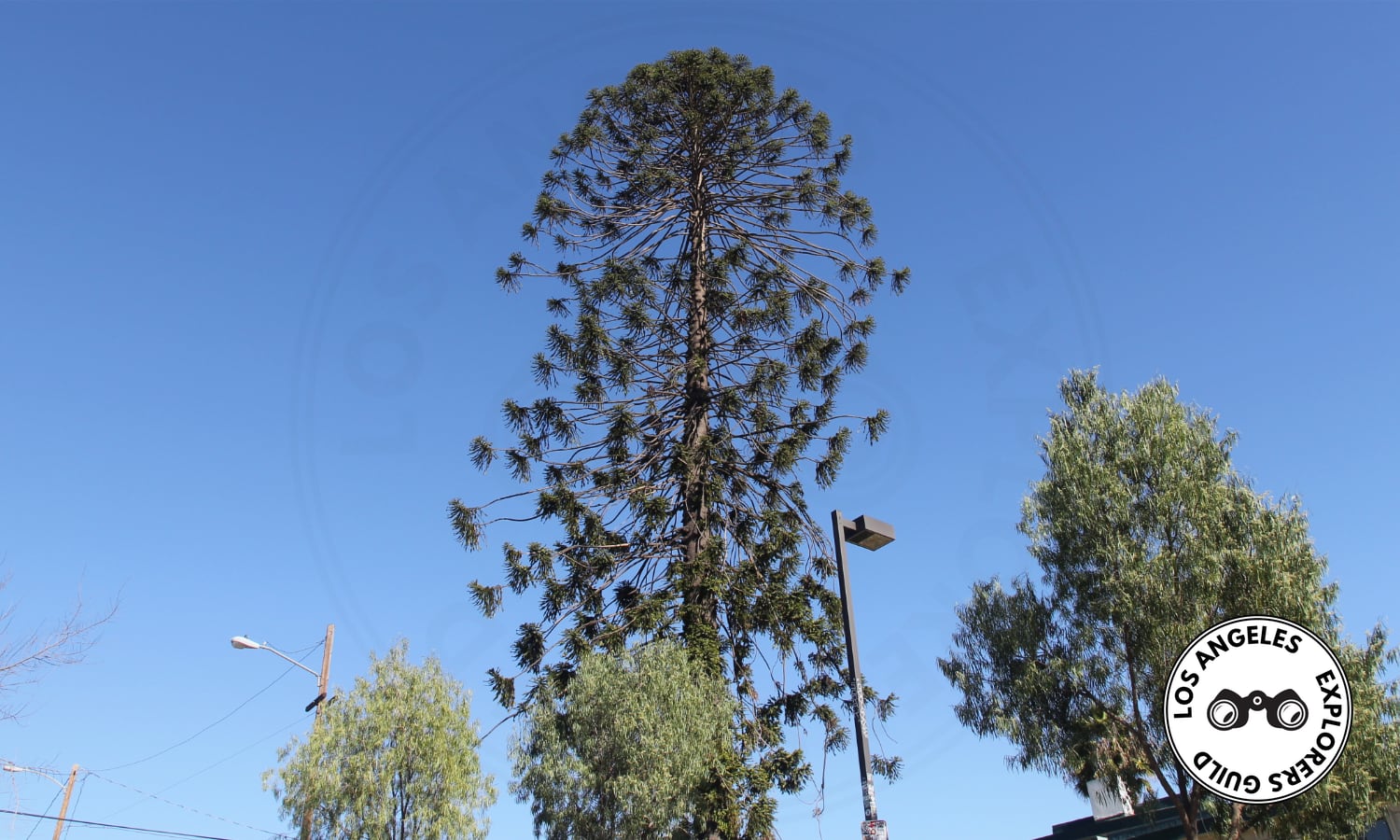
If you’re driving down Cesar Chavez Avenue and look toward the horizon where East Los Angeles meets Boyle Heights, you’ll see it. A massive, bullet-shaped silhouette poking out from the residential skyline. It looks like it doesn't belong here. Honestly, it doesn't.
That’s El Pino.
For most of the world, it’s just a tree on a hill. But for Chicano culture and the people of East Los, it’s closer to a cathedral. People travel from Japan, Germany, and across the U.S. just to stand under its branches. They get it tattooed on their backs. They treat it like a living relative.
But there’s a lot of myth-making involved with El Pino Los Angeles, starting with the fact that it isn’t even a pine tree.
The Identity Crisis: It’s Not Actually a Pine
Life is full of little ironies, and El Pino is a big one. Biologically, it is an Araucaria bidwillii, better known as a Bunya pine. Here’s the kicker: it’s native to Queensland, Australia.
It isn't a true pine ($Pinus$). It’s a conifer from the Araucariaceae family, a lineage of trees that has basically stayed the same since the Jurassic period. It grows these massive cones that can weigh up to 15 pounds—falling hazards that could easily dent a car or, well, a person.
How did an Australian "dinosaur tree" end up at the corner of Indiana and Folsom Streets?
The history is a bit hazy, but the most credible story traces back to Dr. Okuno, a Japanese American dentist. Local legend says that after being released from a World War II internment camp, Dr. Okuno and his wife were gifted the land by a sympathetic "Anglo lady" his wife worked for. He rebuilt his life there, eventually planting the tree (or at least nurturing it to its current heights) sometime in the 1940s.
It stands as a silent witness to the layers of East LA history—from the Japanese families who lived there before the war to the vibrant Chicano community that has called it home for decades.
The "Blood In Blood Out" Effect
You can't talk about El Pino without talking about the 1993 film Blood In Blood Out (also known as Sangre Por Sangre).
In the movie, the tree is the meeting spot for the three main characters—Miklo, Paco, and Cruz. It represents "home." When Miklo gets out of prison and Paco asks where he wants to go, the answer is immediate: "El Pino."
"That tree is East Los to me," Miklo says in the film.
That single line changed everything. The director, Taylor Hackford, originally wanted to film at Los Cinco Puntos, but when he saw the tree towering over the neighborhood, he knew it had that "mythical" quality he needed. It wasn't just a backdrop; it became a character.
Since then, the tree has become a pilgrimage site. It’s common to see "Vatos Locos" fans taking selfies or leave offerings. It’s a piece of cinematic history that transitioned into a real-world monument of identity.
The Great 2020 Chainsaw Scare
In late December 2020, the neighborhood went into a full-blown panic. A rumor hit social media—on Día de los Inocentes (similar to April Fools'), no less—that a developer was planning to chop down El Pino to build a duplex.
People didn't take it as a joke.
Protesters showed up. Lowriders lined the streets. Petitions gathered thousands of signatures almost overnight. It showed just how much the community feared gentrification. To them, losing the tree wasn't just losing a plant; it was the beginning of the end for the neighborhood's soul.
The property owner, Art Gastelum, eventually had to go on the news to calm everyone down. He’d bought the lot back in 2015 specifically because he wanted to save the tree. He even has plans to turn the area into a small "pocket garden" with a commemorative plaque so the public can visit without trespassing on what is technically private property.
How to Visit El Pino Today
If you want to see it for yourself, it’s pretty straightforward. You head to the intersection of North Indiana St and Folsom St.
- Parking: It’s a tight residential area. Don't be that person who blocks someone’s driveway. Park a block away and walk up.
- The View: From the base of the tree, you can see all the way to the downtown LA skyline. It’s one of the best "unoffical" overlooks in the city.
- The Vibe: It’s a quiet neighborhood. Be respectful. People live here. They see tourists every day, so just keep it low-key.
Interestingly, while many think it's a city-designated monument, the technical status of the land remains private. However, the outcry in 2020 basically made it "socially protected." No politician in their right mind would let a saw get near that trunk now.
Actionable Insights for Your Visit
If you're making the trip to East LA to see the landmark, don't just look at the tree and leave.
- Check out Evergreen Cemetery: It's right nearby. It’s the oldest cemetery in the city and features heavily in the film's somber moments.
- Eat at El Tepeyac Cafe: It's a legendary spot for a "Hollenbeck Burrito." Damian Chapa (who played Miklo) actually first saw El Pino while eating here.
- Respect the property: Remember that El Pino sits on private land. You can get great photos from the sidewalk without crossing the fence.
El Pino is a reminder that landmarks aren't always made of marble and bronze. Sometimes, they’re made of bark, needles, and the collective memories of a community that refuses to be erased. It’s survived rumors, drought, and the changing face of Los Angeles. As of 2026, it’s still standing tall, watching over the Eastside.
To get the most out of your visit, use the Metro L Line (Gold) and get off at the Indiana Station. It’s about a 15-minute walk uphill from there, and the view of the tree emerging from behind the houses is worth the sweat.