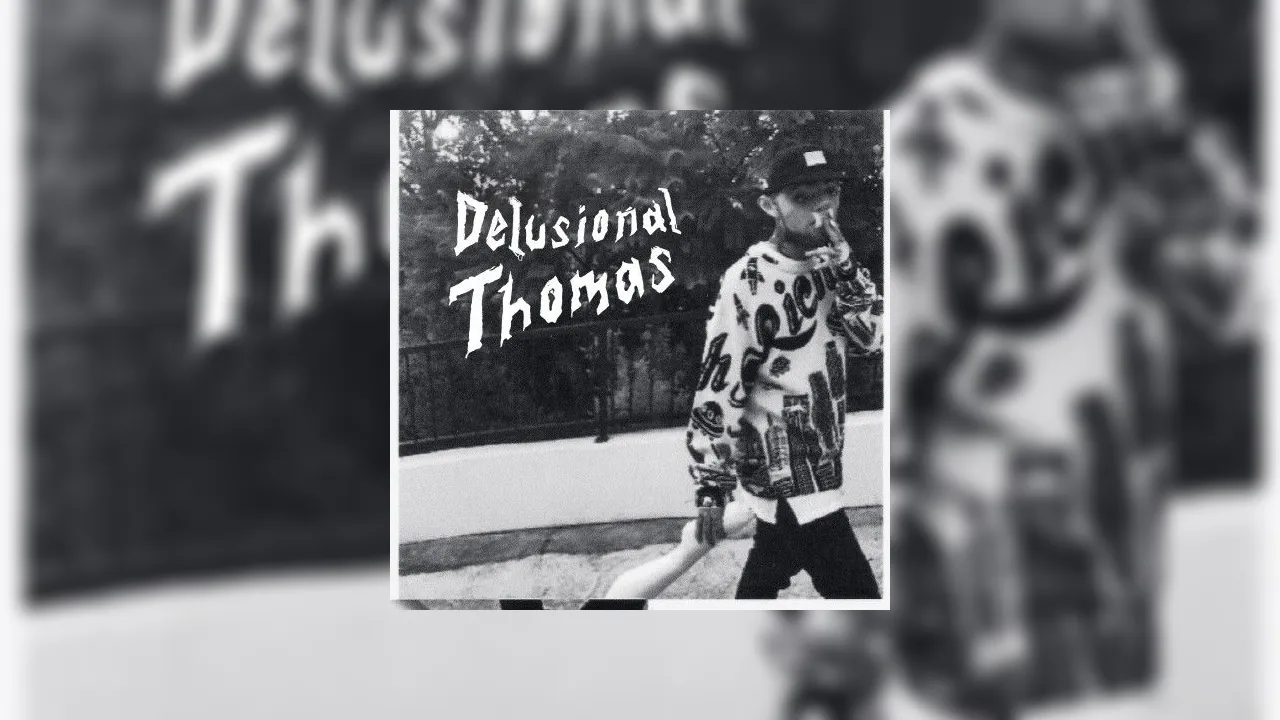
Mac Miller was always a bit of a shapeshifter. Most people remember the "Blue Slide Park" kid or the soulful philosopher of "Swimming," but there’s a darker, pitch-shifted corner of his discography that still makes listeners jumpy. I'm talking about Delusional Thomas.
Dropped on November 1, 2013, right after the sugar rush of Halloween died down, this self-titled mixtape wasn't just a side project. It was a complete psychological exorcism. If you’ve ever wondered why Mac decided to spend 27 minutes rapping in a high-pitched, demonic voice about the most graphic things imaginable, you’re in the right place.
Honestly, it’s the project that separates the casual fans from the "Macheads." It is gritty. It is violent. And it is arguably the most honest look we ever got into the intrusive thoughts he was battling during one of the most drug-fueled periods of his life.
The Birth of the High-Pitched Demon
To understand the Delusional Thomas mixtape, you have to look at where Mac was in 2013. He had just released Watching Movies with the Sound Off, an album that effectively killed his "frat rap" image. He was living in a mansion in the Hollywood Hills, the windows were blacked out, and he was experimenting heavily with every substance he could get his hands on.
He needed a vessel for the darkness that wouldn't fit on a studio album.
The voice itself is the first thing everyone notices. It’s pitched up, reminiscent of Madlib’s Quasimoto, but while Quasimoto was a weed-smoking prankster, Thomas was a homicidal nihilist. Mac once explained that he felt like that "evil voice inside your head" always has that specific high pitch. It’s the nagging, high-frequency anxiety that tells you to do the wrong thing.
By adopting this persona, Mac could say the unsayable. He could challenge Christianity, joke about Michael Jackson, and describe gore with a level of detail that would have ended his mainstream career if he’d used his normal voice.
Producing the Nightmare: Larry Fisherman’s Grittiest Work
While Delusional Thomas was the star, the architect was Larry Fisherman. That was Mac’s production alias, and on this tape, he went for a sound that felt like a dusty basement.
The beats aren't "catchy" in the traditional sense. They’re claustrophobic.
- "Larry" opens with a loon call and heavy, plodding keys.
- "Vertigo" uses the sound of gunfire as a rhythmic element.
- "72" feels like a slow-motion descent into a bad trip.
Interestingly, Mac didn't do this entirely alone. He brought in his inner circle—the guys who were in that house with him during the "Sanctuary" era. Earl Sweatshirt (rapping as randomblackdude on the production side) helped craft the beat for "Bill." That track has one of the best "how did this happen?" stories in hip-hop. Apparently, Mac and Earl were just messing around with a beat when their friend Bill Waves walked in. Bill wasn't even a rapper, but he asked to hop on. He laid down a verse so hard that Mac and Earl basically had to rewrite their parts just to keep up.
Why Delusional Thomas Still Matters in 2026
It's easy to dismiss this project as an edgy "horrorcore" phase, but that misses the point. Delusional Thomas was the bridge to Faces. Without the freedom to be "Delusional," we never would have gotten the introspection of songs like "Wedding" or "Funeral."
The lyrics on tracks like "Grandpa Used to Carry a Flask" are actually some of the most technically proficient bars Mac ever wrote. The rhyme schemes are incredibly dense. He’s stacking syllables in ways that most rappers wouldn't attempt.
"Read the Bible overwhelmed, knowin' imma go to Hell."
It's a line that sounds like a joke in that voice, but when you look at Mac’s trajectory, it was a very real admission of the spiritual weight he was carrying. He was using a character to tell the truth because the truth was too heavy for Malcolm McCormick to carry on his own.
The Impact on the Mac Miller Legacy
Most fans who discover this project today find it on SoundCloud or YouTube because it was never "officially" cleared for streaming services like Spotify or Apple Music. That’s probably intentional. It’s a piece of "hip-hop noir" that wasn't meant for the masses. It was meant for the people who wanted to see the full spectrum of his artistry, even the parts that were ugly.
He proved he wasn't just a white kid from Pittsburgh who got lucky with a catchy tune. He was a student of the craft, someone who respected the darker traditions of Gravediggaz and early Eminem, and someone who wasn't afraid to let his "black tar-covered demons" out for a walk.
How to Listen to Delusional Thomas Today
If you're going to dive into this, don't do it as background music. It’s meant to be heard in one sitting.
- Find the original source: Go to SoundCloud or the archived delusionalthomas.com mirrors. The audio quality is intentionally "lo-fi," so don't expect a polished studio master.
- Listen to "Grandpa Used to Carry a Flask" last: It’s the only track where Mac’s normal voice appears alongside the Thomas voice. It feels like a moment of clarity at the end of a long, terrifying night.
- Check the lyrics: Use a site like Genius while you listen. The pitch-shifting can make it hard to catch every word, and the wordplay is too good to miss.
Whether you love it or find it completely unlistenable, you can't deny that it was a bold move. It was an artist choosing creative freedom over brand management. In a world of polished, PR-approved releases, Delusional Thomas remains a raw, uncomfortable, and brilliant artifact of a genius at work.
Next Steps: If you’ve finished Delusional Thomas, your next logical stop is the Run-On Sentences volumes. These are Mac’s instrumental projects under the Larry Fisherman name. They carry that same experimental, psychedelic energy but without the "evil voice," giving you a better look at his growth as a producer.