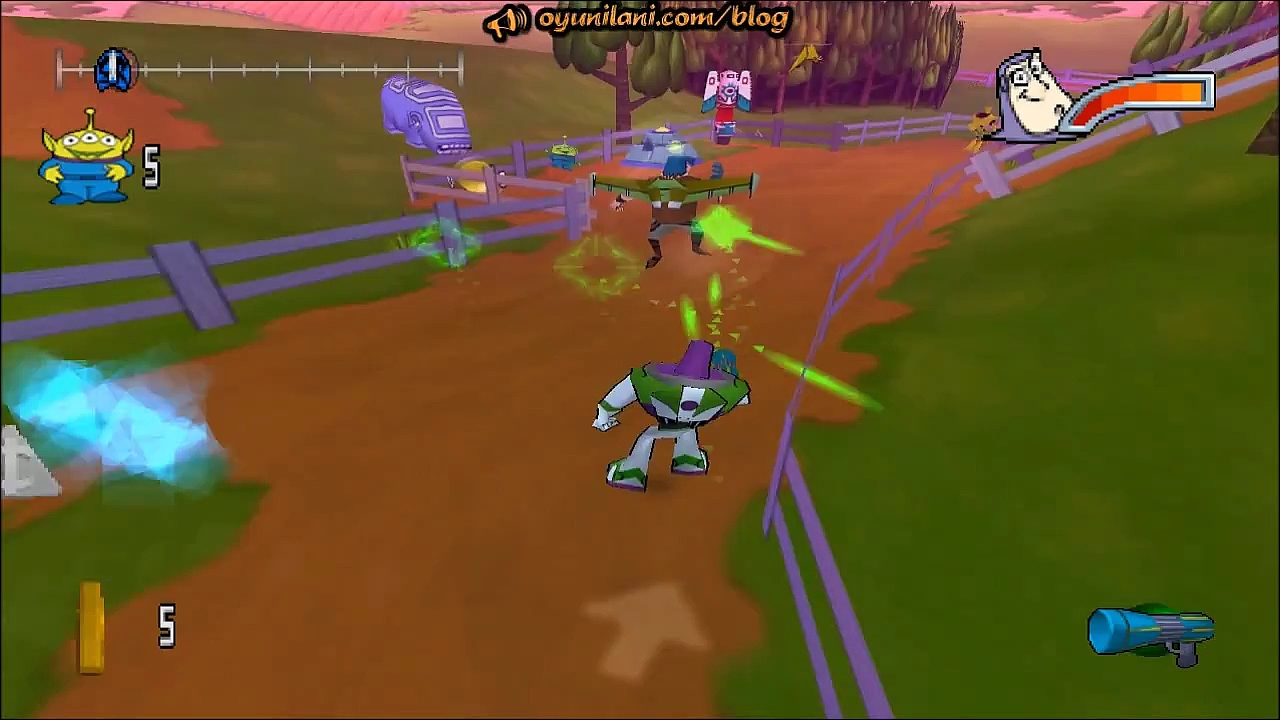
Honestly, if you grew up in the early 2000s, you probably remember the absolute fever dream that was the Buzz Lightyear of Star Command animated series. It was weirdly gritty for a Disney spin-off, had a killer theme song, and replaced Tim Allen with Patrick Warburton—a trade that many of us actually preferred. But the buzz lightyear star command game that hit the PlayStation, Dreamcast, and PC in late 2000? That’s a whole different story. It is a strange, fast-paced relic of an era when licensed games were allowed to be experimental and, frankly, a bit punishing.
Most people see the cover art and think "third-person shooter." They expect a typical 3D platformer where you wander around, jump on stuff, and occasionally blast a robot.
They’re wrong.
Basically, this game is a racing game in disguise. If you try to play it like Toy Story 2: Buzz Lightyear to the Rescue, you’re going to have a bad time. You don't have time to explore. You don't have time to sightsee. You are constantly, relentlessly chasing a villain to the end of a linear gauntlet, and if they beat you there, they’ll probably blow up the planet or escape into the cosmos. It’s stressful. It’s loud. And for a certain subset of retro gamers, it’s one of the most underrated titles of the 32-bit/64-bit transition.
The Mechanic That Changed Everything: The Chase
Every single one of the 14 missions follows the same frantic rhythm. You drop into a planet—like the swampy Jo-Ad or the icy Canis Lunis—and immediately, the boss starts running. You have to stay on their heels. If you fall too far behind, a timer starts ticking down. Hit zero? Mission failed.
Traveller’s Tales (the same studio that eventually became the LEGO game masters) developed this, and you can see their fingerprints everywhere. The levels are packed with shortcuts you can buy using coins collected on the fly. You’re literally paying for "boost pads" and "teleporters" while dodging laser fire. It creates this weird economy where you have to decide: do I spend my coins on a powerful Lightning Beam to finish the boss later, or do I spend them now on a hoverboard just to keep up?
Who Are You Actually Fighting?
The rogue's gallery in the buzz lightyear star command game is ripped straight from the cartoon, which means you aren't just fighting Zurg. You’re going up against:
- NOS-4-A2: An energy-vampire robot that is genuinely creepy.
- Gravitina: The big-headed mistress of gravity.
- Torque: A multi-armed villain who loves grenades.
- Wirewolf: A cybernetic werewolf (yes, really) that forces a room-by-room brawl.
The boss fights themselves only happen once you reach the end of the "track." But here's the kicker: the boss’s health at the end of the level is often determined by how much damage you managed to sneak in during the chase. If you were a crack shot while riding a jetbike at 80 mph, the final showdown might only take five seconds. If you sucked at the chase, you’re in for a long, grueling fight.
Why the Dreamcast Version Wins (Mostly)
If you're looking to revisit this today, the platform you choose matters more than you’d think. In 2000, we were in that awkward gap where the PlayStation 1 was ancient but the PlayStation 2 was still the "new kid."
The Dreamcast version is easily the prettiest. It features vibrant, cel-shaded graphics that actually make Buzz look like a cartoon character rather than a collection of jagged triangles. The PC version is similar, though getting it to run on Windows 11 is a nightmare involving fan patches and ritual sacrifice.
However, the PlayStation version—which was recently re-released on PS4 and PS5 in late 2023—has its own weird charm. While the textures are muddier and the frame rate chugs, it feels "right" for the era. Interestingly, the PS1 version also features a "Super Story Mode" and some mini-games that aren't as fleshed out on the more powerful Sega console.
But let’s be real: no matter the platform, the voice acting is the star. Hearing Patrick Warburton’s dry, heroic delivery makes the repetitive "To infinity and beyond!" lines bearable. It’s a shame the FMV cutscenes look like they were compressed through a toaster, but hey, it was 2000.
The Medals: A Completionist's Nightmare
You want 100% completion? Good luck. Each level has five medals you need to earn:
- Victory Medal: Just beat the boss. Easy.
- LGM Medal: You have to save all the Little Green Men scattered throughout the level. This is hard because, remember, you're in a race. Stopping to save a three-eyed alien usually means the boss gets further ahead.
- Coin Medal: Collect a specific amount of currency.
- Time Trial: Beat the level under a strict limit.
- XR Medal: Find the hidden parts for Buzz’s robot partner, XR.
Collecting all 65 medals is what unlocks the "true" ending and the final confrontation at Zurg's Throne Room. Most kids back in the day never saw it. They’d get stuck on the Bathyos underwater level because the controls changed completely, and Buzz moved like he was wading through molasses.
The Speedrunning Scene is Weirdly Intense
You might think a 25-year-old Disney game would be forgotten, but the speedrunning community loves the buzz lightyear star command game. Why? Because the mechanics are built for it.
Since the game is fundamentally a race, the "Any%" runs are basically a masterclass in pathfinding and weapon management. Runners like StebMcDreb have pushed the "All Bosses" category to under 40 minutes. They use "damage boosts"—intentionally getting hit by an enemy to propel Buzz forward—to skip entire sections of the map. Watching a high-level run makes the game look less like a casual Disney romp and more like a high-stakes twitch shooter.
Actionable Next Steps for Retro Fans
If you're feeling nostalgic for the Space Ranger, don't just go in blind. Here is how to actually enjoy the buzz lightyear star command game in the modern day:
- Play the PS4/PS5 Version First: It’s the easiest way to access the game without hunting down a CRT television and a dusty console. The rewind feature is a godsend for the more frustrating boss fights.
- Focus on the Hoverboard: Whenever a level offers a vehicle, take it. The walking speed in this game is way too slow for the timers they give you.
- Don't Hoard Coins: In most games, you save money. Here, you spend it. If you see a weapon upgrade like the Plasma Discharge or the Triple Laser, buy it immediately. The default laser is basically a flashlight.
- Watch the Show First: If you can find clips of the Buzz Lightyear of Star Command cartoon, the game makes way more sense. The context for characters like Warp Darkmatter or Commander Nebula adds a layer of enjoyment that the game's blurry cutscenes just can't provide.
The buzz lightyear star command game isn't a masterpiece, but it’s a fascinating snapshot of a time when developers weren't afraid to make a "kids' game" genuinely difficult. It’s loud, it’s fast, and it’s a bit janky, but it captures the spirit of the Space Ranger better than almost any other Toy Story tie-in. Just remember: don't stop to look at the scenery, because Zurg definitely isn't waiting for you.
Expert Insight: If you find the PC version, look for the "SilentPatch" or similar community fixes. The original game's internal clock is tied to the CPU speed, meaning on a modern computer, the game might run 10x faster than intended, making it literally unplayable without a frame rate limiter. For the most stable experience, the emulated PlayStation versions remain the gold standard for casual play.