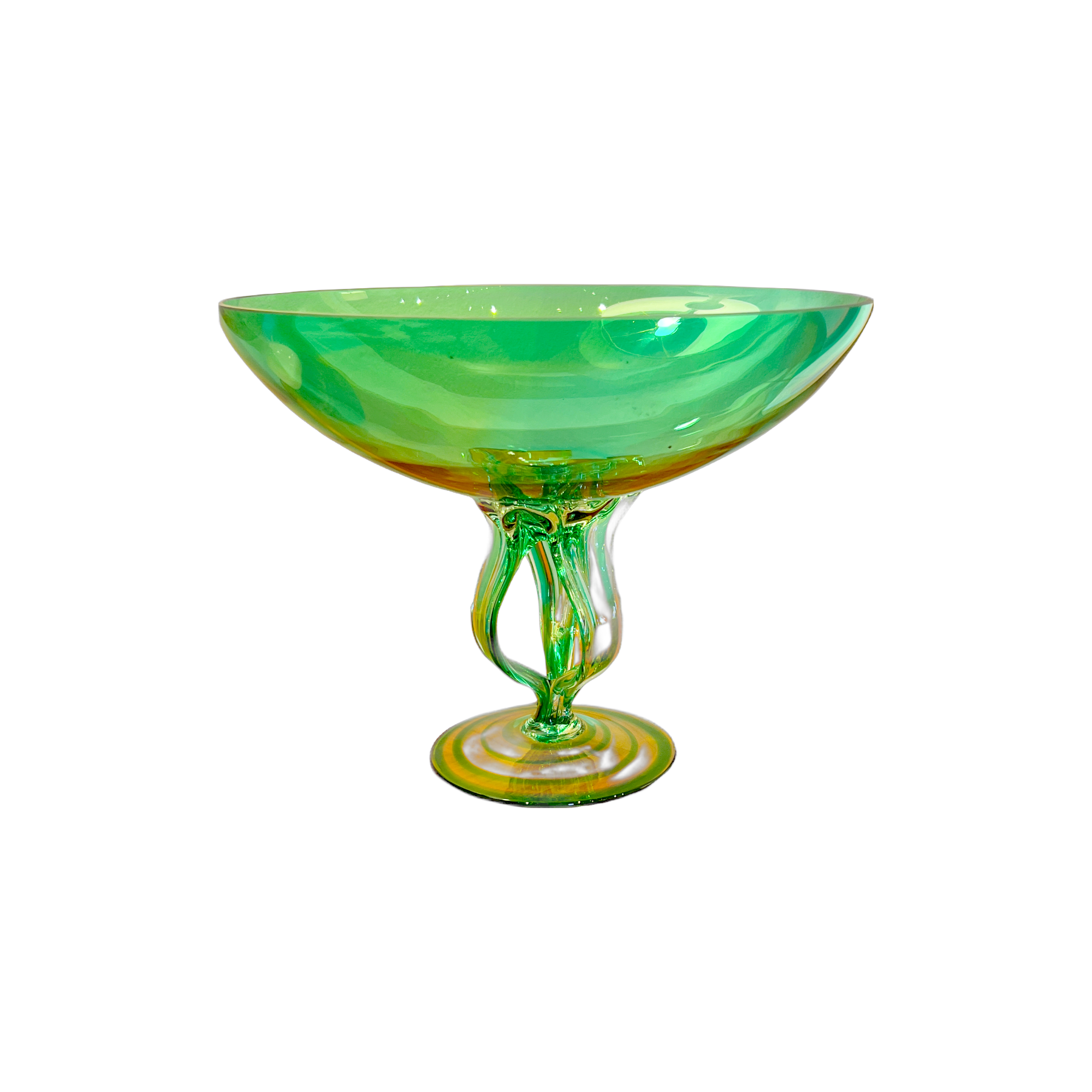
You’ve seen them at estate sales. Usually, they’re tucked away on a dusty bottom shelf or sitting under a pile of cheap floral arrangements at the local thrift shop. They look like fancy fruit bowls, but to a seasoned eye, an antique glass pedestal bowl is a window into the chemistry and social hierarchy of the 19th and early 20th centuries. Most people just walk past them. Big mistake.
Honestly, the "compote"—which is just the fancy French-derived name for these things—used to be the literal centerpiece of high society. If you didn't have one on your sideboard filled with preserved fruits or nuts, you weren't really part of the conversation. But today? People confuse authentic Victorian pieces with 1970s mass-market reproductions. It's frustrating. Let's get into what actually makes these pieces valuable, because it’s rarely about how shiny they are.
The Chemistry of the Glow
Ever heard of "Vaseline glass"? It’s a subset of the antique glass pedestal bowl family that literally glows under a UV light. Why? Because they put uranium in the glass. It sounds terrifying. It’s actually fine. The radiation levels are negligible, but the visual effect is hauntingly beautiful. Between 1880 and the start of WWII, manufacturers like Fenton and Adams & Co. used uranium dioxide to get that specific canary yellow-green hue.
If you find a pedestal bowl that looks slightly oily or yellowish, take it into a dark room with a blacklight. If it lights up like a neon sign, you’ve found something special. But don't expect everything that glows to be a million-dollar find. Manganese glass glows a faint, sickly green too, and that was just a decolorizing agent used in cheaper batches. Real uranium glass is unmistakable. It’s vibrant. It’s weird. It’s exactly what collectors are hunting for right now.
It Isn't Just "Old Glass"
There is a massive difference between Pressed Glass and Cut Glass. Most people can't tell them apart at a glance.
Pressed glass was the "IKEA" of the Victorian era. It was made by pouring molten glass into a metal mold. You can usually tell because there’s a faint seam running up the pedestal or along the side of the bowl. It allowed the middle class to have "fancy" things without the price tag of hand-carved crystal. Companies like Bakewell, Pears & Co. in Pittsburgh perfected this. If you feel the edges of the pattern and they feel rounded or "soft," it’s pressed.
Cut glass is a whole different beast. This is the stuff that can actually cut your finger if you aren't careful. It was hand-blown and then carved using spinning stone wheels. The edges are sharp. The glass is heavy—usually because it has a high lead content. If you tap an antique glass pedestal bowl made of lead crystal, it won't just "thud." It will ring like a bell. A long, sustained ping that lasts for several seconds. If it goes clink, it’s probably just soda-lime glass. Still pretty, but not a masterpiece.
The EAPG Obsession
Early American Pattern Glass (EAPG) is the bread and butter of the American collecting scene. We're talking about the period between 1850 and 1910. This was a time of pure design chaos. There were thousands of patterns—"Dolphin" pedestals, "Moon and Star," "Thousand Eye."
The "Dolphin" compote is probably the most iconic. It’s not actually a dolphin as we know them; it looks more like a grumpy, scaled fish with its tail in the air, holding up the bowl. Sandwich Glass (Boston & Sandwich Glass Company) made some of the most famous versions of these. If you find an authentic 1850s canary yellow dolphin pedestal bowl, you’re looking at hundreds, sometimes thousands of dollars. But watch out. The 1920s and even the 1960s saw a huge wave of reproductions.
How do you tell? Look at the bottom. True antique glass usually has "shelf wear." It’s a series of tiny, random scratches on the base where the bowl has sat on wooden sideboards for 150 years. If the bottom is perfectly smooth and pristine, it’s likely a modern copy. Also, look for "straw marks." These aren't scratches; they are tiny ripples or lines formed when the hot glass cooled too quickly. They look like flaws, but to a collector, they’re a birthmark of authenticity.
Color is a Liar
Color is usually the first thing that draws people to an antique glass pedestal bowl, but it can be deceptive.
- Amethyst: Sometimes this was intentional. Other times, it’s "sun purple." Old glass often contained manganese. When exposed to UV rays (like sitting in a sunny window for 80 years), the manganese reacts and turns the clear glass a soft lavender.
- Carnival Glass: This is that iridescent, oily-looking glass that looks like a puddle of gasoline. It was originally given away as prizes at carnivals (hence the name). Northwood and Fenton were the kings here. The "Marigold" orange color is common, but if you find "Northwood Grape and Cable" in a deep purple or emerald green, that's the jackpot.
- Milk Glass: It looks like porcelain but it's glass. Westmoreland and Imperial Glass made tons of pedestal bowls in this style. Look for the "lace" edge or the "doric" style. If it looks too white—like a piece of plastic—it might be a cheap mid-century piece. Antique milk glass often has a slight translucency at the edges, often called the "fire." When you hold it up to the light, the thin edges might glow with a ghostly blue or orange tint.
The "Bread and Butter" Patterns
If you’re starting out, you’ll see "Moon and Star" everywhere. It was originally called the "Palace" pattern, produced by Adams & Company in the 1880s. It’s chunky. It’s bold. It has deep "craters" that catch the light. It was so popular that Smith Glass and Wright Glass reproduced it for decades.
Then there’s the "Hobnail" pattern. You know the one—it looks like it has little bumps or "nubs" all over it. Fenton made this famous. While a clear hobnail bowl is a dime a dozen, an opalescent hobnail (where the tips of the bumps are a milky white) is much more desirable.
Why Condition Is Everything (And Also Isn't)
In most hobbies, a "chip" is a death sentence for value. In the world of the antique glass pedestal bowl, it’s a bit more nuanced. A "flea bite"—a tiny nick you can feel with your fingernail but barely see—might only drop the value by 10%. But a "heat crack" or a "spider" (a crack that radiates out) usually kills the value for everyone except those who just want a pretty candy dish.
Check the "stem" where the bowl meets the base. This is the weakest point. Since these were often used for heavy fruit or desserts, the torque on that joint was immense. Look for "clamshell" chips at the base. If the piece is rare enough, like a rare Mid-West Pomona glass piece, collectors might overlook a small chip. If it's a common pattern? Pass.
Finding the Good Stuff
Stop looking at the big "Antique Malls" where everything is marked up 400%. The real finds are at estate auctions in small towns. Look for the boxes labeled "Kitchenware" or "Assorted Glass."
Many times, an antique glass pedestal bowl is misidentified as "Depression Glass." While Depression glass is collectible, it’s usually thinner, machine-made, and from a later era (1929–1939). EAPG and Victorian glass have a soul to them. They have bubbles in the glass (seed bubbles). They have slightly uneven rims. They feel "handmade" even if they were pressed into a mold.
Actionable Steps for the Aspiring Collector
If you're ready to start hunting, don't just go out and buy the first shiny thing you see. You'll end up with a cupboard full of 1980s Indiana Glass (which is fine, but it's not an investment).
- Buy a jeweler's loupe and a small UV flashlight. These are your primary weapons. The loupe lets you see "shelf wear" and the UV light identifies uranium or manganese content.
- Feel the weight. Antique lead glass is surprisingly heavy for its size. If it feels light and "tinny," keep walking.
- Search for the pontil mark. On hand-blown pedestal bowls, look at the center of the bowl (inside or on the bottom). A "rough" or "snapped" pontil is a sign of age. A "ground" pontil (a smooth, polished divot) shows high-quality craftsmanship.
- Join the Early American Pattern Glass Society (EAPGS). Their database is the gold standard. You can search by pattern features—like "scalloped edge" or "ribbed stem"—to identify exactly what you have.
- Check the "Ring." Always do the tap test. If you're in a shop, gently tap the rim with your fingernail. A long, musical resonance is a sign of high lead content and quality.
- Avoid "Sick Glass." If the glass looks cloudy or foggy and you can't wash it off, it's "sick." This is a chemical permanent etching caused by minerals or improper storage. There is no easy fix. Unless the piece is incredibly rare, leave it behind.
Collecting glass isn't about filling a shelf. It's about spotting the one piece in a room that was made by a craftsman in a soot-covered factory in 1870, surviving through wars and moves and clumsy dinner guests, just to sit in your dining room today. That's the real appeal of the antique glass pedestal bowl. It's a miracle it didn't break a century ago. Keep it that way.