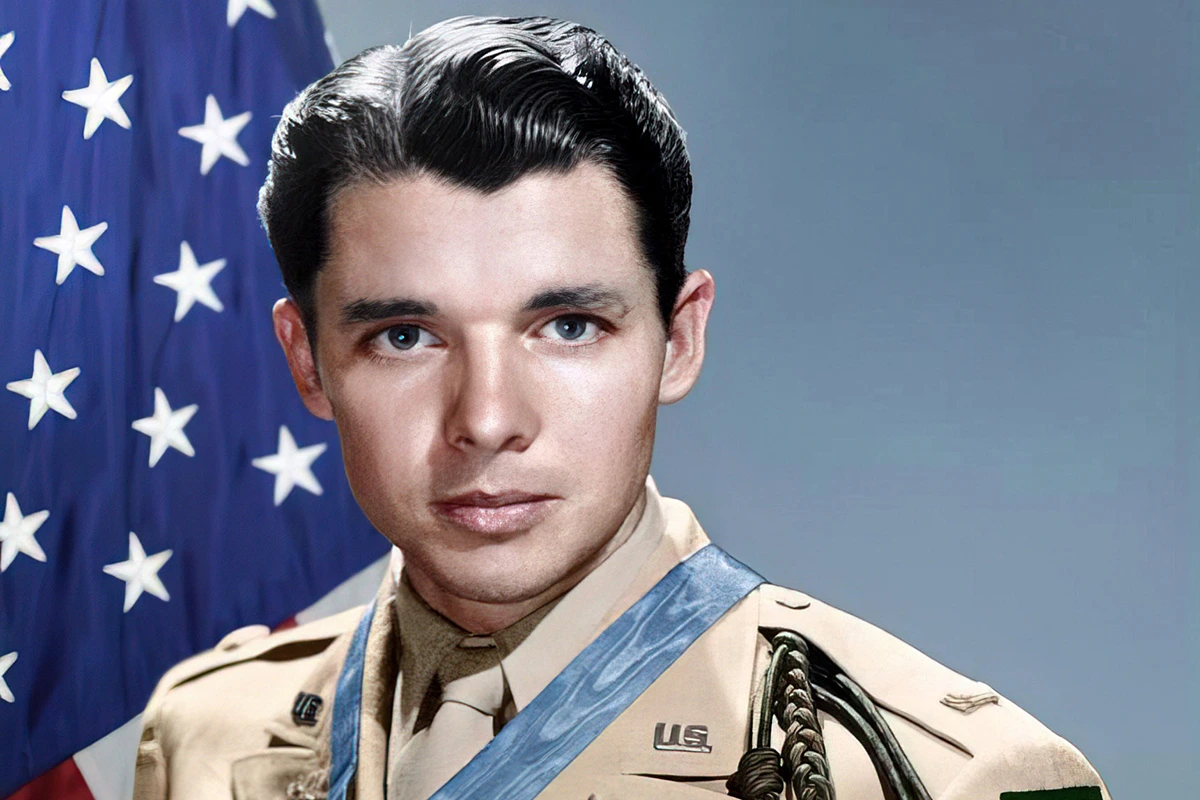
On a fog-choked morning in May 1971, a twin-engine plane carrying the most decorated soldier of World War II vanished into the Virginia timber. It wasn't a blaze of glory like the movies. There were no German Tiger tanks or desperate stands on burning tank destroyers this time. Just a pilot in over his head and a mountain that didn't move. Honestly, the actor Audie Murphy death remains one of the most tragic "what-ifs" in American history, mostly because it was so entirely avoidable.
You've probably seen the grainy footage of Murphy receiving the Medal of Honor, or maybe you caught him playing himself in To Hell and Back. He was the baby-faced hero who shouldn't have survived the war, let alone became a Hollywood star. But on May 28, 1971, his luck finally ran out 2,700 feet up the side of Brush Mountain.
The Final Flight of N601JJ
It started as a routine business trip. Murphy and four associates—Claude Crosby, Kim Dodey, Jack Littleton, and Raymond Prater—boarded an Aero Commander 680E at DeKalb-Peachtree Airport in Atlanta. They were headed to Martinsville, Virginia, to check out a modular home plant.
The pilot, Herman Butler, was experienced on paper. He had over 8,000 hours in the air. But there was a massive, lethal catch: Butler wasn't rated for instrument flight (IFR). He was a visual pilot only.
That basically means he needed to see the ground to know where he was going. When you're flying into the Blue Ridge Mountains during a spring rainstorm, that's a recipe for disaster.
A Timeline of Errors
The flight left Atlanta at 9:10 a.m. By the time they reached southern Virginia, the weather was turning into a literal wall of gray.
- 11:30 a.m.: Witnesses in Galax, Virginia, saw the plane "yo-yoing" in and out of the clouds. It was only 150 feet off the ground.
- The Highway Attempt: Butler actually tried to land the plane on a four-lane highway bypass. He missed or got spooked and pulled back up into the soup.
- 11:49 a.m.: Butler radioed the Roanoke Flight Service Station. He asked for a weather report and said he was coming in to land. He never mentioned he was in trouble. He never sent a Mayday.
- 12:08 p.m.: The Aero Commander slammed into Brush Mountain at high speed.
It was a "controlled flight into terrain." That’s the clinical NTSB way of saying the pilot flew a perfectly good airplane straight into a mountain because he couldn't see where he was. Everyone on board died instantly.
Finding a Legend in the Fog
Because there was no flight plan filed and the weather was miserable, nobody knew exactly where the plane had gone down. It took three days to find the wreckage.
Members of the Civil Air Patrol finally spotted the debris on May 31. The impact was so violent that the aircraft was shattered and burned. Murphy’s body, along with two others, had been thrown uphill from the main cabin. It’s a grim image: the man who survived the Colmar Pocket and the Siegfried Line, lying in the brush of a quiet Virginia forest.
"The Nation stands in his debt, and mourns at his death." — President Richard Nixon, June 1, 1971.
Why the Actor Audie Murphy Death Still Stings
The tragedy wasn't just the loss of life; it was the timing. Murphy was only 45 (though some records say 46 due to his falsified enlistment age). He was struggling financially, dealing with a gambling habit, and wrestling with what we now call PTSD. Back then, they called it "battle fatigue."
He was one of the first celebrities to speak openly about the nightmares and the "jitters." He slept with a loaded pistol under his pillow. He was a man trying to find his footing in a world that didn't have much use for aging war heroes who didn't fit the John Wayne mold.
The Legal Fallout
His family didn't let the matter rest. In 1971, his widow, Pamela Murphy, filed a massive $10 million lawsuit. They targeted the estate of the pilot and the company that owned the plane, Colorado Aviation.
The legal battle dragged on for years. Finally, in 1975, a jury awarded the family $2.5 million. It was a clear statement: the pilot’s decision to fly into "instrument conditions" without the proper training was negligence, plain and simple.
Visiting the Crash Site Today
If you're ever hiking the Appalachian Trail near Roanoke, you can actually visit the spot where it happened. There’s a modest stone monument there, erected by the VFW. It’s about a 0.7-mile trek off the main trail.
It’s a quiet, somber place. People often leave pennies, small flags, or military challenge coins. It feels a world away from the glitz of Hollywood or the mud of the European Theater.
What You Should Know Before You Go
- The Hike: It’s a short but steep spur off the AT. Don't expect a paved path.
- Respect: It’s a grave site, essentially. Keep it clean.
- The Monument: It lists his name and his status as America's most decorated veteran.
The Lessons Left Behind
The actor Audie Murphy death remains a textbook case in aviation safety seminars. It highlights the "get-there-itis" that kills so many private pilots—the internal pressure to complete a trip even when the weather says no.
But more than that, it reminds us of the fragility of heroes. Murphy lived through hell, survived the impossible, and was taken out by a bad weather report and a stubborn pilot.
If you want to honor his legacy, don't just watch his movies. Read up on his advocacy for veterans' mental health. He was fighting for "battle fatigue" research decades before it was fashionable. That was his real final mission.
To pay your respects in person, you can find his grave at Arlington National Cemetery, Section 46. It is famously the second most visited grave in the cemetery, right after John F. Kennedy. Unlike other Medal of Honor recipients, Murphy requested a plain, simple headstone—the kind given to an ordinary soldier. He didn't want the gold leaf. He just wanted to be one of the men.
Actionable Next Steps:
- Read the NTSB Report: If you're a history buff or a pilot, the full 1972 NTSB report on N601JJ provides a fascinating, albeit sobering, look at the technical failures of the flight.
- Visit the Memorial: If you're near New Castle, Virginia, take the hike to Brush Mountain. It offers a perspective on the terrain that no article can capture.
- Support Veterans' Mental Health: Murphy’s true "unfinished business" was the recognition of PTSD. Consider donating to organizations that focus on veteran suicide prevention and mental health support in his name.