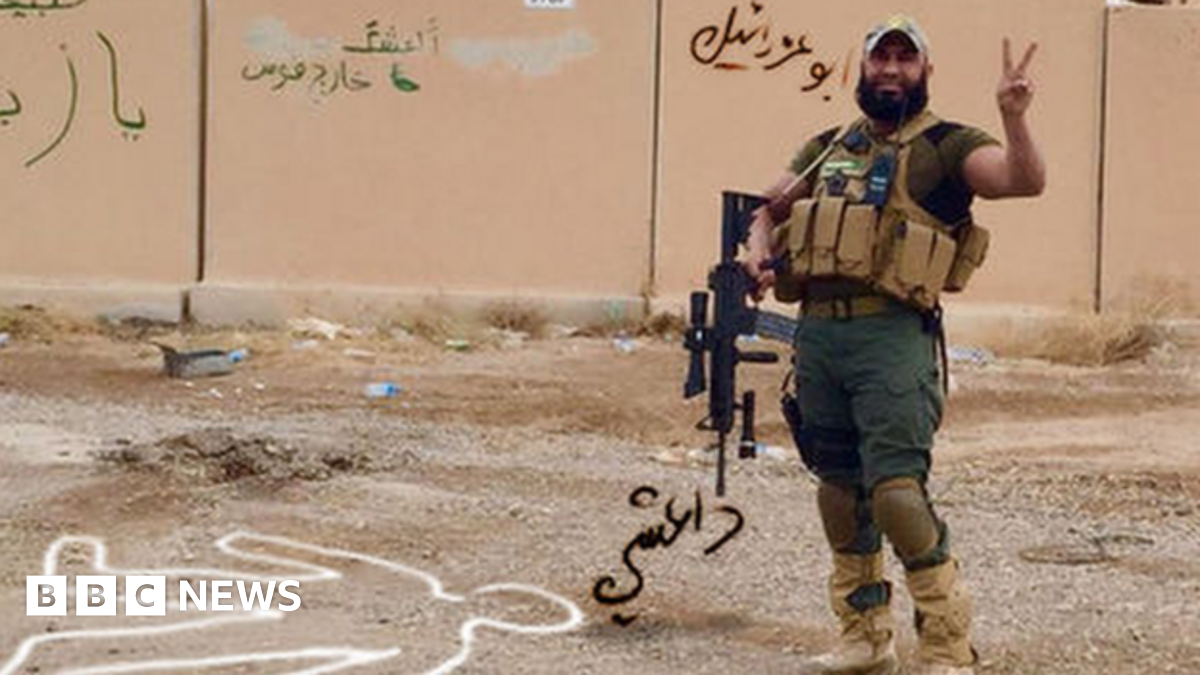
He became a face of the war against ISIS. You probably saw the videos back in 2015. A bald man with a thick black beard, often carrying a massive axe or a heavy machine gun, grinning at the camera while standing amidst the rubble of Tikrit or Fallujah. This was Ayyub Faleh al-Rubaie, better known to the world as Abu Azrael, the Iraqi Angel of Death. He wasn't just a soldier. He was a meme, a folk hero, and a terrifying psychological warfare tool all rolled into one. At the height of the conflict, his face was on billboards and t-shirts across Baghdad. But the story of how a former PE teacher became the most feared commander in the Imam Ali Brigade is a lot messier than the viral clips suggest.
War creates icons. Sometimes those icons are manufactured, and sometimes they just happen because a guy has a knack for social media and a very scary-looking sword.
The Man Behind the Myth
Before he was the Iraqi Angel of Death, Ayyub was reportedly a physical education teacher at a school in Iraq. Think about that for a second. The guy who would eventually be filmed slicing through extremist militants once spent his mornings blowing a whistle and telling kids to do jumping jacks. It’s a wild pivot. But according to various reports from the Associated Press and Agence France-Presse, his military background didn't start with ISIS. He had been part of the Mahdi Army, the militia led by Muqtada al-Sadr that fought against U.S. forces during the occupation of Iraq. He wasn't some rookie who picked up a gun because he was angry; he was a seasoned veteran of sectarian street fighting.
He’s a father of five. Honestly, looking at the photos of him playing with his kids versus the videos of him on the front lines is a masterclass in cognitive dissonance.
Why the "Angel of Death" Moniker?
The name "Abu Azrael" literally translates to "Father of Azrael," with Azrael being the Archangel of Death in Islamic tradition. It’s not a subtle nickname. He earned it through a combination of sheer brutality and a catchphrase that went viral: "Illa Tahin." It means "nothing but flour" or "into dust." Basically, he was telling ISIS that he would grind them into powder. In a time when ISIS was using high-production-value horror videos to demoralize the Iraqi army, Abu Azrael used their own tactics against them. He became the Shia response to the Sunni extremist propaganda machine. He was the boogeyman for the boogeymen.
The Rise of a Social Media Warlord
You’ve got to understand the context of 2014 and 2015. The Iraqi national army had essentially collapsed in Mosul. People were terrified. Then comes this guy. He’s charismatic. He’s funny in a dark, twisted way. He rides a bicycle through a war zone. He mocks his enemies. For a population that felt humiliated by the rapid advance of ISIS, Abu Azrael was a shot of pure adrenaline. He didn't look like a stiff general; he looked like a guy you’d grab a coffee with, assuming you didn't mind the tactical vest and the assault rifle.
The Imam Ali Brigade, which he represented, is a part of the Popular Mobilization Forces (PMF) or Hashd al-Shaabi. This is where things get complicated. While the PMF was crucial in stopping ISIS, they were also heavily backed by Iran. Abu Azrael became a poster boy for Iranian influence in Iraq, whether he intended to be or not. His popularity wasn't just organic; it was amplified by media outlets friendly to the PMF to show that they were the ones doing the "real" fighting.
The Dark Side of the Fame
It wasn't all "heroic" combat footage. If you look deeper into the history of the Iraqi Angel of Death, you’ll find the incidents that made human rights organizations like Human Rights Watch very nervous. In one notorious video, Abu Azrael was filmed standing over the charred body of a suspected ISIS fighter. He used a knife to carve a piece of flesh from the leg, joking about it to the camera. It was gruesome. It was a war crime.
This is the nuance people often miss when they talk about "war heroes" in the Middle East. One side's savior is another side's war criminal. The very brutality that made him a hero to those who feared ISIS was the same brutality that fueled sectarian resentment. When that video surfaced, it forced the PMF leadership to distance themselves from him temporarily. They even issued statements saying his actions didn't represent their official "code of conduct."
War isn't a superhero movie. It's a series of choices made in the worst possible conditions, and sometimes the people we cheer for do things that are objectively stomach-turning.
What Happened to Abu Azrael?
The fame didn't last forever. By 2017, as ISIS was being pushed out of its last strongholds in Iraq, the need for a larger-than-life "Angel of Death" started to fade. The Iraqi government wanted to integrate the militias into the formal military. A guy who does "Illa Tahin" videos and hacks at bodies doesn't really fit into a professionalized army structure. He started to fade from the international headlines.
He didn't just disappear, though. In 2019, during the massive anti-government protests in Baghdad—the Tahrir Square protests—Abu Azrael made an appearance. But the reception was different. The young protesters weren't interested in his war stories. They were angry at the corruption of the political class and the influence of Iranian-backed militias. There is a video from that time showing Abu Azrael being attacked and beaten by protesters. It was a shocking fall from grace. The man who was once the shield of the nation was now seen by some as part of the system that was crushing the people's future.
Where is he now?
As of the last few years, he has mostly stayed out of the direct line of fire, though he occasionally pops up on Telegram or local Iraqi social media channels. He reportedly suffered several injuries over the years, including from shrapnel and gunfire. There were even rumors he contracted COVID-19 and was in serious condition at one point, but like many "warrior" archetypes, he seems to have a knack for survival. He remains a divisive figure: a symbol of resistance to some, and a symbol of unchecked militia power to others.
The Complexity of the Iraqi Conflict
The Iraqi Angel of Death story is basically a microcosm of the last decade in Iraq. It’s about the vacuum of power. It’s about how social media can turn a soldier into a god-like figure in weeks. It’s also about the blurred lines between defending your home and becoming the thing you hate.
If you look at the research by groups like the Carnegie Endowment for International Peace, they point out that the rise of figures like Abu Azrael happened because the formal state failed. When the army fails, the "strongman" fills the gap. People wanted a protector, and he gave them one that looked like a movie character. But the cost of that protection was the normalization of extrajudicial violence.
What We Can Learn From the Legend
So, what’s the takeaway here? Is he a hero? A villain? Honestly, the answer depends entirely on who you ask in Baghdad. To the Yazidis or the Shias who were facing genocide by ISIS, he was a savior. To the Sunnis who lived under the thumb of the militias after ISIS was gone, he was a nightmare.
You can't talk about the Iraqi Angel of Death without talking about the trauma of the country. Iraq has been through a blender. Since 2003, it’s been one conflict after another. In that environment, people don't look for nuanced diplomats; they look for the guy with the axe.
Actionable Insights for Understanding Conflict Propaganda
- Verify the Source: When you see a "viral hero" in a conflict zone, check who is promoting the footage. Is it a state-sponsored channel? A specific political party? Propaganda is often 90% truth and 10% very careful framing.
- Look for the Aftermath: The most telling part of any "war hero's" story isn't the battle; it's what they do when the guns go quiet. How do they treat civilians? How do they act toward their own government?
- Acknowledge Multi-Layered Identities: Figures like Abu Azrael are rarely just one thing. He was a teacher, a father, a militia commander, and a media personality. Realizing that someone can be a loving father and a brutal combatant is key to understanding the human element of war.
- Distinguish Between the PMF and the State: When reading about Iraq, it is vital to distinguish between the Iraqi Security Forces (ISF) and the Popular Mobilization Forces (PMF). They often worked together but had very different command structures and end goals.
The era of Abu Azrael as a global celebrity is over. The "Angel of Death" has mostly retired to the shadows of Iraqi politics and internal militia affairs. But the impact he had on the psyche of the region—and the way he showed the world how war would be fought in the age of the smartphone—is something we’ll be analyzing for decades. He wasn't just a soldier; he was a symptom of a world on fire.
To truly understand modern conflict, you have to look past the "Illa Tahin" memes and see the fractured society that produced them. Iraq is still trying to heal from the scars left by both ISIS and the men who rose up to stop them. It’s a slow process. It’s complicated. And it’s definitely not as simple as a 30-second video on Twitter.
To dive deeper into how militia culture impacts Iraqi governance today, look into the recent reports by the Institute for the Study of War or the International Crisis Group. They provide the political context that explains why figures like Rubaie still hold sway in certain circles. Stay updated on the evolving role of the PMF in the Iraqi parliament, as this is where the real power struggle is happening now.